


Toni Morrison, may she rest in power, was the author of eleven novels and three essay collections as well as the recipient of the Nobel and Pulitzer Prizes. Her distinctive voice and profound storytelling have been incredibly influential in shaping contemporary fiction and literary criticism; it is fruitless to try to describe the extent of her impact.
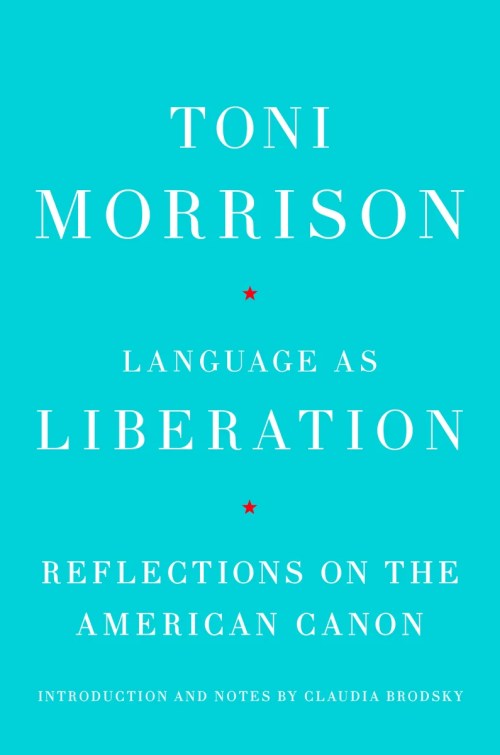
In addition to her career as a writer and editor, Morrison was a Humanities professor at Princeton University for seventeen years. Language as Liberation: Reflections on the American Canon, serves as an archival volume of her teachings, lectures and explorations on and of the American literary canon.
Specifically, Morrison’s notes and lessons focus on interactions between the American canon and race, in particular, an Africanistic one. In Playing In the Dark: Whiteness and the Literary Imagination, Morrison describes Africanism as “a term for the denotative and connotative blackness that African people have come to signify, as well as the entire range of views, assumptions, readings, and misreadings that accompany Eurocentric learning about these people.” She builds off of this term in Language as Liberation and details the construction of race in early American history and its interconnections with American identity. It is through this sequence that the reader comes to understand the reliance American literature has on an Africanistic presence.
Complete with her original syllabus, this book was achieved through the efforts of Morrison’s son, Ford, who felt his mother’s classroom instruction belonged alongside her other writing. Claudia Brosky, Morrison’s colleague, provides a comprehensive introduction, “History and Literature: The Metaphysics of Race in America.” This introduction helps distill Morrison’s course and provide the reader with a foundation to approach Language as Liberation. Additionally, Brosky supplements Morrison’s writing with endnotes, filling in gaps and leading readers to resources, just as Morrison would have done as she actively taught the class.
It is important to note that this book is a compilation of her class notes, her lesson plans. While some sections are quite detailed, others include bullet points, questions, fragments of ideas that Morrison would have used to guide her lessons or lead a discussion. This unpredictable cadence is a reminder that these teachings were embodied, that they were shared and full of vitality, that we are not accessing the course as a student within her class but rather a learner inside her mind. And what a dream it would have been to have had the privilege to be in Morrison’s classroom. This book brings readers closer to that opportunity, a glimpse inside her genius mind and the literary imagination.
Within Language as Liberation, each chapter focuses on a different, canonic American writer and the way their texts interact, manipulate, rely on, disrupt, and reinforce this Africanistic presence. From Edgar Allan Poe and Willa Cather to Gertrude Stein and William Faulkner, Morrison carefully unravels the intricacies of their canonized classics and how each author’s treatment of race is indicative of the formulation of American identity as a whole and its literature.
While readers would benefit most from following along with Morrison’s syllabus and reading the novels and articles in tandem with the course, her writing and wisdom are so poignant and powerful that there is much to be gleaned no matter one’s familiarity with the texts she is analyzing. Full of detailed anecdotes, discussion questions, and page numbers for close reading, this book is ideal for a structured learning setting–whether that is in a classroom or within one’s own mind.
In unpacking the American literary canon, Morrison hones in on its unequivocal whiteness, and, in continuation, the whiteness that has become synonymous with being American. Indeed, when faced with the overwhelmingly white and primarily male American canon, Morrison asks us to consider how those notions of “whiteness” and “maleness” are constructed, their reliance on difference and contrast to have meaning. Thus, Morrison argues, Africanistic characters are often guides or markers to help the reader understand the white characters, much like a foil. She traces this notion through a variety of texts to show how whiteness becomes legible only through its contrast with blackness.
In many ways, Morrison emphasizes how the creation of hierarchy, especially a racialized one, is built, not upon what one is, but what one is not–much like how she states in Playing in the Dark that, “The concept of freedom did not emerge in a vacuum. Nothing highlighted freedom–if it did not in fact create it–like slavery.” Further, she finds American identity to be characterized by four concepts: autonomy, authority, newness and difference, and absolute power and that Africanism served as an ideal background with which to explore these issues. American literature, intrinsically, provides insights into what the American identity is, and Morrison reveals how an Africanistic presence makes self-definition easier, clearer.
Ultimately, Morrison reminds us that liberation can be found in language and that if we take the time to consider how race has been inscribed upon our nation’s literary imagination, we can imagine a better future, a way to alter, reframe, retell those relationships and conceptions.

And, perhaps, there is no better time to unpack and grapple with the racialized roots of American identity.
No better time to acknowledge the ways in which the American literary tradition has responded to and is informed by Africanism and an Africanistic presence.
Indeed, perhaps there is no better time to be transported into the classroom of Toni Morrison.
Nonfiction
Language as Liberation
By Toni Morrison
Knopf
Published February 3, 2026


