


I first met Sarah Bruni some 26 years ago at a party in Iowa City, where we were both undergraduates at the University of Iowa. I don’t recall what we initially talked about, maybe our friends, classes, Los Crudos (a Latino punk band from Chicago), or books. But I definitely made a mental note when she told me she liked to write. I must have said something like: Hell yeah, me too…I think.
When you are young, as we were then, you try things out, you live a number of lives. Some of those lives slip through the cracks of time. Others, improbably, remain. It was only years later, when we both found ourselves as writers and living in New Orleans, whether through happenstance or a compelling need to be closer to Latin America (in spirit and practice) when I recognized that there are some friends in your life who stand like sentinels at every turn. They share the perfect book recommendation right when you need one, offer the greatest pep-talk when a novel has gone sideways, and show up in daily life, again and again, as a comrade. So, it was no surprise to me that Bruni’s masterful and tenacious second novel Mass Mothering, which follows an amateur translator’s discovery of a slim book of testimonials of grieving mothers, inhabits, like Rosario Castellanos and Meridel LeSueur before her, a deep reverence for humanity, intimacy, and radical care.
In some ways, the conversation we had for this interview about Latin American literature, imperialism, resistance, and travel is one we’ve joyfully had for years, so, of course, I jumped at the chance to continue it here in celebration of Bruni’s new book.

Michael Zapata
While reading Mass Mothering, I was simply awestruck with how much the novel is in communication with the great literary genres and traditions of Latin America, ones like crónica that utilize journalistic inquiry, unstable truths (especially in the face of political and capitalist corruption), and testimonials. I felt as if you were both drawing from a deep Latin American well and gracefully suggesting a way forward for English language novels. How did you find yourself traversing both continents in your work and in your life?
Sarah Bruni
Ah, this is such a great, generous question. I can say that this novel was written on the heels of a kind of re-education from getting lost in Latin American literature. I spent some time in Montevideo, Uruguay, in my 20s, and I learned Spanish there, and I kept finding myself in the part of town with many used bookshops and just walking away with whatever the booksellers put in my hands. When I started reading literature in Spanish, I had to read excruciatingly slowly.But I found the practice to be totally exhilarating, perhaps because my experience couldn’t be diluted by everything I had studied in English in terms of craft. Of course, as my language skills slowly caught up with me, I realized there were all kinds of incredible things going on narratively that I just didn’t see happening in the US literature I had grown up with. First, that plot felt like a much looser, secondary thing, so the form had liberty to be more playful. And also that much of the literature I encountered did not exist in a vacuum independent of social and political issues, that critiques of things like inequality and imperialism existed in narrative worlds without feeling didactic.
I was living in New York after Montevideo, working a bevy of odd jobs while trying to finish my first novel, but I felt like I had this itch buried under my skin, and what I really wanted to be doing was just finding time to read in Spanish. I ended up in a graduate program in Latin American Studies at Tulane in New Orleans (a city where I was incidentally very happy to cross paths with you too!), and there, I had the tremendous privilege both to find grants to get me back to spend time in Latin America (first to Uruguay, and later to Colombia) and also to take classes where we read and talked about narrative genres like crónica and testimonio. My exposure to these traditions, and the gift to spend more unstructured time moving between the US and Latin America deeply informed how I was thinking about both the instability of narrative truths, and the layered, complex transnational flows—of people, texts, objects, stories—from one part of the world to another.
Michael Zapata
I was beyond ecstatic that our lives crossed paths again in New Orleans! There are few things in life and nothing else in the United States like Super Sunday, Mardi Gras morning, or the slow sun over the Mississippi River. Perhaps we were attempting to flee the imperial core? In the West, we are often sold the notion of things like investigating other cultures or artistic pilgrimages, but your experiences are much more profound than that. They are a type of becoming, of the self, of language, of political narrative set outside the imperial core or in deep recognition of it. I especially love this concept of “transnational flows.” In Mass Mothering, the testimonials of mothers grieving their lost boys become, at once, transnational texts. What led you first to testimonial?
Sarah Bruni
Oh yes, and as you know, New Orleans itself happens to be a great teacher in terms of submitting oneself to a kind of culture of participation that works against what you’re calling “the imperial core.” You’re just walking down the street, or whatever, and suddenly you’re inside the parade or the second line, and you don’t have much of a choice but to surrender yourself to dancing. This was a revelation to me, to not need some kind of journalistic excuse or proof of belonging to participate in the thing that was already happening around me. Even as an outsider, and obviously with respect for the things you just can’t understand, the power of living in a place where you are invited to be a part of spontaneous acts of celebration and communion can’t be overstated.
Regarding testimonial narratives, I guess the short answer is that I started by reading testimonies of the military dictatorships in Uruguay and the Southern Cone. Later, when I spent time in Medellín, testimony seemed present everywhere, in different types of grassroots, artistic, and even municipal efforts to use storytelling as a vehicle for reconciliation of the armed conflict. When people narrated their own stories, they often did so in a way that eschewed drama despite the potentially horrific content. They also tended to keep centering the most salient details of collective experience, rather than those elements that made their stories unique. I realized early on that if my novel was going to include descriptions of political violence, I wanted the narration to somehow reference and honor these features of the testimonial, particularly because the settings of my novel are deliberately undefined. My exposure to these traditions is inseparable from these experiences, yet it felt important not to ascribe a geographical location to the novel, in part because I didn’t want to invite the reader to make assumptions about the kinds of places where certain types of tragedies occur, or even the sort of story this would be.
Michael Zapata
The stories of Southern Cone military dictatorships are the ones I grew up with in Chicago, too. Dinner table testimonials of a sort told by family and family friends from Ecuador, Mexico, Chile, and Brazil. Of course, the United States involvement often came up. It goes without saying, especially here in Chicago where ICE increasingly resembles and behaves like those occupying forces in Iraq from two decades earlier, that we are currently under similar conditions. And, yet, like in the Southern Cone, a deep sense of care and protection for each other has materialized in our neighborhoods. In your novel, A. is a caregiver for a boy and the mothers care for each other. You beautifully write: “Typical protocol is that they take turns mothering whoever is at her weakest.” Can you talk a bit about care and solidarity?

Sarah Bruni
Care works in direct opposition to abuses of power designed to divide people. As we’ve seen this past year in Chicago, and now in Minnesota, communities show up for those most in need when they refuse to stop seeing one another as human. It’s been moving to witness these acts of solidarity—whether it’s walking someone else’s kids to school, blowing whistles in the street, mutual aid—people contributing in the ways they can, to show up for our neighbors persecuted by ICE brutality. When I started writing the book, I was thinking a lot about my own discomfort with my country’s violent intervention around the world, and I was inspired by examples of different models of community resistance. I also wasn’t sure whether I would have my own children, and I was drawn to portraits of caretaking in the absence of that relationship. The beautiful thing about mothering—and how I landed on that word in particular—is one doesn’t have to be a mother, nor a child the beneficiary of the act, to practice it. It’s a form of care that can be just as fierce but operates independent of family bond or biological connection.
Michael Zapata
I’ve never been more aware of that village than when I taught high school in Humboldt Park in Chicago. That fierce act of care. You’ve had such rich experiences as a reader, writer, and world traveler. This is where I’m supposed to ask you if you have any advice for writers, but let’s take a more adventurous turn for the moment. What advice would you give anyone seeking to travel the globe?
Sarah Bruni
I feel like my advice for writers and travelers is actually almost the same: read in translation and keep your overhead as low as possible. I don’t even know if I would necessarily characterize my own experiences as travel so much as temporarily relocating to places to try to tap into some alternate version of daily life there. In my own case, I was only able to do that because for a long time, I took freelance editing gigs that I could do from anywhere, or teaching jobs with summers off, and I lived in a lot of austere, shared spaces with others of similar mindsets. In the case of Montevideo, I put the flight on a credit card, moved into a hostel for a few weeks until I found a room to rent with Uruguayan architecture students. I guess my advice would be that if you have the means and the tolerance for this sort of thing, welcoming the initial discomfort of trying to navigate a place you fundamentally don’t understand on some level can be enormously enriching as a person and as an artist. I recognize, of course, that the choice to pursue this sort of transience is a privilege not available to everyone. Thankfully, there is so much great translated literature out there to help transport us to versions of life we couldn’t otherwise access.
FICTION
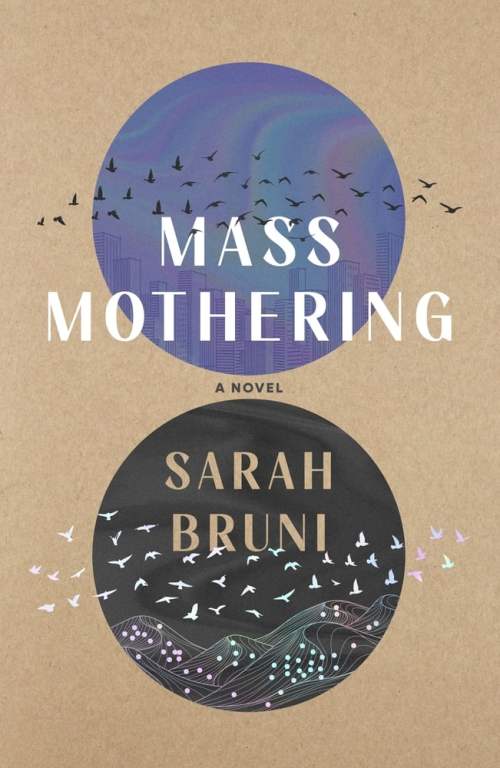
Mass Mothering
By Sarah Bruni
Henry Holt and Co.
Published February 3, 2026


