


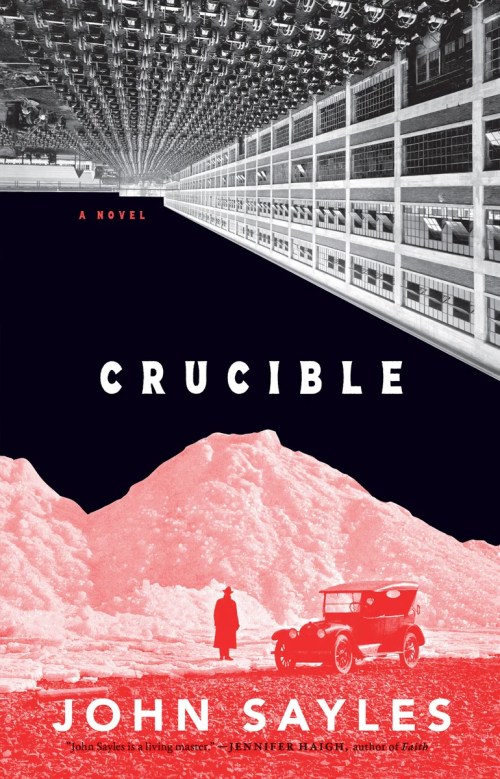
In his new novel Crucible, the acclaimed author and independent filmmaker John Sayles uses a graceful device to mark the passage of time in a novel that chronicles fifteen tumultuous years in mostly Depression-era Detroit in a multi-threaded, character-rich narrative. At various intervals he inserts advertising copy heralding each year’s new Ford automobile.
Make no mistake: Crucible is not a novel about cars, car-making, or the fortunes of the Ford Motor Company. But it is very much about the pervasive culture of Fordism and the monstrously outsized impact the so-called “People’s Tycoon” Henry Ford had on the lives of people in Detroit, whether they worked for him or not. Crucible captures the Ford Motor Company’s invasive social engineering that was as relentless as the 24/7 operations at its mammoth River Rouge plant and the rigid anti-unionism enforced through Ford’s ICE-like private army. The book also features a rich and memorable cast of characters both imagined and real, famous and forgotten, and intimately captured in innumerable vivid vignettes.
Crucible opens with the introduction of the Model A in the heyday of Prohibition in 1927 and roars on through the Depression era’s mounting labor wars, from 1937’s brutal Battle of the Overpass to the tide-turning Rouge workers’ strike of 1941. It hurtles with ominous inevitability towards the 1943 race riot that tore the motor city apart.
Far from Detroit, Sayles also unspools a surreal parallel narrative of Ford’s disastrous attempt to establish a rubber-making colony in the Brazilian Amazon called Fordlandia, a quagmire into which the Chief’s ill-prepared emissaries sink deeper and deeper as the story progresses.
In this interview, Sayles and I discuss what drew him to Detroit and Fordlandia, what made Ford an inheritor of sorts to the robber barons who dominated American industrial life in the preceding century, and where we see parallels to Fordism and its discontents and depredations in today’s corrosive plutocracy.

Steve Nathans-Kelly
One thing that always interests me is how writers get from one project to the next. With To Save the Man you were in Carlisle, Pennsylvania exploring the horrors of Native American boarding schools. What brought you to the Ford River Rouge plant and labor and racial strife in Detroit in the 1930s?
John Sayles
I spent some time in Detroit when I covered the 1980 Republican National Convention, which was the one that nominated Ronald Reagan, at the Joe Louis Center in Detroit. When I got there, it was in bad shape. A lot of houses had been burned down. Only a third of the houses were still up from when it had been this incredible center of industry. At the convention, half the delegates were being housed over the bridge in Windsor, Canada. The Republicans didn’t want them to see the conditions in Detroit, so they put cardboard over the windows of the buses that they brought them in on. And just thinking about how this incredible manufacturing center and major U.S. city got to this point, I got interested in Detroit. From the research I did, it was a crucible—a crucible being not just a thing that you melt metal together in, but also just any place where different elements come together and there are big reactions to it.
I started to learn about how Detroit had been a center of activity during Prohibition because all the good stuff—the real liquor—came across the border from Canada there before it went to Chicago and other places. It was also a place where the races came together, because Henry Ford said, “I’m paying a couple dollars a day, black or white.” And the jobs aren’t just janitor jobs. If you’re on the line, you get paid what everybody on the line does and immigrants from all over the world were coming there as well. So I got interested in it as the idea of it being a crucible for all these big forces in America.
Steve Nathans-Kelly
Ford’s massive failed rubber plantation in Brazil also plays a significant role in the story. How did that become part of Crucible, which is otherwise a Detroit-centric book?
John Sayles
[In 2009], Greg Grandin’s book, Fordlandia, came out, and some producers wanted to see if they could make that into a miniseries, and I helped pitch it to them. And that seemed like the last bit of the story that would make a good novel because in its way, it was this shadow world. It’s kind of like Henry Ford’s Vietnam. He poured money into it and he never got anything back but trouble. It’s an extension of his thinking. At one point he said, “Well, so what if the rubber isn’t working out? It’s all about the model community.”
I started working on this before Elon Musk got into politics in a big way, but he’s a good example of that kind of person who’s very good at what they do, they make a lot of money, and then they decide that they know how the whole world should live, how people should run their lives. They’ve got the formula for a perfect society. And I felt like the Fordlandia experiment was kind of his ego gone to another place where, even though he never showed up there, he feels like he can control things like he was trying to control things in Detroit. Not totally successfully, although he had a huge influence on the place and kind of ran the town for a long time. He finally failed in controlling Detroit.
Steve Nathans-Kelly
It seems like Fordlandia happened at an odd point in his life, because he was so lackluster about it. In earlier years in Detroit, he was not a hands-off social engineer with the people that worked at the plant with the Ford Sociological Department. After promising an unprecedented profit-sharing plan to everyone working the line, he said, “You don’t get your $5 a day unless you let my investigators monitor your life and tell you how to live it.” But it seems like Fordlandia happened at a point when he was already more into building his museum at Greenfield Village. Why do you think he ended up being so hands off with that project?
John Sayles
Originally he didn’t think he would be that hands off. I think he thought, “This is going to be big for us. The Brits and the French or whoever are going to try corner the rubber market and they’re going to stick it to me, so we’re going to have our own rubber.” So he starts it in ’27, which is also right when he was pulled kicking and screaming into a world where he wasn’t the only game in town, where the Model T wasn’t the only car, partly by his son, Edsel. And I think he never forgave him for it.
It takes a while to grow rubber trees. Even Ford knew that despite not knowing. So I think it really was one of these things where he started it and then—again, like Vietnam—he couldn’t say, “Oh, that was stupid. Let’s get out.” He just kept doubling down, which people do.
He was kind of the last of the robber barons on that scale. He was not as much of a robber as [his 19th-Century predecessors], but he owned that company, which was very rare. Even in 1927, the world was starting to get more corporate and Ford really didn’t go corporate until many years after his death. The Ford family still owned that business. That was interesting too, for one man to have that kind of power that late in the game, so that even during World War II, there are people from the State Department showing up at Edsel’s funeral and taking Ford’s grandson [Henry II] aside and saying, “We’re going to nationalize the Ford Motor Company unless you are willing to take over and get rid of Harry Bennett and put your grandfather in his place.”
Steve Nathans-Kelly
In Crucible, Henry Ford is kind of a spectral figure. His fingerprints are on everything in the book from Inkster to Fordlandia, but he’s a minor character in the narrative. One of the few scenes where we see him in a prolonged interaction with someone is with Diego Rivera at Greenfield Village, when Rivera is in Detroit to paint his murals of the Ford plant. It’s hard to imagine the nativist tycoon Ford and the Mexican communist Rivera in the same room. Did this encounter actually happen or was this something that you imagined?
John Sayles
Rivera came to the museum, which was kind of Ford’s dream project at that point, and Ford could see him from his house. He said, “Who’s that fat guy who’s been there all day?” Nobody was coming [to Greenfield Village] at first. It wasn’t as popular as it became in the first few years. And so somebody went over and said, “Excuse me, who are you?” And he said, “I’m Diego Rivera, and I’m here to do this mural for Edsel Ford,” who was financing it. The word came back to Henry that Rivera was fascinated by the plant, and Ford said, “Well, I’d like to talk to that fella.” And they actually had a very good lunch.
Diego Rivera loved machines and loved the look of them, especially in that era. They weren’t computerized or inside something; you could see the works. And also, being a good communist—or trying to be a good communist, because at that point he’d been kicked out of the party for taking too many commissions from rich people—he thought, “This is going to liberate humans. This is going to be the answer. The machines are going to mean that everybody has to work only half a week, and then the rest of the time they can do wonderful things and have a lot of fun.”
And so there was nothing about the Ford factory that he could see with his eye that he didn’t think was really cool. And then when he started explaining how he did his murals, Henry Ford realized, “Oh, he’s a tinkerer like I am. He doesn’t have these things full blown in his head. He starts working them out and there’s a process to it and he’s got assistants and it’s actually kind of an interesting process. You put this stuff on the wall and you score it so the paint will hold onto it and there’s two or three layers.”
So they actually had a lot in common.
Steve Nathans-Kelly
My favorite character in the book is Rosa. She’s a non-observant Jew who listens to Father Coughlin with her immigrant father, she’s politically engaged and active in the labor struggle, and she’s a member of the Young Communist League who refuses to toe the party line. She’s also fascinated by baseball, fearless, and fairly sexually liberated. Was there a historical model for her character?
John Sayles
Yeah, a lot of them. For instance, I’ve written [a screenplay] about the Rosenbergs. I got to meet the Meeropol brothers who were the sons of Julius and Ethel Rosenberg, and their parents were of a certain faction, but their antagonism for other factions on the Left was almost as bad as their antagonism toward the right wing. And so she’s kind of drifting. She’s a young communist, she’s very pro-labor. Later in her life, she would think the Reuther brothers [leading the United Auto Workers] had become very conservative. Even though they do some stuff for civil rights, they back Hubert Humphrey, for instance. She would be somebody who could never be that centrist, but she’s still figuring it out. She gets kind of MeToo’d by her own party because she’s not Stalinist enough for them. She asks too many questions. And when it gets very doctrinaire, she kind of jumps off the train.
But she has this affair with this worker who’s as racist as anybody else in Detroit. So I just thought she was an interesting character to be caught up in all of that stuff and active rather than inactive. The leftist parties all really supported the UAW at the beginning. And then in the early ’50s, the UAW had this purge and the Reuther brothers kicked out a lot of their old friends and certainly a lot of their old supporters because during the McCarthy era, it was pretty much, “We’re going to let you have your union as long as you get the Reds out.” And the Reds were often the most progressive [people in the union], the most likely to have a strike. It was also a control thing: “We’ve got to get rid of those people because they’ve got an agenda that goes way beyond ours.”
Steve Nathans-Kelly
Another character who stands out is the head of Ford’s internal security force, Harry Bennett. He’s the most notorious figure in Ford’s circle, but he’s also one of the most colorful characters in the book.

John Sayles
Bennett certainly was the most entertaining of the real people characters to read about. He just was one of these pugnacious little guys who decided, “I’m going to be a son of a bitch for Henry Ford.” He had a 007 [license] from Henry Ford, who hired him because he saw him in a fist fight and thought he had a lot of guts. Henry Ford used him to do the things that he didn’t want to do personally.
Basically, Ford thought, “Well, this is part of running the machinery. If we need another turbine, we get another turbine. But we need these guys to keep people in line because they’re human beings. They’re not machine parts.”
Steve Nathans-Kelly
I know you’ve been writing novels since the 1970s, although until recently I was much more familiar with your films than with your novels. A lot of Crucible is very dialogue-driven and very visual and cinematic, and so is To Save the Man, which I understand did start life as a screenplay. When you start a writing project, how do you know if it’s a novel or a movie?
John Sayles
Usually I write it in the form that I think of it first. Certainly with movies, the visual part of it—“this would be cool to see”—is an important part of it. To Save the Man and A Moment in the Sun, started as a screenplay and became a novel because of my failure to raise the money. So then they may sit for ten years or something and then I’ll say, “I really like that story. Is there a possibility of making that into a book?” And then they tend to expand as I go further into the characters.
So for instance, in the screenplay for To Save the Man, I didn’t go to Wounded Knee [as I do in the book]. You get a letter from one of the characters who’s left school and gone back there, and that’s all you hear about it, and the kids read about it in the paper. And another reason I didn’t go to Wounded Knee in the screenplay was it would make the movie not just longer, but more expensive. So as an independent filmmaker, you have to think about that too.
But to me, the biggest difference is that [when you’re writing] a novel, you’re God. If you want the sun to shine, the sun is shining, and you don’t have to worry about, “Are we not going to show the soldier’s feet because the costumer can only afford so many boots?”
But when you’re making a movie, you also have all these other people who have the costumes and makeup and the actors’ interpretations—you’ve got all this help to make something that you hope is greater than the screenplay itself.
So, even if I control the writing, directing, and editing, the collaborative nature of movies makes it a very different animal for me than writing a novel.
FICTION
by John Sayles
Melville House
Published on January 20, 2026


