


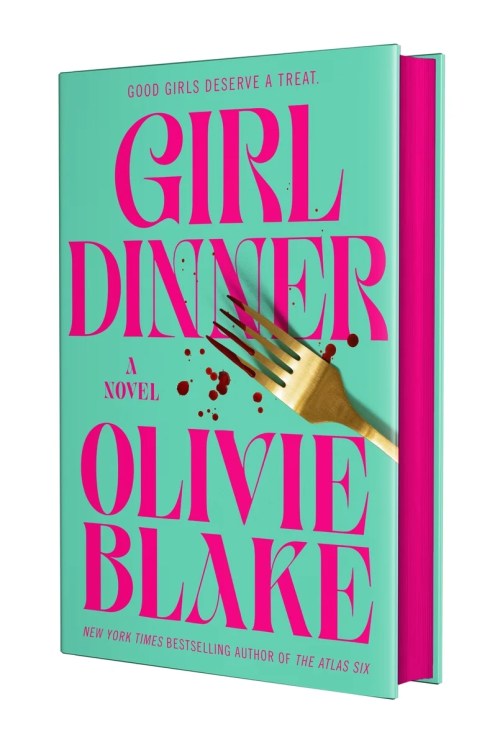
What makes a good woman? It’s the question at the meaty center of Girl Dinner. It’s also what Dr. Sloane Hartley explores when she is appointed as faculty advisor at The University for the ubiquitous House. Her husband, Max, a philosophy professor who flirts with his students, is a constant frustration in her life. Having sacrificed her tenure-track job for Max’s career, Sloane is struggling with her new adjunct position and consumed by caring for their infant daughter, Isla, until she meets The Women of The House. The alumnae who, amongst glossy hair and perfectly tailored clothes, also parent their perfectly behaved children with Montessori toys and progressive development. And through a burgeoning friendship with The House’s alumnae chair, Alex, her fascination with The House grows.
For rush recruit Nina Kaur, a rare sophomore recruit, The House shines as a beacon of safety, with its security of sisterhood and future-proof networking among prestigious, successful alumnae—anything less than extraordinary is the exception, not the rule (at least, these are Alex’s feelings toward recent graduate Caroline). The Greek letters offer, as many who have rushed sought, a sense of sisterhood that comes with domestic living quarters, nurturing a desire to be chosen.
Nina’s ambition to enter The House, to become a lawyer, is entangled with her present infatuation with the current President or Lady Superior, a junior student named Fawn. Nina and Fawn explore queerness behind closed doors, in Fawn’s bedroom, the invite event bathroom, and the complexities of their desire play out. Nina is attracted to Fawn’s certainty, and Fawn to the larger game being played. Nina’s desires tie Fawn to the breath of The House, and her whims and desires, ultimately blinding her to the metaphorical and physical question of what’s at stake.
Form is played within the wraparound structure of invoking the character of The Country Wife, visible on screen to Sloane, who is peppered with videos of traditional homemaking and values, perfectly curated in quotations. While for the alumnae chair, Alex, the graduate behind the Country Wife, Caroline serves as a dark stain on The House’s reputation, but not for reasons on the surface, but rather a darker invocation similar to Lady Macbeth’s incessant washing of her hands—but a little more mad. These quips are integrated into textual soundbites to transition between the novel’s five-part sections.
The novel’s pacing mirrors the sorority cycle, with each part covering recruitment, education, initiation, invitation, and dinner. Girl Dinner begins by aromatically transporting the reader into the lives of Nina and Sloane, who are settling into life at The University. The Country Wife, an influencer-adjacent character and alumna of The House, serves as a point of conflict between The House’s current administration and its members. She harbors secrets under the guise of a homemaker influencer, and her embrace of a traditional role and disregard for algorithmic placement worries Alex and excites Fawn.
As a reader, the novel’s shape is similar to a menu, which is not intended to evoke a cliché about the title but instead exists in an exciting conversation between the body and the sorority rush process. The five partitioned sections: recruitment, education, initiation, invitation, and dinner mirror the psychological process of Sloane and Nina entering the fold. Thematically, one begins to wonder as the house’s standards become the norm for these young women—what really is being eaten away. The reader wants to know: what about The House makes the women so glossy? What secrets, like the fountain of youth, are they hiding? Similar to the campus novel of Mona Awad’s Bunny or the selection into the secret society of Lethe in Leigh Bardugo’s Ninth House, Girl Dinner flirts with the uncanny, centered around their society’s criteria for choosing its members: does their selection make them special, or does access to this secret space make them special?
The course-like structure often left me yearning for a faster pace around the third section—for Sloane and Nina, their curiosity about what fuels this anomalous amalgamation of successful women propels the novel forward as their psychological obsession transforms into physical relationships. However, arguably, once this secret comes to light, the greater ramifications, or rather, so what, no longer revolve around elusion, but instead around actions that seem siphoned into the enclosure of campus life.
In the novel, characters are overwhelmed by a sense of knowing, from top to bottom, that you own what you created. For Nina, this extends to bodily autonomy, coping with the trauma of engaging in the intellect of her desirability, pushing her philosophy professor to reveal his true character, skin bared—a la Emperor’s New Clothes—and, of course, owning her selection to The House. For Sloane, this mine-ness, once focused on her work, also extends to her daughter—how in this world full of inherited systems can her daughter, who already struggles to get the nutrients she needs to survive, actually thrive? She, too, needs the advantages of The House.
In the end, hunger satiated physically through the rush and initiation rituals serves as a larger metaphor for positioning in society and for taking back the luminous qualities drained by both The Substance’s metaphor of pitting women against each other and the dark, ironic argument of the affable men who tap into their conflicts.
FICTION

By Olivie Blake
Tor Books
Published October 21, 2025


