


I met Diana Xin a few months ago when we were both fellows in Get the Word Out, a publicity incubator program by Poets & Writers. She mentioned one story (“Someone Else”) in her debut collection, Book of Exemplary Women, is set in Chicago (Andersonville, to be exact), and I was eager to check out the book. Upon reading the first page of the first story, “Here’s the Church, Here’s the Steeple,” I fell in love with Xin’s witty and memorable prose.
The well-crafted stories in this collection are wide ranging, with many grounded in contemporary realism while others deal with fantastical creatures such as ghosts. On the surface, the range of such stories don’t seem as though they’d complement each other, but in Xin’s deft hands they are stronger side by side. Whether it’s a story about a woman in China getting pregnant by her married lover whose wife is in the U.S. (“Sweet Scoundrel”) or one about an honor roll student going to prom with a vampire predator (“Dear Vlad”), the stories that make up this collection all feature strong female protagonists who have desires. Book of Exemplary Women is an exemplary collection examining regret, desire, sex, death, and belief with a depth of curation that belies the fact it’s a debut.

Rachel León
This collection is so rich and brilliant, I almost don’t know where to start! But let’s begin with the mix of stories because it’s so unique. I found the juxtapositions both fascinating and effective with ghosts alongside realism— it somehow made the supernatural aspects more convincing. I’m wondering if you had any trepidation that these stories could work together? Or did you instinctually know that even if they might not seem like they’d blend well, they’d actually be stronger together?
Diana Xin
Thank you so much! I absolutely worried about whether the collection would hold together. Short story collections face a tough market and it seems like agents prefer there to be a strong unifying theme—there are beautiful collections of stories that offer a kaleidoscopic view of a specific place, person, or community. My focus felt much too scattered at times, but I think there are some “first album” subjects I keep returning to, mainly sex and death. What I noticed is that after exploring a certain theme and following an idea through a realist story, it would come up again in another piece, often a more playful one. I suppose there were certain ideas that would stick with me, stories I couldn’t quite finish so I continued them in different ways. My hope was that those echoes and refractions would carry throughout the book.
Rachel León
They really do. I felt the varying degrees of realism helped strengthen the themes: Sex and death, as you mentioned, but also art, creation, and faith. And there is something really compelling about the exploration of these themes together—the tension between creation and death or sex and faith inspires a deeper exploration of the themes.
I also want to come back to that phrase you used—“first album” subjects–because there is a real breadth to these topics that I suspect could be explored over and over in multiple albums (or books) and still have new insights popping up. Do you think you’ll continue to explore these things in your work?
Diana Xin
Probably, but near the end of working on these stories (or I suppose, in the last few years of editing and organizing the stories), I also grew tired of some of the topics. No more cancer, I decided. My mother survived two different types of gastric cancers over the decades I spent working on these stories, and I was pretty over cancer as a plot point. The “first album” idea certainly applies though because I do feel like the whole collection connects me to younger versions of myself, from mid-twenties to college undergrad, perhaps even further back for some of the initial seeds of scenes and stories.
I’ve also worked on a lot of other stories on the side that weren’t a part of the collection. I’ve even written stories about men! Or, you know, men as the protagonists. Other stories didn’t make it into the collection because the voice was too caustic and didn’t feel right. As I consider other works in progress right now, I’ve been drawn to more friendship stories versus mother-daughter or family stories. I also want to write about our natural world, wildness and untameability, wonder and community in the midst of catastrophe. I guess there are ways my interests have grown and diverged that aren’t reflected so much in this particular book, but I hope there will be another one, and that it might take a little less time to write.
Rachel León
How long did it take to write? When did you know the stories you were writing were a book?
Diana Xin
It’s hard to quantify exactly, but probably around two decades or so. There are a few stories I started working on in my undergraduate program at Northwestern, and one that I was actually able to publish during that time in Alaska Quarterly Review, thanks to the support of my professor. I didn’t publish another story until after grad school. Most pieces took several drafts to write. I’d work pretty intensively on one draft and then send it out or let it sit, sometimes for years. “Sweet Scoundrel” and “Joy Comes in the Morning” are the two longer stories in the collection. They both came out around the same time in 2020, but I started working on them in 2011 and 2012, when I was teaching in Beijing and then returning to the U.S. It’s strange how I still think of them as somewhat paired. When I started grad school shortly after [returning to the U.S.], I think I had a good stash of messy drafts. I started pulling these together for the required graduate thesis.
Going back to that early pub—this was “The Magnificent Funerals of Grand Auntie Du,” the first ghost story—I knew I wanted to add to this piece with other ghost stories, featuring the same characters, but those other two pieces didn’t come until much later. The third ghost story was particularly difficult, because there is some pressure that builds from the two preceding stories. I wrote several very different drafts for that third piece. It felt really necessary for closing the collection and making it feel whole. I was still working on it and changing things quite a bit even after the book was under contract with YesYes. KMA generously considered different versions of it through the editing process.
Rachel León
I find it weirdly heartening it took so long because this collection is so brilliant and fully realized! As someone who wants to do everything quickly, I appreciate the reminder that [good] art takes time. I’d love to hear about the editing process, especially as you alluded earlier, that much time passing, a lot happened, and I assume you changed. What was it like revisiting older work with where you’re at now, both as a person and a writer?
Diana Xin
Hmm, yeah. During the drafting phases, I moved between different pieces as I desired—sometimes because a voice was clearer or a certain detail emerged, or because of some external factor like a submission deadline. When the editorial process started with my publisher, there were definitely a few pieces I dreaded revisiting. I very much considered them done, but KMA would point out certain unevennesses or push for new endings. Stepping back into “Someone Else” was very much like stepping back into my own haunted house. There was a lot to take apart and reconstruct to find the heart of the story again. “Camp Wishsong” was another one that had gone through a few different iterations. I was never sure I got it right, but I was hesitant to revisit it. The last revision actually brought me closer to the very first draft of it, which kind of came in a dream (a rare circumstance for me). Being more removed from it, with perhaps a wiser perspective, I was able to add in the elements that helped the story toward this initial ending, so perhaps it feels less shocking or surprising than it had in the past.
It’s hard to take drafts apart though. I think I wrote about 11 versions of “Joy Comes in the Morning,” where not much changed at all from draft to draft. I finally got a few lines of editing notes from Carve magazine, during one of those submission periods where you can pay to receive more feedback, and that was what pushed me to make the more substantial changes that gave characters more agency and fullness.
Out of all the stories, “We Lived Like Astronauts” came easiest. I wrote it in less than a week, and it never required any major edits or revisions. A little miracle of a story.
Rachel León
Can we talk about point of view? Most of the stories are in third person, though a few are in first, and “Last Night with the Brothers K” is in second. How do you settle on POV? Do you ever write a story in one point of view and realize it needs to be told in a different one?
Diana Xin
I think a common revision exercise is to try different stories in different voices. It’s a useful generative technique as well as you’re exploring a scene or a character. Most of these pieces were voice-dependent from the outset though, so I didn’t play around with POV as much within individual pieces. Because short stories are such great opportunities to practice different aspects of craft, I did shift perspectives a lot between stories. Sometimes this was done in mimicry. Depending on what I was reading at the time, I might be more drawn to first person or to a slightly omniscient third. Each story presented the chance to try something new.
Rachel León
I’m glad you mentioned voice because it’s another strong aspect of the collection. Regardless of the voice you employ, it’s typically humorous, in a way that immediately wins one over, such as in the opening story. In that story, and throughout the entire collection, much of the humor deals with sex. What is it about sex that makes it fodder for levity?

Diana Xin
I’m not sure! Maybe because it was such a taboo topic, growing up as I did in an evangelical church? There’s also that adolescent rush of telling a silly, racy joke, which could of course devolve into more sinister gossip. It’s fun to be titillated, and I guess we don’t outgrow that. I remember reading a piece in The Baffler where Barbara Eirenreich explored cave paintings. What did all the etchings mean? One theory she raised is that the carvings may often have been comical and mocking, including some good phallus-centric jokes. Entertainment good enough to etch into stone and share with future generations.
Rachel León
Interesting! In any case, the humor makes the stories entertaining for sure, but they’re also super thoughtful and reflective. I really admire that balance and texture, and would argue it helps make themes like power and religion pop. Did you have to work to calibrate the contemplation and emotions of these stories at all? Or is that not something you thought about consciously?
Diana Xin
Whether a story had emotional depth was certainly one reason I kept returning to it. I mentioned that there were a few pieces that I never considered for the collection, in part because the voice was too caustic. I think those pieces may have been more voice-driven, but they lacked a certain compassion or forgiving quality. Recognition was important to me—moments where characters could carry each other’s grief and hopes, even if they might trespass against each other as well.
I also very much considered common narratives around girlhood and womanhood, attempting to subvert expectations where I could and embrace more positive storylines. This really pushed me to examine my own expectations as well. I remember reading Jia Tolentino’s essay “Pure Heroines” and thinking, oh no, I totally fall into the pattern of plucky young girls that grow up into women who disappear off the page. I hope I’ve set up enough within the stories, however, to make those moves off the margins feel like big leaps into greater freedom and possibility, some place where their lives and stories cannot be so easily contained.
Rachel León
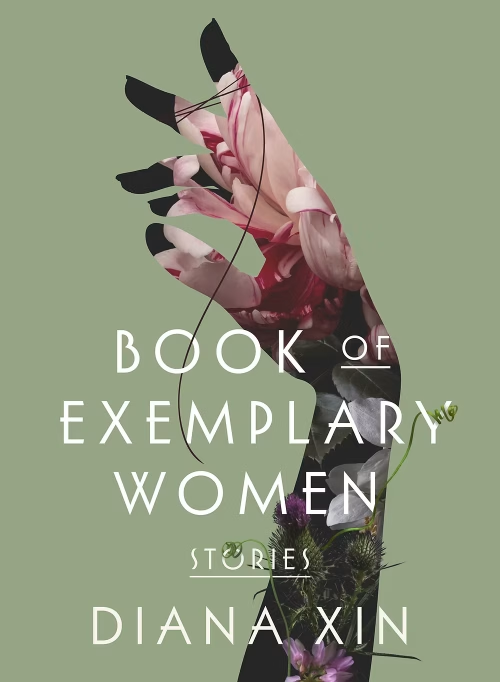
I think you do exactly that. Can we wrap up by talking about the title and cover? Both are what we see first with a book we’re considering picking up. (I love the title, Book of Exemplary Women, and the gorgeous cover, by the way.) How do you think of these two elements as invitations to readers?
Diana Xin
Thank you! It took a while to land on the title. During earlier submission processes, I used different story titles for the collection, but Book of Exemplary Women (or virtuous women, in another version) seemed more expansive and representative of the collection as a whole. I do still worry about “exemplary women” feeling exclusionary, but I hope it’s taken tongue in cheek, as a general nod to the many expectations and demands placed on women.
Earlier this summer, when I was wrapping up revisions, Poem-A-Day from Poets.org released Ama Codjoe’s poem, “Come One, Come All! Step Right Up! Welcome to the World of Wonders!” In the language of carnival and sideshow posters, Codjoe lists out marvels of womanhood: “The woman with two souls/ and one body. The woman riding/ a stampede of seahorses.” And so on. It moves swiftly through moments of strength, sorrow, fragility, transcendence. This poem blew me away. It distilled for me an essence of what I hope the short story collection can do, in a much wordier way.
In general, I’m excited for projects that take on the topic of girlhood and womanhood, as well as criticism such as Tolentino’s essay. Jessie Ren Marshall’s Women! In Peril! is a fantastic read. Her Body and Other Parties by Carmen Maria Machado was similarly influential and made space for a lot more speculative content in the somewhat literary genre of short stories. I’m also excited about the community anthology K-Ming Chang is editing for The Seventh Wave, On Girlhood. I’m glad to think of Book of Exemplary Women situated among these reflections and interrogations of womanhood.
FICTION
Book of Exemplary Women
By Diana Xin
Yes Yes Books
Published December 1, 2025


