


Kristin Collier’s debut memoir, What Debt Demands, explores the blast radius of student loan debt, which includes health problems and medical debt, which in turn affects home ownership, impacting generational wealth. “Keep zooming out in this way,” Collier says in lyric, assured prose, “from bedroom, to house, to street, to neighborhood, to city, to state. Outward and outward. Soon, we are looking down at all of the United States, across mountains and lakes, forests, prairies, and plains. Debt is shaping us across landscapes and generations.” Collier’s scope ranges, breathtakingly, from the aerial to the intimate. Debt, she makes clear with both grace and ferocity, decimates not just individual lives and countless families, but our collective body.
It was an honor to speak with Collier about her groundbreaking book, which I believe will usher in a paradigm shift in how we understand America’s student loan industry, lending systems, access to higher education, and collective care.
This interview was edited for clarity and length.

Jennifer Eli Bowen
You’ve really challenged me with this interview, Kristin, because your book has many rich threads, and I want to explore them all: the human right to education, the predatory loan industry, motherhood, what it means to forgive, the cruelty of bureaucracy, and even bodily sovereignty. It’s a wonder what you’ve accomplished here. This book is deeply researched and propulsive and maddening and tender, and all the while I was reading it, I found myself thinking, how in the hell—with so much research and reportage and memoir—did she pull off such an elegant structure? How the hell did you?
Kristin Collier
Thank you, Jen, for those kind words about the book and for considering the structure “elegant,” rather than chaotic, which was a fear of mine! Structuring the book felt, at times, like an insurmountable task, and I spent a great deal of time early on choosing a structural architecture and then writing it through till it stopped working. Then I would re-order everything and keep writing ‘til I got stuck again. I went for lots of walks during this time and cried—haha—and talked to my editor and agent and friends about what I should do.
The breakthrough came when my agent suggested I try to write the book in small sections of differing lengths, using Anne Boyer’s The Undying as a loose model. I love that book, and I knew my book could never accomplish what Boyer did, but I tried anyway, and the result was something like 90 shortish chapters, each attempting to offer something by itself that would be deepened by all the chapters around it. It was a total mess, nearly unreadable, but the splintering of so much content allowed me to slowly group the tiny chapters into larger ones, using the chronology of my story as a through-line and then pulling in content that linked thematically. To do this, I cut the early draft up and stacked sections in piles on my basement floor, which I kept re-ordering and adjusting thematically as I added and subtracted slips of paper. I had always assumed the cut-the-writing-up trick—something I often tell my students to try—would never work for me, but then it did!
Jennifer Eli Bowen
You write, “Debt was rarely solitary in its cruelty. It didn’t just wound one person but many: a mother, maybe, and a daughter, too…If you couldn’t pay, then it was your body that you should give. And if your body was not enough, you should give away someone else’s.” You did, in fact, suffer a serious and irreversible physical wound that you attribute to stress from your own debt, as did others whom you interviewed. If one can never reclaim the body that was, do you think it’s possible to reclaim peace in the body? How? Or why not?
Kristin Collier
Oh, wow, what lovely phrasing—“the body that was.” I don’t think so, even if the physical consequences for indebtedness seem to be ephemeral, such as stomach aches from anxiety, I think they still record themselves on the body, if only in memory. Nearly everyone I spoke to for the book still had debt, so it would be interesting to talk with folks who’ve been released from their debts, either because they were able to pay them off or their debts were cancelled. I wonder what they would say about their own bodies; were they returned to them when the debt no longer existed?
My debt is nearly gone now—just a few thousand dollars left in federal loans—but I suspect that even when that’s been paid off, or hopefully relieved through public service loan forgiveness, I won’t reclaim whoever I was before. I do think, however, that we all have the chance to find peace through something more collective, the reclamation of a social body over an individual one. For me, that has meant joining the Debt Collective and working toward a future in which higher education is free and people don’t have to debt-finance their lives to survive.
On a different note, and maybe contrasting to some degree what I said before. I recently was talking with a friend who was formerly incarcerated and is thinking about the experience of incarceration for his American Studies PhD. He’s recently said to me in a much smarter and more eloquent way than I’ll capture here that the carceral system makes humans into objects– that it has to do this to punish them and abandon them in the particular violent ways that it does—and that some people believe that objectness can never be erased, even when the sentence is over and people come home. Once made into an object, you can never be unmade, they think. But he believes in something he termed a “residual being,” some tiny little slice of you, maybe only a particle, that stays with you no matter what you endure, something essential to your humanity and soul and that when you leave the confines of incarceration if you can nurture that little particle it can grow bigger and bigger, occupying more of yourself. “If this isn’t possible, then what’s the point?” He said to me, and it took my breath away.
I don’t think the violence of debt is the same as the violence of incarceration, and the ways in which debt threatens subjectivity aren’t the same either—I have never been forced to live in a prison away from people I need and love—but I think this framework is really useful anyway. Maybe I can get closer to getting back the-body-that-was.
Jennifer Eli Bowen
“Residual being,” might be the most hopeful concept I’ve heard in ages. Thank you (and your friend) for that. You contextualize debt, personally and societally, as an abandonment. I want to first say: it pisses me off on behalf of the public school teachers we’ve abandoned to overfilled classrooms and second jobs. And the many other public servants you talk about in your work. Do you think changing the narrative around debt and forgiveness will shift culpability? Or does policy change (as Ibram X. Kendi contends) need to come first?
Kristin Collier
I think narrative often precedes policy. Take, for example, the many hard-won victories of student borrowers. I’m thinking of the students, known as Corinthian 15, who began a debt strike in 2014. Their for-profit college, Corinthian, had defrauded them, and so they understood that they should not have to pay back these student loans that were harming them. They stopped paying, and kept asserting through several administrations, while recruiting more students and working with lawyers, that their school and the debts were predatory and unfair. Their fight resulted in $5.8 billion of debt being cancelled for all students with loans from Corinthian, whether they had applied for this relief or not. And it created the pathway to a kind of relief known as Borrower Defense to Repayment, which borrowers use to be relieved of debts from other schools that have scammed them. So the students’ asserting their humanity had to happen first.
It seems to me that under capitalism, institutions never lead the charge to see us as automatically worthy of benefits and care. Borrowers nearly had another enormous win under the Biden administration when they said that they’d cancel between $10k and $20k per borrower, but because the administration means-tested the relief and used an application, there was time for a right-wing effort to block the relief. Even so, when I first learned of my debt, I never could have imagined that an administration would cancel anything. That impossibility was isolating and heartbreaking. This almost-relief only happened because of the efforts of organizers across the country.
I do want to be careful of something, however. The logic doesn’t flow in reverse—if we don’t get relief, it’s not because we haven’t earned it. I don’t think we owe anyone, especially the government, these stories of ourselves in order to be “rewarded” with forgiveness. But we can strategically offer them to the government and, just as importantly, the public, to build the power we need to win.
Jennifer Eli Bowen
Credit versus debt was a moving distinction, the latter being “an uncorrupted promise,” where we “willingly and joyfully owe one another.” Can you say a little about what that is and how it has impacted your way of being in the world?
“Bad debt” is from Fred Moten and Stefano Harney, and it refers to the obligations that we have to one another that exist outside the marketplace that are not tracked and from whom no one profits, at least not in the financial sense. Credit is the opposite: it’s all the financial shit forced on us to live—which must always be tracked and accounted for—and from which economic actors make money. Our debt is “bad” because it’s not adhering to the market’s terms. And by extension, we are also bad.
I have been a pretty obedient person my entire life, in and outside of school, even when I didn’t agree with the rules that were thrust upon me. Once, in middle school, after my volleyball team arrived home late after a big win, the team decided to wear pajama pants—in part to celebrate but also probably to brag about how late we’d stayed up. Anyway, pajama pants were against the rules, so all of us were forced into in-school suspension for the day. Many of my teammates wrote notes and took naps and joked around, but I put my head down and cried most of the day. Haha. I wasn’t crying at the injustice of being disciplined for wearing soft pants, but because I was certain my teachers were mad at me.
Now, many years later, it feels thrilling to stop thinking about the debt that credit would like me to worry about and instead rack up “bad debt” and be deliberately disobedient for a good reason. Sometimes this shows up when I give something to someone else, just because I want to and because I think it will make their life better, not expecting or wanting anything in return. I’ve been challenging myself to do this more. And sometimes it shows up as a kind of contrast. I can’t opt out of our economic system—even if I can resist elements of it—and so if I check my bank account or make a payment, I have to think about credit. And then afterward, when I’m with a friend I love, going for a walk and talking about books, or talking to my daughter about the world or playing with her in the sprinkler, I think about how beautiful and uncorrupted that moment is, that it’s just ours, that no one is making money from us, that our joy and care, wonder and curiosity defies “credit.”
Jennifer Eli Bowen
Nonfiction is fucking hard. And this book is deeply intertwined with your family, your mother in particular. You write about this complex situation with grace and compassion. How was navigating that territory during the writing process? How are you doing now that it’s launching into the world?
Kristin Collier
I avoided navigating this complexity during most of the writing process in a way that was perhaps cowardly as much as it was protective. As I was researching and writing, I didn’t tell my mother how much of the book would be about the theft, even though she knew the project was broadly about student loan debt. This was for several reasons: our communication has waxed and waned over the years, and I wanted to write the story as I knew it. I worried about a contemporary conversation– that had only arisen because of the project– muddying my understanding as a young person about what was happening to me. So I relied on emails, texts, documents, G-chats, etc, to piece together what I knew and when. I used those artifacts to establish a timeline and to uncover, as much as possible, how I felt, which turned out to be pretty hard. I didn’t always have a very nuanced handle on how I felt as a young person, beyond being very scared. While working on the project, I also worried about introducing this subject to my mother and leaving her terrified for several years before the book was finished and she could see what I’d written. I think she would likely disagree with my assessment and would have preferred to know earlier, even if that knowledge cast a kind of shadow on the future. But our relationship remains shaped by the debt, and introducing conversations that will likely be fraught remains hard for me. Additionally, I didn’t want to hurt her, and I think I worried about having to hold that hurt. If I could do it all differently, I’d make changes to what I shared and when.

Now that the book is nearly in the world, I’m trying to be attuned to two different experiences of this publication: mine and hers. It was challenging to write this book, and I’d like to find opportunities to celebrate it and to allow myself to feel proud. And I know that even though my mother is very proud of me, which she has said many times, this book features some of the worst moments of her life, and seeing these moments discussed publicly and read by people who might not be kind is going to feel awful. I’d like to believe this book could be freeing for her, but I wonder if that’s a fiction I invented to make writing it possible. I guess I’ll find out.
Jennifer Eli Bowen
Motherhood is woven into this book exquisitely, examining your relationship with your own mother, and with your daughter, and the role sovereignty plays in both relationships. I would never have imagined a book on debt could hold this much care and caretaking, but it adds warmth and depth and helps the reader see the invisible threads that connect what we ask each other to carry. When did you realize your own daughter would have a place in this book?
Kristin Collier
I decided that I’d try to write a book around the time I found out I was pregnant the first time, and I was still working on the proposal during a miscarriage and into my second pregnancy. Those transitions from being pregnant to not being pregnant to being pregnant again felt so weighty and layered. It didn’t take long for me to realize they were bound up in the debt. So I realized very early on that my child would likely be in the book, not just as a chronological marker near the end of the book, a reminder that I carried the debt for so long that I carried it out of my own childhood– or more accurately young adulthood– and into someone else’s, but also as an example of another relationship that would respond to the debt. I hope the response is one of resistance, one that works against what debt asks of us. That in parenthood I might accidentally recreate aspects of my own family dynamic that I wish to avoid is not unique to me, but perhaps my debt has confused things in particular ways. And because my body, which was both literally a site for the debt and also more remotely in the way it was tracked and catalogued in banks and collection agencies, was also the first site of motherhood, it felt like there was no way to avoid talking about becoming a mother and using my body in a new way.
Jennifer Eli Bowen
Sumargi, your book tells us, is a Samarian term meaning “return to mother,” as a jubilee or freedom from debt. That’s such a beautiful concept and adds a deeply spiritual component to your work and, hopefully, to our collective thinking on debt. Did you have any kind of ritual to mark the legal end of your debt burden?
Kristin Collier
What a lovely idea, Jen! No, I didn’t, but I should have! The legal end to the fraudulent loans was confusing because the process itself was so unclear, iterative, and uncertain. My lawyer was hopeful that I’d eventually get out of that debt, but bankruptcy is a hard and unreliable process that doesn’t work for most student borrowers and only sort of worked for me, which I explain in the book. It ultimately took an agreement between the lenders, my mother, and me, and even then, the lenders tried to collect from me much later on a $30k loan I didn’t know about. I think I’ve been bracing myself for the return of the debt because it has seemed to keep returning in numerical ways and immaterial ways, too. But maybe I need a ritual to help it stay put. A funeral for the debt seems sort of appropriate but also too kind and intimate. I hate this debt. I don’t want to honor or memorialize it. In The Debt Collective, we sometimes host debt-burnings where you record your debt burden and light it on fire. People do this for their current debt burdens as a way to disempower them. So maybe I could have a fire in my backyard with some friends and toss my debt inside, and maybe, with a nod to the idea of collectively, I could ask my friends to do that, too, because I think it will ultimately take all of us to cancel these debts for me and for the 44 million borrowers across the country.
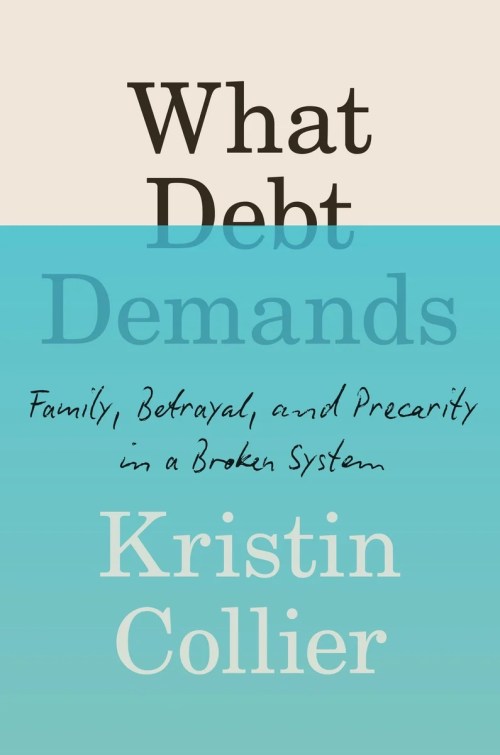
NONFICTION
By Kristin Collier
Grand Central Publishing
Published November 18, 2025


