


It’s official: I’ll read anything Deborah Shapiro writes. I’ve loved her work, and therefore I dove into her new book, Watching the Detective, without hesitation even though the detective in question is Columbo and I’ve never seen a single episode of the show named after the protagonist. (I do remember seeing about five minutes of one, enough to have a visual reference, but no sense of the detective’s character or the show’s tone.) Yet I dove in, a proponent of the idea that it’s not what the book is about, it’s how it’s written, and having faith in Shapiro’s writing ability. I was not disappointed.
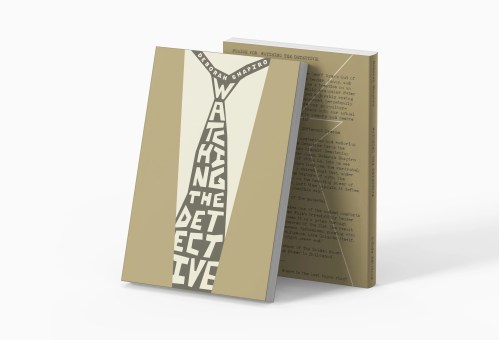
The third title on b-side editions, Watching the Detective, is a slim book that examines, yes, rewatching old Colombo episodes. But it’s about much more than that: memory, perception, interpretation, mystery, dreams, faith, and the act of investigation. I interviewed Shapiro earlier this year about the press, which she launched herself. Shapiro says she hopes b-side editions books are ones that make people feel energized, emotionally and intellectually. That was certainly the case for me with Watching the Detective. It is indeed serious without being pretentious, it’s full of humor and curiosity—it was a book I truly enjoyed spending time with, and which I recommend to both fans of Colombo and the uninitiated alike.

Rachel León
I love the opening, which is told in third person to convey a memory, and part of what makes it so compelling is that it reads like fiction. This is your first nonfiction book, and I’m curious if this use of that narrative technique was a helpful starting point to you as a fiction writer?
Deborah Shapiro
Thank you! And yes, for sure. This book has a lot to do with memory and time, so beginning with an old memory somehow related to Columbo made sense to me. Constructing it in the third person allowed me to establish both the distance and intimacy of memory. And maybe, as a fiction writer, it helped me get my bearings and ease into a work of nonfiction. Did the sequence of events I describe happen exactly that way? Who knows, but that’s what I remember – and that’s what we’re working with here, that’s part of the puzzle. There’s a later section that’s written the same way and it gave me a chance to step back – to see a younger (or older, depending on how you look at it) version of myself almost as another character than the “self” that’s narrating or writing the book.
Rachel León
When did you realize this could be a book? Or perhaps rather, how did this book come about?
Deborah Shapiro
I was watching a lot of Columbo, and I guess posting about it on Instagram, and a friend suggested I should write something about it. It was at a time when my latest novel, Consolation, had come out and I wasn’t actively engaged in a new fiction project. Initially I thought possibly I could do a kind of spin on a detective novel. I went through a period in my twenties where I read a lot of noir fiction (Raymond Chandler, James M. Cain, John D. MacDonald) and figured I might be able to tap into that. But I wasn’t all that motivated to come up with a plot (though some of those noir novels did find their way into this book). I was more interested in figuring out why I was so compelled by Columbo. And I couldn’t really do that through fiction.
I always thought of this as an associative, digressive book – partly because that’s how I think and partly because Columbo itself encourages that kind of connection-making. I had read and loved Nathalie Léger’s Suite for Barbara Loden, a slim text which centers on the movie Wanda but becomes about so much more, with all of these Sebaldian connections and correspondences, and I thought maybe I could try to do something like that… but with Columbo.
Rachel León
I had many favorite parts, but one was the meditation on the idea of being “unassuming,” which is how someone described you, and Columbo could also be described the same way. This line in particular really hit me: “To put it another way, you don’t make too much of yourself because you are occupied with making much out of what is going on around you.” I never thought about the parallels between being a [fiction] writer and a detective before, but now it’s something I can’t stop thinking about.
Deborah Shapiro
There are so many parallels! I mean, I think there are a lot of parallels – I’ve never been a detective so I can’t say for sure. But approaching things as a mystery appeals to me. Life is strange, people are weird, the subconscious is so mysterious. Most writers, on some level, are writing to figure things out, to try to make some sense of things. To do that, it helps to be observant. And to not make assumptions – or to train yourself not to rely on those assumptions, to question those assumptions to get at some kind of truth. That’s a skill that good detectives and good writers would have in common. I’m realizing, though, that all the detectives I’m thinking of are the creations of writers. So maybe the parallels are sort of predetermined. It’s like when you can tell a novelist decided to make a character a painter or something largely in order to talk about the artistic concerns of being a writer, but they thought it would be too solipsistic to actually make that character a writer. So, you make them a painter, or you make them a detective, you know? Because you can address some of the same impulses, motivations, and sensibilities.
Rachel León
And then building from there is the idea of perception and interpretation. I loved the mention of an episode when an artist tells Columbo they have the same talent of knowing how to truly see the world. But it’s more than seeing, it’s recognizing how pieces connect—even recognizing there is a puzzle at all. I don’t think I’d considered how some people don’t see the world this way, so a statement more than a question here: thank you for this observation. (I might be a kinder person now in some small way, thanks to you.)
Deborah Shapiro
Well, the artist in that episode is a pretentious ass, flattering himself while condescending to Columbo. But yeah, I’m not sure everyone sees the world as a puzzle. Some people seem so certain and so comfortable in their certainty. Not much interest or curiosity beyond themselves and their circumstances. Maybe it’s all a cover for some deep insecurity but it’s weird to me when people lead with that kind of certainty. And interpretation and perception are such deep, endless concepts – they’re heady and philosophical but they also have material implications, especially in our current moment, in America, where it seems like people are living in such different media-shaped niche-realities. Something that comes up when thinking about Columbo is the loss of a monoculture, in a pop cultural sense. I’m not necessarily lamenting its loss, but the monoculture did reflect some kind of shared, baseline understanding of reality, more or less. (Also, what an amazing compliment, thank you).
Rachel León
I’d like to talk about the tone because it’s what makes this book so charming. The tone tends toward the serious, but there is also humor. Overall, there’s a strong sense of curiosity on each page, which I love. Was tone ever a concern? (And a related follow up question: how do you keep curious on the page?)
Deborah Shapiro

I knew this book could never take itself too seriously, tonally, because it’s about Columbo. And even when it’s about how watching Columbo relates to more serious things, like mortality, there’s necessarily a kind of lightness that counterbalances the heaviness. I wanted to be serious about and attentive to things in a way that’s somewhat playful rather than somber or ponderous. I’m so happy to hear you say the curiosity comes through. I think I was able to stay curious on the page mostly because I was curious about this subject matter. I’m still curious.
Rachel León
There is a source list at the end of the book. How much research went into writing Watching the Detective?
Deborah Shapiro
A good deal of research went into it, but it didn’t feel like research. Which goes back to curiosity. I read a number of excellent books about Columbo – and went back to books that seemingly have little to do with Columbo but actually have quite a bit to do with it, or at least how I wanted to write about it (books by Roland Barthes, Eve Babitz, Nathalie Léger, Patrick Modiano and others). I read Peter Falk’s memoir, searched for various related articles, and played some Watch It for Days deep dive analyses of old Columbo episodes on YouTube. And it was never a chore to go back and watch an episode of Beverly Hills, 90210 (with the line dance that solved racism) or old clips from the Tonight Show with Johnny Carson or to rewatch certain Cassavetes movies or Wings of Desire.
Rachel León
I thought we could end talking about ritual because that’s an idea that’s explored at the end of the book, mostly talking about Jewish rituals, but it seems like watching Colombo became a bit of a ritual, as well. Are rituals important to you? Do you have a writing ritual?
Deborah Shapiro
Yes, it totally became a ritual, for a time. I like rituals and I can be deeply moved by ceremony and certain customs. The sense of comfort and connection rituals provide. I can also be a creature of habit and repetition. But I don’t have any real writing rituals. In the book, I talk about the line (or how maybe it’s not a line) between ritual and superstition and I think there’s also a point at which ritual can tip into fussiness and rigidity. And I try not to be too fussy about needing a writing routine, aside from having my computer and finding space and time where I’m able to concentrate.
NONFICTION
Watching the Detective
By Deborah Shapiro
b-side editions
November 18, 2025


