The newest entry in Belt Publishing’s series of Rust Belt–focused anthologies centers on the city of Rockford, Illinois, a microcosm of the impact of economics and environment on a city and its people. Edited by Rachel León (full disclosure: my colleague at Chicago Review of Books and our Managing Director), the essays, photographs and poems in The Rockford Anthology reflect the cultural diversity, the generational range and the gamut of opportunities and challenges within the borders of this city of workers and dreamers. The city has experienced heydays and hardships, like many others in the Midwest, but is populated by determined citizens who feel a passion for their community, and for its future.
The Rockford poet Ryan Burritt writes in the anthology that “history flows through this city like the Rock River.” The personal histories that flow throughout these pages are accompanied by memories of those unable to share their own stories, and León wisely focuses on these witnesses and their disparate stories to create a meaningful societal mapping as well as geographic one. This volume is specific to Rockford, but ultimately a love letter to how we find our place in the world, and relatable to all of us with complicated, passionate feelings about home—leaving it, missing it, seeking it.

Mandana Chaffa
Talk about the inception of this anthology. What were you initially hoping to accomplish with it, and how did that change during the course of the project?
Rachel León
Last July I interviewed Belt Publishing’s founder and publisher, Anne Trubek, about Best of the Rust Belt. It’s a fantastic collection that includes work from Belt’s city anthology series, but I kept finding myself wishing Rockford was represented among the pages. I sent a pitch and was delighted when the brilliant editor Phoebe Mogharei accepted. It all happened fast. The pitch was accepted in July and Belt hoped for the manuscript to be delivered in January. That’s an extremely tight timeline to spread the word, collect submissions, edit them, and put together a collection—but, I told Phoebe, if any city can do it, it’s Rockford. And we pulled it off.
Initially, I simply wanted to create a nuanced portrait of my hometown. When I was growing up Rockford only made national headlines for negative things: mostly our crime and unemployment rates. We’ve ranked high on lists like “Most Miserable City” and “Worst Place to Live.” I’ve been frustrated with how Rockford gets reduced and flattened, and it was my goal to capture Rockford as it really is: flawed, yes, but full of strengths, too.
I had been foolishly optimistic about how the election would go, and sent responses to submissions on November 1. I knew in October, after the submission deadline, that I had gaps to fill in terms of certain voices not being represented, and immediately began extending personal invitations to people to contribute to the project. But after the election, I also had to consider the political landscape the book would be published in, which made me want to push back where I could. As I worked with writers on edits, when appropriate, I invited them to get more political with their pieces. And I also more or less harassed Linda Zuba until she agreed to write something. (Sorry, Linda!) Her perspective specifically, due to all the work she’s done at the border and here locally to help immigrants and fight for justice, felt essential to include under a second Trump term.
Mandana Chaffa
What surprised you about the entries you received? How did they impact your own perspective of Rockford?
Rachel León
I was surprised by how far the submission call reached. I created accounts for the project on Facebook and Instagram, posting about the submission call, hung flyers and posters around town, and sent out a press release. A few local media outlets covered the story, yet each time a stranger submitted, I found myself surprised and delighted by the power of word of mouth.
I learned more about things I’d already known about, such as the force behind South Main Mercado and Somnium. But I also learned things I hadn’t known, like Civil War soldier Albert D.J. Cashier (who’d been born Jennie Irene Hodgers). I was also deeply moved by people’s personal stories, including how they ended up in Rockford, or why they left. Each and every story broadened my perspective of Rockford in some way.
Mandana Chaffa
Would you talk about the process of getting submissions for the anthology and the subsequent structure of it? At what point did you have a firm idea about the sections, and what essays to put in each?
Rachel León
Getting submissions was a combination of the traditional literary mode of putting out a call so people send their work and doing outreach to ask specific people for stories. Most of that outreach came through people I knew who knew someone. (My dad went to high school with Tommy Meeks, who founded our local Juneteenth celebration decades before it was a state or federal holiday, and my dear friend Melissa Massiel Blanco went to high school with Darian George, who now lives abroad and hadn’t heard about the submission call.) I also did collect a few of the stories orally. I made an editorial decision not to note those instances, though the one I’ll mention here, if only to highlight an injustice, is the person who is currently incarcerated—and has been awaiting trial for six years now.
As for structure, that was something I played around with until the very last minute. I printed out all the pieces and physically moved them into different sections, reading for flow and emotional impact. So many pieces could fall into multiple sections, and those pieces did shift around many times until I finally settled on the current organization.
Mandana Chaffa
I noticed that you’re using the proceeds from the book to support programs in Rockford. Would you talk about that?
Rachel León
Yes! Typically the anthology’s editor receives the book royalties because editing a book takes a tremendous amount of work. We weren’t able to compensate contributors, so I made the decision early on (admittedly, before I knew just how much the project would entail) that the book royalties would be donated back into the community. It felt like a very “Rockford” decision. I also like to think it helped when reaching out to our three contributors with national renown (Academy Award nominee Bing Liu, New York Times bestselling author Kimberla Lawson Roby, and comedian Ashley Ray-Harris) asking for their participation in the project.
I asked contributors for ideas of where the money could be donated and asked everyone to vote. The options were The Liam Foundation, our public library foundation, our local branch of the NAACP, Rockford Family Peace Center, and the Rockford Area Arts Council. We had a tie between the Family Peace Center and the arts council, and using a tiebreaker, the Rockford Area Arts Council won. All book royalties will go straight to the arts council to help fund community action grants.
I wish there was a way to support all the organizations, though we did find a way to honor the fact that so many participants wanted to support the Family Peace Center. A few contributors wanted anthology-themed T-shirts, so we bought some through a local T-shirt company and all proceeds from the T-shirt sales are being donated to the Family Peace Center.
Mandana Chaffa
Did you always intend to use photographs?
Rachel León
Yes. Rockford is a city that really loves and supports its visual artists, so it was important to me that the book include visual art. I’d studied some of the other city anthologies and when I saw photographs I wanted to make sure this anthology had some, too.
Also, seeing the little illustrations of the Mitchell Park Domes as section break symbols in The Milwaukee Anthology made me want to do something similar. I organized The Rockford Anthology into three sections (and within those, three subsections), and each is named after one of the city nicknames. The section break illustrations (drawn by my son!) are reflective of each section, and include little drawings of a peach (for Rockford being home of the women’s baseball team, the Peaches), a screw (as Rockford was once the screw capital of the world), and three trees (to represent Rockford as “the Forest City”).
(A fun side note: the T-shirts I mentioned earlier include the three section break illustrations.)
Mandana Chaffa
As nostalgic and hopeful as many of these essays are, they also don’t shy away from difficult issues, beautifully summarized in this quote [from anthology contributor Emily Klonicki]: “Rockford struggles: against racism, against the ghosts of systemic disinvestment, against the generations-deep cycles of trauma, both individual and community, against the progression of industry that made us boom in the 1900s and toil and strain in the 2000s. But Rockford also dreams. Necessity is the mother of invention, it is said, and from struggle comes innovation.”
Rachel León
I think one of the most defining qualities of Rockford is what we’re able to do, not only despite our struggles and problems, but because of them. I’m glad you quoted Emily Klonicki because she beautifully captures that idea, doesn’t she? I also love when she says, “a city that struggles is a city that dreams.” It’s true. I often describe Rockford as being full of dreamers and doers. The city has a real scrappy, can-do attitude. And so while yes, some of the work in this collection indeed reckons with hard aspects and problems—an anthology about Rockford that didn’t would be disingenuous—the overall tone, I think, is one of hope and pride. That tone is very Rockford, too.
Mandana Chaffa

There’s a larger conversation to be had about Rust Belt cities, which were originally manufacturing strongholds that were forced to reinvent themselves, and what that means for different groups of individuals, for the populations, and for the soul of the cities themselves.
Rachel León
Yes, there definitely is. And I’m so grateful a press like Belt Publishing exists to offer nuance to that larger conversation. Belt is publishing some very dynamic and important books and I urge readers to check out more of their books. I’ve never been disappointed by a Belt book.
Mandana Chaffa
Reading this collection, one has the sense of so many individuals across time, walking through the streets of Rockford. How does the city look to you now, seeing it through so many eyes beyond your own?
Rachel León
It looks much richer and fuller. And if you’ll indulge me, I’d love to share a very cool thing that happened the eve before the book’s launch: our mayor, Tom McNamara, made a proclamation at City Council that the week of October 20-26 was “Rockford Anthology Week.” He’s a truly wonderful mayor (and person) and to quote his proclamation: “The stories that make up The Rockford Anthology capture the dreams and disappointments of the authors, the frustrations and the favorite memories, but mostly how Rockford means different things to each of us and that the best is yet to come.” Yesss.
Mandana Chaffa
Would you talk about your own Rockford story?
Rachel León
I alluded to it in the introduction, but the short answer is I was born and raised on the West Side of Rockford. I swore I’d leave, not because I necessarily wanted to, but because in the ’90s, that was the dream: grow up and get the hell out. But I’ve stayed. I’ve planted roots here. I love this beautiful, flawed city.
Mandana Chaffa
Your debut novel, How We See the Gray, is coming out in 2026 from Curbstone Books. Might you offer a preview?
Rachel León
You are so kind to mention it. Yes, my novel comes out next May! It’s about a caseworker who must reckon with her past, her privilege, and the child welfare system after her drinking problem puts her preschooler in jeopardy and she finds herself in a custody situation that mirrors her clients’. How We See the Gray is about mistakes, second chances, and trying to do better—which is all very Rockford, I think. It’s definitely a very Rockford novel, so while I’ve worked on it much, much longer than the anthology, I love that the two books will get to be in conversation.
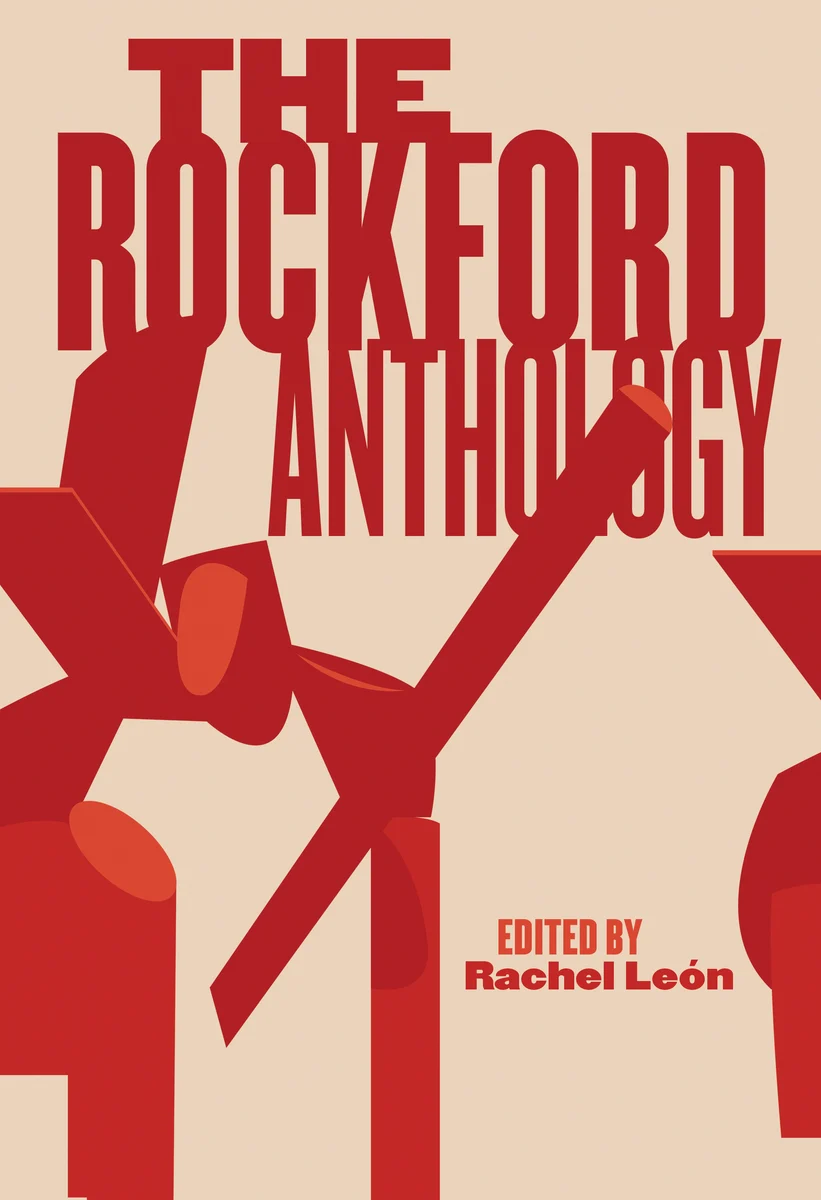
ANTHOLOGY
The Rockford Anthology
Edited by Rachel León
Belt Publishing
Published October 21, 2025