


I’ve always loved books about books and books about social movements, so when I came across Black Owned: The Revolutionary Life of the Black Bookstore, which combines both of these topics, I knew I needed to talk to its author, Char Adams. It outlines, in richly-reported detail, the integral role that Black owned bookstores have played in organizing movements for justice. In a world where books and lesson plans about Black history and racial justice are being banned, this book was a much needed salve, reminding me that crucial organizing can happen in third spaces such as bookstores.
The book starts with the first Black bookstore in the 1800s and moves through to the present day while also incorporating Black publishers and authors. It was a beautiful reminder of the symbiotic relationship between Black authors and Black bookshops; many of the bookstores achieved a new level of success when visited by authors such as Maya Angelou and Terri Mcmillan, who intentionally sought them out to support while on tour. And like any business, occasionally capitalism causes tension and disagreements in the relationship, conflicts Adams doesn’t shy away from describing. Chicago’s own Afrocentric bookstore and Third World Press also receive some page time. While I was somewhat familiar with the history of Afrocentric from the previously published, Prose to the People, I was thrilled that Third World, one of my favorite publishers, received much deserved accolades and rightsizing of its place in publishing history.
Char Adams is a former reporter for NBC News and People; we had a conversation about the history and futures of bookstores by and for Black people. This interview was conducted via email and edited for clarity.
Ariana
In the book you explain the difference between a Black bookstore and a Black owned bookstore. Since the book just came out, can you start by offering a brief overview of the key differences to orient future readers?
Char Adams
I had a really good conversation about this with W. Paul Coates (who owns Black Classic Press) and Troy Johnson (founder of the African American Literature Book Club), who both really challenged me to think deeply about this. I felt it was important to address the distinction between the two even though I use the terms interchangeably in the book. To me, the difference lies in ownership and inventory. A Black bookstore, to me, is a store with an inventory largely consisting of books by and about Black people, and the owner doesn’t necessarily have to be Black. A Black-owned bookstore is a shop specifically owned by a Black person, no matter what types of books they sell. So there is a distinction that I felt was important to address in the book. But I use both terms in the book interchangeably in an effort to focus on the similarities between the two rather than their distinctions — which I believed could be distracting for readers. With that being said, a lot of the stores I highlight fall under both terms, they are owned by Black people and prioritize Black books.
Ariana
As a journalist what made you realize there was enough material for a book after you wrote the excellent Mic piece?
Char Adams
I consider myself to be a journalist and a storyteller. The storytelling part is what let me know I could expand the Mic piece into a full book. So when I read Joshua Clark Davis’ 2018 article in The Atlantic about the FBI surveillance of Black-owned bookstores, I immediately began thinking about the very human stories that would come out of such targeting. I was immediately curious about what that situation felt and looked like for Black booksellers. I wanted to know their stories. And I knew those stories, many of which I couldn’t even fit into the Mic piece, would be more than enough for a compelling book. I often say the book came about basically because I’m nosey and wanted to know people’s business.
Ariana
I’m always curious about authors’ research processes. Your acknowledgements mentions how Colin Beckles’ work was particularly helpful as a source; was there a specific book or paper of his? Other helpful sources? How did you identify present day Black booksellers to talk to?
Char Adams
There are so many people whose work made this book possible. Colin Beckles was a particular touchstone because his research is among the first to holistically study Black bookstores as sites of political resistance. He has a few journal articles on the subject but, in my research, I often came back to his 1995 dissertation from his time at UCLA called “PanAfrican Sites of Resistance.” A lot of the research for the book was through old news and journal articles, books, and interviews. It wasn’t difficult to identify present day Black booksellers to talk to, they’re so beloved that people I asked were more than happy to point me to their local Black-owned bookstore.
Ariana
W. Paul Coates is a legend and I was so pleased to see his insights woven throughout the book. Could you expand a bit on the relationship between Black publishers and Black bookstores? (And I hope he’s writing a memoir!)
Char Adams
I hope so too! He is such a monumental, influential person whose story, I believe, would be required reading for anyone interested in not just Black books, but Black radical movements, and Black history in general. The relationship between Black bookstores and Black publishers is so comforting to think about. There is this atmosphere of unconditional support and camaraderie that consumes the relationship. I immediately think of Haki Madhubuti, who started Third World Press to get his own work out into the world. The story of Black publishers is one of self-determination and they’ve worked with and supported Black bookstores and authors in ways that promote the truth that Black communities are collectivistic and glaringly so in our individualist society.
I really appreciated the additional information included in the book from the index to the suggested reading list from Black booksellers. I want people to read the list for themselves, but in your conversations with booksellers, did any titles come up that surprised you? Deep cuts or perhaps a popular title that you didn’t expect to have done so well?

I wasn’t surprised by the top two books, the autobiographies of Malcolm X and Assata Shakur. I was expecting those to top the list. But I was surprised to see 100 Years of Lynching by Ralph Ginzburg, not because it’s not worthy of being on the list but because it’s such a deep cut! It’s a book full of vivid accounts of racial violence. It’s the book that inspired Ed Vaughn to open Vaughn’s Bookstore in Detroit in the 1960s. I was happy to see it on the list, but surprised that there wasn’t a more popular or widely-read book in its place.
Ariana
I’m curious about what, if any, regional differences you noticed among Black bookstores, especially since you lived on the East Coast and in the South. We know Black people are not a monolith but were there interesting differences (in product, business model/ethos etc) you noticed among bookstores in Chicago versus Dallas versus Los Angeles?
Char Adams
Actually, I was more shocked to find the opposite. That no matter what region I visited or studied, there were more similarities between the stores than differences. For example, the emphasis on community was consistent across regions. Black booksellers focused on making their shops safe havens for the people in their communities and put on similar programs and events to that end. I loved the commonality, it was kind of like a thread tying all these shops together. Sure, there were some differences, like Pan African Connection in Dallas, Texas, offers farming classes and volunteer opportunities whereas we don’t really see that in New York’s Black bookstores. So there are differences based on what is available in the community and what the particular community needs, but there is definitely more that makes these stores the same than makes them different.
Ariana
In your interviews with modern day booksellers, what left you feeling hopeful about the future of Black bookselling?
Char Adams
Black booksellers are overall hopeful about the future of the business, even if they know there will be great struggle. There is an emphasis on passion for the work and there is a sense of responsibility that seems to drive many booksellers. What everyone is realizing though, and this isn’t a new concept, is that they will have to do more than sell books to make it in the book business. So many shops are leaning into this idea of the “bookstore and more” for example Baldwin & Co. Coffee & Bookstore in New Orleans also has a cafe, an event space, a podcast studio, and other things that make it appealing for customers. I believe innovation will be the key to Black bookstore survival. Booksellers are constantly coming up with new, exciting ways to draw in customers, engage with their communities, and build a loyal base. I think this mixture of passion and innovation will carry the businesses through.
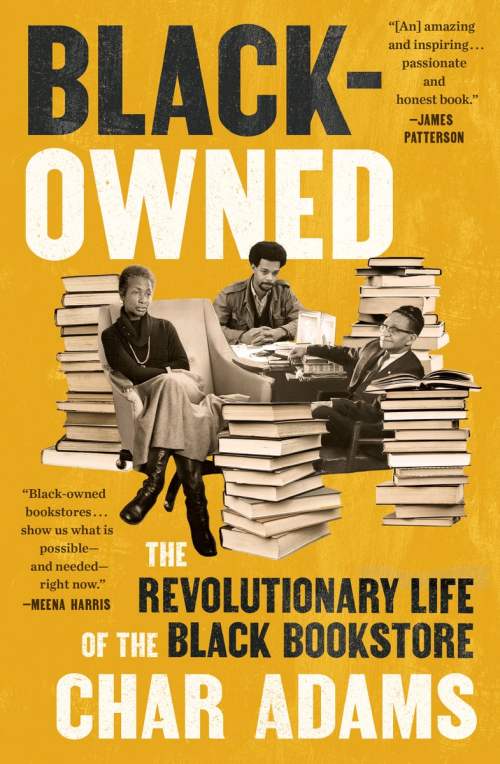
Nonfiction
Black-Owned: The Revolutionary Life of the Black Bookstore
By Char Adams
Tiny Reparations Books
Published November 04, 2025


