


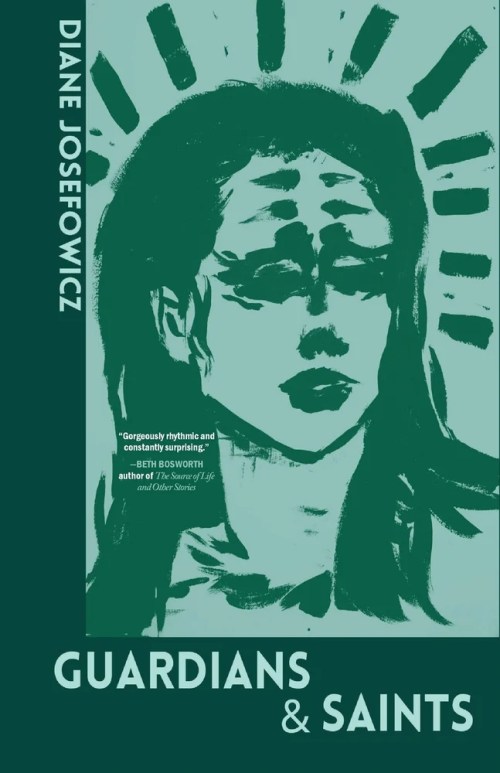
At a time when literary citizenship is especially needed, Diane Josefowicz is someone I’ve seen stick to her principles and elevate the work of other writers. We’ve followed one another on social media for years and I’ve watched her literary citizenship as the reviews editor at Necessary Fiction and as senior editor of translations at The Adroit Journal. Josefowicz is the author of several books, including her debut novel, Ready, Set, Oh, and her latest book, a collection of short stories called Guardians & Saints, is now available.
As the title suggests, Guardians & Saints deals with characters in guardian-like roles: mentors, teachers, and therapists. While most of the stories are grounded in reality, a few have hints of speculative-like qualities. Some deal with facilities, others are more familial, but all are fascinating examinations of caretaking—the juxtaposition of sterile environments with the home creates a thought-provoking look at those who are dependent, for a variety of reasons, to get their physical, emotional, social, and psychological needs met.

Rachel León
Most of the stories are written in first person, with two exceptions. Can you talk about how you approached point of view in this collection?
Diane Josefowicz
I didn’t have an approach to point of view; in general my approach to point of view is to make sure that whatever point of view I’m writing in, I’m being as faithful as possible to it. I’m always trying to make sure my syntax, for instance isn’t causing the point of view to shift in subtle ways. Things can go wrong so easily, clause by clause.
The stories in this collection are culled from almost twenty-five years of writing, and over that time, I became more comfortable, and I hope more adept, at different ways of approaching point of view in storytelling. I also went from being a single and childless student—I was a student for a long time, four years of undergraduate study followed by a PhD and, after a break, an MFA—to being a wife, a mother, a teacher. I went from being someone who depended on others to someone others depended on. I was writing stories through all of those changes. The stories reflect these linked trajectories.
For a long time I wrote in the early mornings while my family was asleep. What I did, because I was half-asleep too, was sit down at the computer and tune into whatever dream stuff was hanging around. Usually it was a voice. I’d take dictation for a while. This was my practice. It still is, more or less. I write what I hear, or overhear. For a long time, what I heard were first-person monologues.
While I was studying for my MFA at Columbia, I began to hear a different voice, the sound of a narrator telling a story in the third person, in a “close third” point of view that shifted the reader’s attention—slowly, carefully—from one character to another. This was new for me, and very hard to manage for a long time.
One of my teachers at Columbia, who shall remain nameless, told me to quit writing in anything but the first person. He told me that stories could not be told in any third-person point of view at this point in literary history. Which was some bullshit, and I did tell him so, directly and at some volume. What he meant was that he didn’t like the authority I was daring to assume by telling a story as if I knew anything about what was happening with its characters apart from the one character who could most clearly be identified with me, that is, with a narrator saying “I.” Clearly we are in the realm of identity here, who gets to say what to whom. From a white woman writer, he required confessional; that was the only genre in which he could hear me tell a story.
The feedback left a bad taste, but I did persist, I wrote my MFA thesis in this point of view; it became my first novel, Ready, Set, Oh. I learned to manage the close-third point of view by writing (and rewriting) that book. The last story in Guardians & Saints came after I’d finished Ready, Set, Oh. At that point, I was just more comfortable in it, I think.
Rachel León
While I wouldn’t call this collection linked, there are a few recurring characters. I’d love to hear how Zinnia and her family came to show up in multiple stories.
Diane Josefowicz
Zinnia Zompa is the main character in L’Air du Temps (1985), a novella I published last year with Regal House. I wrote that novella in its entirety in 2021, during the Covid-19 pandemic. But Zinnia had been showing up in my work for fifteen years already; her earliest appearance was in “I, Zinnia” (first published under the title “I Knew I’d See You Someday” in a DC-based magazine called Folio), which I wrote during my final workshop at Columbia in 2006. At some point, I began to think of my body of work in a more connected or holistic way. I had started to wonder about the universe of my work. What if all my characters are actually from the same neighborhood but living there in different epochs? What if they’re all distant relatives? These questions helped me draw more connections between the stories, to allow a character in one story to appear, perhaps even if just in glimpses, in other stories.
Rachel León
I wish we had the space to talk about individual stories, but I do want to discuss a quote from “Psoriasis Memoir,” not only because it’s so compelling, but it seems like a central theme in the collection: “I have come to some conclusions about personal relationships. Above all, I now believe that, in order for love to come into the world, one person must say to another: ‘I know you,’ and the other must believe it. At the precise moment when a person compels this belief of being known, of being understood, from another, there is love.”
Diane Josefowicz
The narrator of that story is a young woman who doesn’t fit in. She’s perceptive—for instance, she knows she’s a little awkward or weird—but she also has trouble making sense of her perceptions. She goes through a bad breakup, and it’s bad partly because she has been misreading signals from the boyfriend all along. Part of the fun is that the reader sees this mismatch between appearance and reality. But she also insists on making her own sense of things, and she’s not exactly wrong in her observation about love. Love can certainly spring from a feeling of being known or, as people like to say, “seen.” Her ex-boyfriend does make her feel seen, in a way that is as much about hating as about loving: he observes her faults and relentlessly lets her know about them. This very ordinary sadism keeps her off balance, of course, and him in control; but his effort is so pathetic because she really is always off balance. She doesn’t need more help in this department. And that’s actually draws him to her—her evident flaws, which she does not conceal because she doesn’t see them as flaws in the first place.
Kirstin Allio, a writer I admire very much, is brilliant at showing these moments of vulnerability without lapsing, as I do, into a reliance on a character’s idiosyncrasies to explain or make space for it all. She takes the reader by the hand, basically, and leads her gently through a thicket of cringe, but her characters remain ordinary and recognizable. I’d love to have more facility with that, to be braver about seeing my shortcomings as ordinary, the dross of a life, not more or less meaningful than that, and to get them on the page without fluffing them, making them seem more interesting than they are.
Rachel León
Let’s talk about the title. I think the “&” makes it powerful, hinting at a tension between the role of guardian and saint. At what point in working on this collection did the title come in?
Diane Josefowicz
It came at the very end. It was the absolute last thing I wrote. I had all the stories, and as I was experimenting with how to order them, the title came to me, ampersand & all.
Rachel León
While there is such variety in these stories, they’re tightly linked thematically. I always love hearing about the process of assembling a story collection. Do you mind talking about how you put together this collection? Did you have to cut any stories? Add any?
Diane Josefowicz
My processes are embarrassingly low-tech. I simply printed the stories and read them, making notes as I went. Most of the notes pointed to moments where I sensed that I could create a connection between one story and another. So, in one story, I might note that on page 3, there is a moment when Zinnia Zompa, the recurring character we’ve talked about, might be glimpsed in passing—through the entryway of a restaurant, say, or as the doors close on a subway train. This moment will only work, however, if the reader has known about Zinnia for a while; and so the moment can’t come before Zinnia is properly introduced, either in that story or in a preceding one. I made a series of changes like that, and then I printed the whole thing again, read it, and made more notes and changes.
After a while I had a sense of how different sequences might be constructed. But I had to sit with these possibilities for a while because the theme and title had not yet come through. I set the stack aside for a few weeks. Then I read everything again, without notes, just trying to get a sense of emerging themes. At that point I saw that many of my characters were dealing in different ways with dependency, their own or other people’s. They were children and parents, doctors and patients, students and teachers. Or, and this is where the theme really came forward, they were parental stand-ins, like the retrograde landlady in “I, Zinnia”— a person acting intrusively in loco parentis, who locks the entry to her apartment building, the St. Dunstan Arms, in order to discourage her young women tenants from the sexual adventuring they so want to undertake. An editor gave me the gift of a clue: St. Dunstan is the patron saint of locksmiths. The image is the key condensation: guardians and saints.
I didn’t add any stories. I did cut a few. An early story, “Miracle of Science,” which was published in The Saint Ann’s Review in 2002, fit the theme, but the story, which takes place in 1999, was just too dated in its references. Who remembers Y2K at this point? Another story, “Rich Living,” didn’t make the cut because it contained a kernel of madness, of deep unrelatedness, that wasn’t sufficiently controlled. I mean, one of the characters engages in this truly wild act of self-harm—he amputates his own hand—and then just kind of laughs it off, and this development really does not do anything for the story.

The story was published in 2000 in Laurel Review, and it was my first publication, and I’m still proud of it. But I was also still in thrall to a kind of gonzo style, valuing what I could get away with putting on the page and into the reader’s imagination even if that gonzo element made no sense narratively. Over time these wild intrusions did become less frequent. I stopped asking myself at the end of every scene, How do I push the envelope? I started getting curious about a different boundary: What can I say to bring the reader and the narrator closer at this moment?
Rachel León
I thought we could wrap up by talking about storytelling. It struck me when reading “Eleven, the Spelunker,” an epistolary story, about the role of writers as guardians of the truth and—I’ll add since you’re also a historian—of history. Can you share any thoughts on that idea?
Diane Josefowicz
I’m glad you asked, because it’s a chance to explain my background, which is a little odd. In addition to being a writer of prose fiction, I’m a trained archival historian, specifically of science and technology in early-nineteenth-century Europe. My doctoral dissertation, completed in 1999 at MIT, focused on a topic at the intersection of mathematical physics and instrumentation, that is, the study of the earth’s magnetic field, which in the first decades of the nineteenth century was a hot research topic involving a network of observatories across Europe and around the world.
For me the leap to creative writing was not huge. I had taken writing workshops in college. In 1999, during my final semester of graduate school, I lucked into a workshop taught by Anita Desai, whose encouraged me to establish a daily writing practice, which I did. My first published short stories began to appear in 2000-2001. In 2003, I came to Columbia’s MFA program, where I had a two-year fellowship. I took my time with that degree, finishing the MFA in 2008, in between looking after my infant daughter and renovating a house and writing the first chapters of The Zodiac of Paris, a book about a controversy in the history of French Egyptology.
So I’ve been writing across genres and disciplines for a while. I’m not the sort of person who accepts a “lane” and stays there. My “lane” is the one I’m clearing at the moment. I do mean “clearing”—for me every path has always been overgrown and strewn with brush. I don’t mind.
And sometimes, in choosing a “lane,” I’m making a practical decision. For instance, in 1999, when I finished at MIT, digitized archives were a distant dream. Doing archival history meant actually going to an archive and living there for as long as it took to work through the material. I’d done some of that while writing my dissertation, but turning the dissertation into a book, which was something I needed to do if I was ever going to make my way professionally, was going to require more archival visits. For those I needed free time and money for travel and living expenses, not to mention a place to live and some kind of institutional affiliation to smooth my passage across borders and into those archives in the first place. I mean, the resources required were immense. Meanwhile I could write fiction for free, sitting at my desk, in the morning before going to work. I looked at my bank account and made my choice.
“Eleven, the Spelunker” came out of my experiences as a graduate student at MIT. Questions of truth—what is a fact, what is accuracy, what is objectivity, how do we know?—were hot topics in my program, in the history and social study of science and technology. Then, in 1996, there was scandal, an academic tempest-in-a-teacup that flared into the wider culture and left a deep impression on me.
What happened was, a scientist with a little too much time on his hands wrote a send-up of the worst kind of postmodern theorizing about science—the nature of its claims to truth—and managed to get the thing published in a fashionable journal called Social Text. Long story short: the hoax was revealed, and there was a lot of noisy argument over how and why the piece, which was execrable, got past the editors, who in my view should simply have retracted the article and issued a statement saying, well, we screwed up, we got fooled. Maybe they could have even done a special issue on error—not just as a thing to be avoided, which is impossible anyway, but on the importance of it as a teacher and a source of knowledge in itself, and the reverence in which it should be held. Instead what followed were many angry op-eds and handwringing symposia and defensive academic essays, and the editors of Social Text wore omelets on their faces for a while.
With “Eleven,” I wanted to capture something of the epic silliness of that moment, the way it blinded people, especially in the humanities, to the double threat posed by right-wing ideologues on one hand and corporatization of the university on the other. Even at the time the controversy only really made sense as a symptom—an oblique response—to those dangers which were already afoot.
I wish I could simply say, yes, writers and historians simply are guardians of the truth. But it has been clear for a long while that they aren’t. Even honest and well-meaning people can fail, as so many of my teachers and colleagues did, to see the forest for the trees; and then there are the cynics, opportunists, and sociopaths who are just out there seeing what outrageous lies they can get away with telling and how much they can get paid to do it. What I can tell you, clearly and unambiguously, is that it is not always an easy matter to settle on what is true; and even so, truth urgently needs its guardians.
FICTION
Guardians & Saints
By Diane Josefowicz
Cornerstone Press
Published October 14, 2025


