


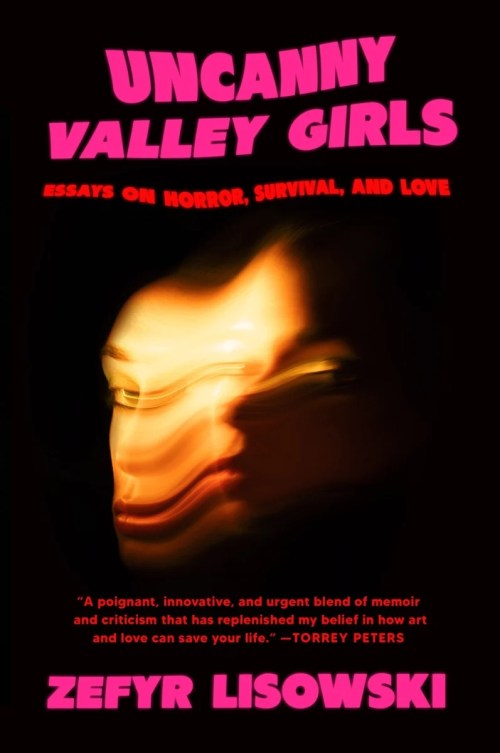
Walking along the beach, fingers tipped with dust, you pick up a rock, smooth and ovalene, perfect for skipping, but instead you toss it, plopping slowly in the bottom of the lake—for that is the way for those of us not born in the Americana of the bicoastal. In Zefyr Lisowski’s Uncanny Valley Girls, essays traipse behind the screen of horror films as the reader understands through weaving of scholarship, editorials, and notes of memoir both the voyeurism and separatism from the subjects on the screen and her personal life, using horror as both catharses, but one which inflicts flawed pain.
The skipping stone is an image of my own, an attempt to conceptualize the emotions distilled after reading the collection—however spooky, a signature style noted in a Bomb interview for Girl Work, part of me couldn’t encapsulate the entirety of the collection without reading more about her, only leaving me wishing I’d requested an interview. I speak the story of the stone because I ascribe the experience of reading Uncanny Valley Girls like wading into Lake Michigan, although Lisowski is from the South, a setting and identity featured in her upbringing and relationship to localized horror. Tangled in a mess of seaweed, you find a Band-Aid, a beach toy, and the silky bottom sand made of silted clay. Reading Uncanny Valley Girls is like wading into water without fishing, but pulling up line after line of transcribed narrative intermixed with the author’s lived experience, contextualized by popular culture, until you are left holding a beautiful tangle of words racing straight to the core of feeling.
Much can be gleaned from Lisowski’s essay collection, thoughtfully divided into three sections, rotating around major films The Ring, Texas Chainsaw Massacre, and The Wolf Girl, and honorable mentions to Scream and Pet Cemetery, among many others. Thematically, each essay begins with an anchoring declarative sentence rooted in the author’s memory, historical context, global and local, or a play-by-play of a scene—so rich that the reader, at least I, did not need to watch the film to follow the train of thought with tracks so carefully laid out.
“Our Oceans Ourselves,” the third essay in the first section, begins with a declaration of local lore of Nell Cropsey, a girl who drowned and was mythologized in Lisowski’s hometown. Utilizing The Ring and Dark Water as references, Lisowski directs us to how water can be both a sign of horror, while bringing into question how individuals are remembered for the violence they commit and those against them. Of all the filmic allusions mentioned, for someone who fears horror, The Ring is the only film I have seen, in the darkened basement prelude to some middle school sleepover. I remember being afraid of the possibility that a ghost could emerge from the television and how someone could be stuck in a well like the infamous story “Ordeal in a Well.” The structural choice of subsections within the narrative provides guideposts to the reader to navigate between deep analyses, moments when the author viewed the film, and adjacent memories, such as her experience swimming in a lake over a cemetery at a writer’s residency.
“Devotion” begins not with the plot of Saint Maud, but with the declaration of religion and a faith in her elder sister Chrissy, who passed before Lisowski was born. The grief shared between mother and daughter, and their diverging faiths, then delves into rekindling romance with a former flame through viewing horror films, ultimately leading to a tattoo and research into familial history.
Intertwined, Uncanny Valley Girls is a collection whose stories can be read again across orders. Many essays originated in standalone magazine publications—an appendix in the back takes great care of the reader, laying out sensitive topics. Ultimately each essay is woven deeply with Lisowski’s authorship, relationships to love, to her trans and queer identity, to horror films, to childhood, and grief—and while the essays may be read on their own, the depth of the collection stems from the twine running through each of them together, not on a chronological, but deeply ideological line of thinking.
NONFICTION

By Zefyr Lisowski
Harper Perennial
Published October 07, 2025


