


I love these poems. I could stop there, but I won’t. Not only because an explanation of why is precisely what brought you here, but because there is so much in these 95 pages that deserves to be highlighted, chewed, and stewed over. Memories you’d rather not have but are relieved to see shared by someone else. Thoughts you never voiced in case you were met with something more violent than indignation.
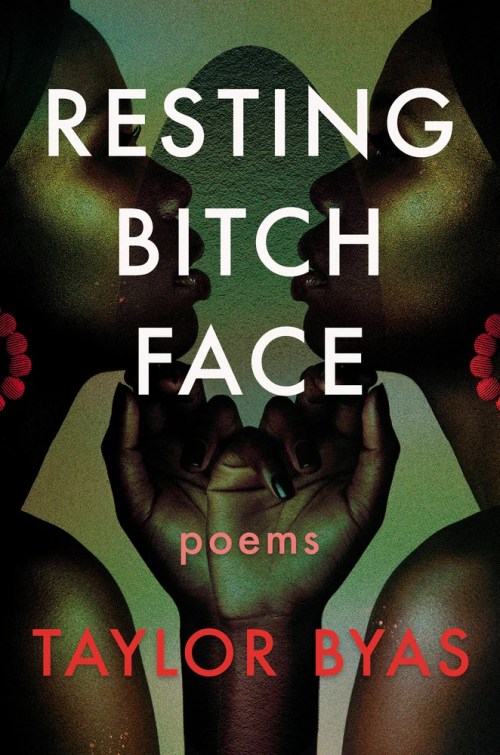
Taylor Byas’s Resting Bitch Face is a beautifully rendered collection of some of the profound observations, questions, and heartbreaks that attend existence in a Black feminine body. These poems will spark recognition in women of every origin, artists, and lovers of art. Whether chronicling childhood, the day-to-day of human relationships, the viewing and making of art, or the ways in which certain revered artists terrorized their subjects, every poem considers (mis)perception and clarity from a unique perch.
We are immediately baptized in the theme of imposing one’s own perception on another with the first poem, entitled “And So You Want a Poem,” in which the you is a masculine figure aggressively shooting their shot with the feminine embodiment of a poem. The masculine employs all the usual tactics in order to subdue the vulnerable poem into malleability. They buy the poem a strong drink, slap the poem’s ass, and make a wall around it with their body at the bar before inviting it home. The ending hits like a bolt of lightning. Like the entire collection, this poem is a story about a type of violence—the violence of trying to remake, use, or capture someone in ways they did not consent to. A forced metamorphosis that disregards every way an individual tries to make themselves known to you on their own terms. In these poems, men who aren’t artists aspire to that sanctioned use of their hands to turn others into what they, the viewer, would most prefer; meanwhile recognized artists leave behind evidence of the ways they have succeeded in molding real human bodies and minds for the sake of their art. In more than one poem, Byas writes about men who take pleasure in making others afraid, even those they profess to love.
Byas, too, exerts control masterfully over the structure of each poem, recasting the shapes of images and ideas as the words change positions. But unlike some of the subjects of her work, Byas’s linguistic manipulations are performed with the intent to illuminate, not intimidate. Some poems are prefaced with excerpts from other texts to provide context. Another is presented in four boxes—one large rectangle full of text that is interrupted here and there by three smaller rectangles filled with tangential, but separate text. In poems like “Eavesdropping” and “Duplex of Lessons,” Byas repurposes the last line of one stanza as the first line of the next, sometimes adding new punctuation to push an idea into new emotional territory.
The only way to test a man’s love—
deny him the flesh. See how long he waits.
Deny him the flesh. See how long he waits
to betray you or blame you for his weakness.
To betray you or blame you for his weakness—
what’s worse? Is this the reason I’m still alone?
The sentences transform to hold expanding propositions about relationships, such as how we are told to handle them versus what we learn by following that advice. In another poem entitled “Essay on Shuttering,” Byas touches on an admonishment little Black girls often receive: “In our own homes, we were inappropriate. When our father’s friends came over, Girl, go put some clothes on. In the command, a father’s knowledge that a man will always look”—a nod to the way Black girls are so often sexualized well before their time, still children in mind and manner but made to feel responsible for how the thoughts of adult men age them.

Byas also addresses ways the world can force maturity upon us in the poem “Tea in the Museum” about children who are having fun running around the Cincinnati Art Museum, creating backstories for the art on display as well as the people viewing it…until they come across The Rape of a Sabine Woman, a sculpture which leaves very little room for interpretation. As in the collection’s other poems, the truth seems to lie where the experience of emotion is too raw to be smoothed like putty into something that could be called agreeable if glimpsed from afar.
Resting Bitch Face is divided into sections that correspond to different aspects of the painting process: Canvas, Gesso, Dry Down, and Signature. Notably, there is no section for the act of painting itself, which speaks again to the changeability of the subject. You could paint a person, situation, or lifetime using any technique you choose, with an intent known in its entirety only to you, and still we the viewers would interpret it through the filter of personal experience, making the image itself almost beside the point. These poems are the paintings. We color them with our emotional baggage, making associations the writer might not have intended. But there is always some bridge connecting the viewer’s truth to the maker’s. Byas’s writing crystallizes the significance of discovering that empathy in our connections with others—particularly those between men and women—and foregrounding appreciation over interference.
POETRY
Resting Bitch Face
By Taylor Byas
Soft Skull
Published August 26, 2025


