


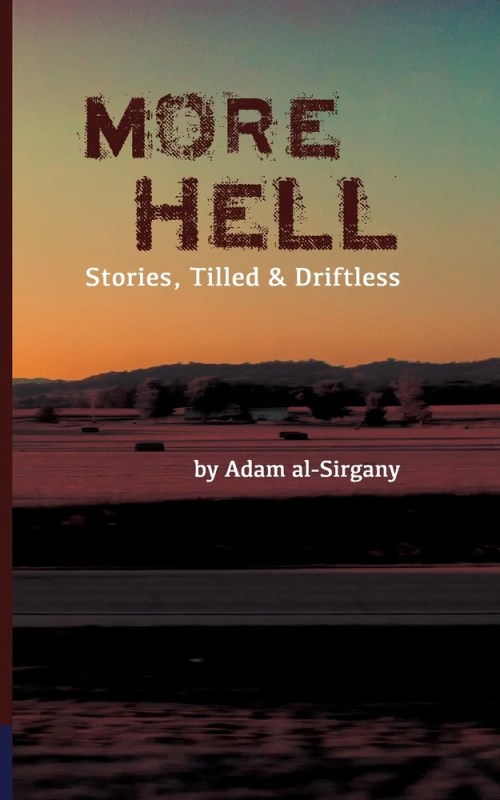
Often relegated to the acknowledgements section, editors may not get much critical attention, even though they are the ones shaping other writers’ work. That’s why I was eager to check out Adam al-Sirgany’s debut short story collection, More Hell as he is the Acquisitions and Developmental Editor for Santa Fe Writers Project, and Executive Director of the literary nonprofit 1-Week Critique.
Al-Sirgany’s sharp editorial eye is reflected in the fifteen stories that make up the collection. Varying in length, tone, and point of view, the stories are brimming with the kind of carefully crafted sentences only a great editor can offer. Some characters reappear in multiple stories so that the reader meets them from different vantage points, offering a more nuanced portrait of these characters. United by the central theme of loss and longing—the latter often for sex and intoxication—the stories explore life in the rural Midwest, places regularly dismissed as corn country. Al-Sirgany thoughtfully counters this stereotype, through his complex, insightful stories, full of clarity and humor.
Al-Sirgany recently moved to my hometown of Rockford, Illinois, and we met at the public library to discuss flyover country, the process of putting together this collection, and how his editorial work impacts his fiction.
This interview was edited for length and clarity.

Rachel León
While the stories in the collection deal with longing, loss, sex, and addiction, there’s also a political undercurrent. Two stories in particular come to mind: “Probable Hypothesis” and “Potluck,” but also the title comes from a (mis)quote by political activist Mary Elizabeth Lease to raise less corn and more hell. We’re in such a weird and terrible place, could we start by talking about the politics of the book?
Adam al-Sirgany
When I originally started the book, I had a very different vision of what I was doing—it was a novel. Shortly after I started though, I was watching the 2012 Democratic Convention, and I had this Jungian epiphany that we were totally fucked. At the time I was living outside of St. Louis, in a rural space, going to school in St. Louis, and living as a busker. The way leftist politics were going felt like a break from how I’d grown up. There was something terrifying about that moment—I realized the Left hadn’t figured out its own direction. I couldn’t tell you specifically what was said, just that the celebratory tone was like, ‘We’ve won! We’ve hit the end of history and now everything’s going to be fine.’ When I was living in DC I had studied genocides and ethnic cleansings, and I was like, ‘Oh no, there’s this real gap in communication between a large group of people, and that’s going to go terribly wrong.’
I had started to write these stories about Neil and Maria, which are based on people in my own hometown and community, and I took a turn from their romance to start thinking about this larger community of people breaking apart or losing the ability to communicate, in a way that’s different from standard rural isolation. That really concerned me, and increasingly became part of the book.
Steve Conn generously blurbed More Hell. He’s the author of this fantastic book called The Lies of the Land that I’m obsessed with. He focused on this net myth about rural communities: that they are pastoral spaces of freedom, untouched by the larger world. In reality, the economies of rural communities have been driven by the utility of large, open spaces, whether as agricultural operations or large-scale military installations. Rural spaces get used for these purposes because there’s emptiness between human beings, and that use shifts the landscape, and it shifts the politics. I think rural people have become isolated by a political dialogue about their anger or their hate without any real acknowledgment of their inability to alter these mega forces. It’s primarily urban people eating all of those pork chops, all of the corn byproducts, all the soy byproducts. A lot of resentment builds up.
There’s a sort of joke to my story “Probable Hypothesis,” about people delusionally worrying about statistical averages and who won an election—the power politics of that—and their inability to access what they missed about the voters. But a story like “Potluck” is way more focused on the people in this community and how they’re thinking and operating. Their small disagreements and their little dissents. I’m not delusional about some of the racist undertones—or overtones—those characters are sharing.
Rachel León
These stories are set in small, rural Midwestern towns. You’ve lived in many places—including Cairo, Egypt, where your father was born before emigrating to the U.S. Out of all the places you’ve lived, what is it about the rural Midwest that fascinates you?
Adam al-Sirgany
I grew up on a hog farm in Stockton [Illinois] until I was 18. Half of my life now I haven’t been in the rural Midwest. But I think the place that you grow up is the place of your fixation. Rural America is sort of the engine of things for me.
There’s something about the room that rural people have to think and do weird stuff and invent and create. I knew so many people growing up who were sort of tinkerers. In Brooklyn, there’s people doing woodworking projects, but it’s their “brand.” Fantasizing about being Joseph Cornell, a little more rat race-y stuff. Rural spaces can be a dream killer, if you’re chasing the conventional dream. Like, no one moves to Stockton, Illinois to make it big.
But I lived in New York and Philadelphia. I’ve spent a lot of time in LA. I lived in Tucson, and DC, I lived in Cairo. I didn’t find proportionally more people who were doing cool things in any of those urban places. I just found people who were trying to sell cool things in a different way, and who talked about cool things in a different way.
I’m fascinated by the fact there are these people in the country who have time, focus, and intent, who are continuing to do those things because they matter to them; it isn’t about success or dreams. There’s something about a rural space that feels pure: I’m doing it because I want to live in a way that feels meaningful, that’ll never pay out in the rewards of fame or fortune. That haunts me, given that my life has often been about trying to figure out how to get to that pureness while also paying the bills.
Rachel León
Back to the title. Some of the stories mentioned hell directly, but mostly hell is hinted at. What is it about the idea of hell that you’re drawn to?
Adam al-Sirgany
Hell is a weird equalizing space that doesn’t feel real to me. From a church perspective, an institutional perspective, it’s about telling you where you’re going if you don’t act in a pro-social way, per our dictates. But for individual people it becomes about the fear of that punishment.
Sartre’s No Exit was fascinating to me. The conclusion is “hell is other people.” It’s where that line comes from. In other contexts, there’s the fantasy that hell would serve something—but there could just be a heaven after death. Like, we could all be happy. If hell has to serve something, that seems like a weird, petty thing. I was fascinated by that idea that hell was largely in my head, based on how I was thinking about myself in relation to others. A lot of the book for me was about working out what that hell looks like in a space where you’re relatively isolated. Oftentimes, the stories are about two people looking at each other very closely, because they don’t have a lot of other people, and they become sort of codependently fixated on one another for lack of other options.
Hell also becomes a symbol of resistance. “Raise less corn, and more hell” captures that attitude. Mary Elizabeth Lease does this thing like, I’m going to be in your face telling you this industrial way of structuring our space and using us in that space is not going to work out for us, and I’m going to continually talk at you about how this is not working for us. I like the name Mary ‘Yellin’ Lease, and she apparently did too. There’s something about that: I am not going to let you not see me. I’m not going to let you turn me into a mechanism.
Some of the characters in the book are trying to see other people. They’re often failing at it and struggling at it. But there’s something about screaming ‘I won’t let you not see me’ that is imposing a hell on other people that isn’t just waiting for them to die and burn forever.
Rachel León
You mentioned the book originally started as a novel. I’d love to hear about how you tackled assembling and arranging the collection. Did you have to add any stories? Or take any away that you’d hoped to include?
Adam al-Sirgany
I probably wrote double, maybe three times, the [number of] stories. The title story doesn’t exist anymore. I spent a lot of time writing about Neil and Maria and building those characters out, starting with two people in a recognizable romance falling apart. I needed to then walk into those political things that are rooted in historical things, which is how I sort of ended up arranging the book backwards. I’m a little baffled by Ulysses, but I love the last chapter where Molly gets to speak finally, and you get her perspective. I wanted to mimic that. But I realized it was important to invert that and give Maria room to speak so we could walk back into all of the Irish dither about politics and odd interpersonal things and connections.
Rachel León

What I love most about these stories is the element of surprise on the sentence level. Often that’s through humor, other times it’s like playing with punctuation or syntax—subverting expectations. Could you talk about that?
Adam al-Sirgany
That makes me happy. I insisted to everyone that I wanted the book marketed as comic stories. There will be many folks who don’t find them funny, though I think a lot are weird and funny, even some of the sad ones. Some of that’s because Midwest humor is different than other versions of humor—what lands, how long you stay with the sad, and how you deal with it.
Gina Berriault is my favorite author. I think she’s the pinnacle of incredibly empathetic storytelling about all kinds of different folks. Peter Orner is also obsessed with her, and he’s someone I learned a lot from as well. Both of them have these fantastic, weird ways of approaching a sentence, and it’s very much about staying with the character in this really intimate way where thoughts drive the sentence. So much of my writing style comes from serious imitation of Berriault, by practicing her style. There’s an interview where she talks about doing an exercise, mimicking Chekhov or Hemingway, but said you’ve got to quit doing that and work on your own style after a while.
I don’t have a better explanation of how those stories were written other than it was a lot of trying to clear space to be in a character’s mind, and a lot of practicing working on someone’s syntax, trying to find what emotionally hits, whether that’s funny or sad or potent.
Rachel León
These stories are incredibly sharp and realized and polished. I assume your work as an editor influences your writing?
Adam al-Sirgany
Yeah, I end up working with 8 to 10 books a year. But about 2000 manuscripts a year cross my desk, and I can’t read them all. There’s something difficult about making fast choices because you can’t read 2000 books. It’s too much.
I teach for the UCLA Extension program, and I show students how I would edit a book once I’ve taken it on. I don’t use track changes. I use comment bubbles. I assume the author knows why they’ve done something, although we all make unconscious decisions. I’ll go through a 300-page novel, and it usually has 1500 to 2500 comment bubbles when I’m done editing. That process is really slow and methodical, and by the time you’ve done that a bunch of times, you manage to miss everything cognizant about grammar.
There’s something powerful about being with someone right down to the line and trying to figure out, What did you mean here? It’s also taught me different ways of reading. I do this all the time with writers I’m editing: Why didn’t that hit? Why didn’t that feel right? Why did I stop here? I spend a lot of time talking with my writers about what does this word mean to them? Why is it here? I don’t understand how language works, but there’s something potent about sitting down with someone and finding out that they too are baffled by why they chose X word. Trying to feel into what that character actually feels as opposed to the easy word—that’s what I’m always trying to get to.
FICTION
More Hell: Stories, Tilled and Driftless
By Adam al-Sirgany
Published by Whiskey Tit
August 19, 2025


