


Always witty, sometimes surreal, frequently diving beneath mundane surfaces to mysterious and mesmerizing depths, An Oral History of Atlantis, the first collection of Ed Park’s short stories, showcases a master of the form. There’s a delightful variety to the stories here, and while Park’s narrators have a consistently engaging kind of urbane intelligence, the real connecting thread here is the selections’ sharpness, the startling and playful piquancy of his work. My first and lasting impression of the collection is of its humor—its wordplay, its absurd juxtapositions, its slyly insightful revelations. But, as I’ve gone over these stories in my mind, returned to them on the page, it’s that impression of depths that confronts me: a kind of seriousness, of dread, sometimes almost of horror, something that doesn’t run counter to the comic or conversational tone but spreads far beyond it.
Park’s use of the form amplifies these qualities: although the collection as a whole has a coherent voice, and although there are a handful of teasingly recurring names, ideas, and motifs throughout, the stories themselves vary considerably in structure and style. In the aggregate it keeps the collection feeling fresh and surprising, and the individual instances demonstrate how the short story can play with and benefit from non-novelistic style. Every paragraph in “The Wife on Ambien” begins with that eponymous phrase, for example, while “Slide to Unlock” reveals its character’s biography—and, eventually, their terrifying predicament—solely by listing their passwords over time. And, in one of my favorite formal bits of play in the collection, “Weird Menace” presents us with two columns of text, complete with gaps for silences, as the aging star and director of a schlocky film provide commentary for a special edition.
There’s something Barthelme-like in how Park heightens the effects of his narratives—whether comedic, emotional, or ominous—with unexpected stylings, and his use of absurd situations to emphasize intensely human moments occasionally reminded me a bit of T.C. Boyle’s work. “Two Laptops,” for instance, gives us a brief snapshot of a divorcee’s grief and desire as technological glitches seem to spread to his mind (and face), while poignant and slightly pugnacious themes of loneliness emerge from the surreal and superb “Well-Moistened with Cheap Wine, the Sailor and the Wayfarer Sing of Their Absent Sweethearts,” in which eighteen women, maybe nineteen, all named Tina, investigate a charged and ambiguous archeological site.
Despite its range of characters and scenarios, the collection does have a definite voice and tone: conversational and erudite, many of its funniest entries are epistolary, as in the uproarious opener, “A Note to My Translator,” wherein an author upbraids his translator for unsubtly re-writing his book. The only-seemingly avuncular “An Accurate Account,” another letter, is saturated with details and wordplay from a playwright’s early stint working as a transcriber, and seems to be raising a rueful glass to the conflicting virtues of accuracy and concision.
Throughout An Oral History of Atlantis, Park evinces the love of codes, connections, and overflowing ambiguities that make his novel Same Bed Different Dreams such a powerhouse. “Watch Your Step,” an espionage scene that teeters between comedy and deathly seriousness, deploys the “diner’s code” in which secret messages are conveyed with bizarre menus; its protagonist might also appear elsewhere in the collection, including the micro-meta-textual “Seven Women” which manages in a dozen pages the kind of densely imbricated character studies that many braided novels struggle to encapsulate in hundreds. The tipsy narrator in “Weird Menace” keeps confusing the “meteor” in a sci-fi B-movie for a “metaphor”; the pandemic ravaging New York in the title story, as ominous and portent-dispensing as any bad star, is officially “MtPR” but “Metaphor” in the streets.
An Oral History of Atlantis is outrageously funny; it also left me thinking about how much of comedy is not just timing, but speed; but duration. What’s tragic, lived over years, can be hilarious, told in a moment; what’s overwhelming and even terrifying at scale is something else, shrunk to just a few pages. The essence of much that’s funny is surprise, but so too for horror: Park’s stories, by using style and substance to startle, can lean far to one affective angle and smoothly flex to another in the next line. And some of the funniest stories here are also the richest. “The Gift,” for instance, with its humorous remembrance of a short-lived academic course on aphorism, also waxes elegiac for lost connections, lost speakers: “True aphorism disdains not only its writer, but history itself.” These stories have a wild apocalyptic undercurrent that belies the tidiness, the neatness of the prose. Park puns to disarm, offers platters of ingenious commentary and clever puzzles to hold one’s attention, delights in politely disclosed innuendo—and yet behind many of these stories is the sense of something dreadful, ineluctable, something enthralling and ruinous.
Nowhere is this more evident than in the collection’s last and titular story. “An Oral History of Atlantis” is a dreamlike, darkly millenarian masterpiece of a plague-ridden New York, glimpsed in snowy streets and shadows as our protagonist, stalking an elusive writer, discovers a strange pelagic peep show before the city succumbs. Park’s gift for wordplay is still very much on display, here with a darker veneer: a Prufrockian “crab of newsprint scuttle[s] past”; a typewriter’s frantic activity is “larded with silences”; entranced with the crank-operated cetacean vision he finds behind a brothel’s façade, the protagonist “spun and blubbered.” Haunting and human, erupting with a kind of atmospheric expansion like something out of Conrad—it’s an astonishing close to an astonishing collection.
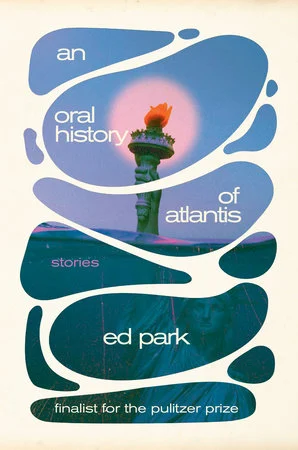
FICTION

by Ed Park
Random House
Published on July 29, 2025


