In Ivonne Lamazares’s new novel, The Tilting House, two estranged sisters reunite in 1990s Cuba and learn to navigate the scarred landscape of their family and country.
In Paladero, a suburb of Havana, teenage orphan Yuri lives with her strict and religious aunt, when a thirty-something artist, Mariela, suddenly arrives from the United States, claiming to be her long-lost older sister. Mariela, exiled to America as a young child, has returned to Cuba to reclaim her roots and make a mark with her art. The sisters begin a tenuous relationship that will span two countries and three decades, putting to the test their sense of self, loyalty, and the meaning of home and family. The Tilting House is a compelling exploration of the impact of immigration, estrangement, and political upheaval on identity and belonging.
I had the pleasure of discussing this thought-provoking book with the author over Zoom.
This conversation has been edited for length and clarity.

Jenny Bartoy
How did the idea for this book come to you? Were there specific sources of inspiration for this story?
Ivonne Lamazares
The idea came to me more than ten years ago when I read a blog about a Cuban American writer who had decided to move back to Cuba, back to Havana, permanently. And this is not the usual story in the Cuban American community, or in the US immigrant community for that matter. My imagination took over at that point, and I was burning with all kinds of questions. Why would a person seek to return to Cuba, a country that is troubled and has a great deal of economic scarcity and political oppression and, for a writer, outright censorship?
So I was mulling that over imaginatively, then the character of Mariela came to me—this Cuban American immigrant who was sent away as a four-year-old, unaccompanied, to the United States, who has lived in orphanages and briefly in a foster home in Nebraska, and who, in the now of the story, wants to return to Cuba, to recover her origins and her roots and to reinsert herself in the homeland and in the family history—and in the history in general—that she feels she was robbed of.
Jenny Bartoy
How did you choose your narrator, Yuri?
Ivonne Lamazares
That took a while, because I was running away from teenage narrators! My first novel, The Sugar Island, was written from the perspective of a teenager, and I felt like, come on, I’m old enough to not write from a teenager’s point of view. But I kept trying to write it from the perspective of a middle-aged woman, and that just yielded nothing. The writing was very static. So finally I came to terms with having a teenage narrator again. That’s Yuri, the sister who lives in Cuba and whose mother has died, and she lives with her aunt Ruth, out of necessity, not choice. It seemed to me that I needed to go back to that teenager in myself, because I migrated as a teenager, and that is a point of great vulnerability and loss and confusion—and also possibility.
Jenny Bartoy
This novel is set thirty years ago. Can you tell me a little bit about that time period in Cuba, and why you chose it for this story?
Ivonne Lamazares
It’s termed the Special Period in Cuban history, which came right after the collapse of the Soviet Union, when Cuba found itself cut off from the Soviet Union subsidies and those sources of economic help, and there was a tremendous economic crisis on the island, to the point where there was even malnutrition. The average Cuban lost about twenty pounds during this period. And this crisis also brought to the island these tremendous changes.
I grew up in Cuba during the period of Soviet-style Cuba, and it was a very closed society. You didn’t see much from abroad or visitors from abroad, except from the Soviet Bloc countries. In the Special Period in the 1990s, Cuba had to find a way to get a currency that they could trade with. And so the Cuban government opened up to international tourism and to some small capitalistic reforms. It allowed visits from the Cuban diaspora all over the world, and from Cuban Americans in particular, which had been very restricted.
So I chose this period because of its great instability and change. I’m obsessed with it because it was also a period of hope. People had hoped that it would be a sort of perestroika on the island, that there would be openings and reforms and perhaps a multi-party system, and a move toward democracy, which of course didn’t happen. It was a period of upheaval in the country. In the book, the disruption and dislocation, and the instability of the family unit, mirror the instability of the country at large.
Jenny Bartoy
Have you yourself traveled back to Cuba?
Ivonne Lamazares
Yes, it was probably the most important part of my research in writing the novel. At some point, I was completely stuck in the writing. I didn’t know if I was actually doing justice to the people there, to what I was trying to represent, because I had been away for so long, about thirty-six years. And that was a difficult decision, to visit a place that is so emotionally fraught for me and also lacking some of the basic liberties and rights. But my visit back was so significant, both for the writing of the book and for myself personally.
I thought seeing the landscapes and places and being there again would create this spark in me for how to continue the book, but it turned out it was the people and my encounters with some friends from childhood and the warmth and the generosity that Cubans have with one another, that familiar way of communicating. At the time, I was like Yuri, trying to deal with my own losses and trauma in my childhood and adolescence, and I had never been able to fully grieve my mother, who died when I was three. Like Yuri, I had a lot of trouble expressing my grief about my mother’s death—I was so young, so little. And like Mariela, I didn’t have concrete and visual memories of her. My grandmother who raised me was in terrible grief about her daughter’s death, and her grief was all encompassing, so I never really found a way as a child to have ownership of what I was feeling. In this visit, I was able to finally go to my mother’s grave as an adult and own that grief. I understood then what Yuri’s journey had to be toward the end of the book.
Jenny Bartoy
I was intrigued by the fact that, despite the story’s fraught sociopolitical context, there are no clear right and wrong sides. As a reader, I instinctively navigated toward finding these moral bearings. I wanted to know who’s the good guy and who’s the bad guy! When I wasn’t getting that answer, I realized, oh I think that’s the point. How intentional was this on your part?
Ivonne Lamazares
Yes, I’m so thrilled that you couldn’t really come up with a bad guy or a good guy. The history of Cuba and of the Cuban Revolution and the aftermath is really complicated. People try to oversimplify—in the official rhetoric of the Cuban government, the Yankee imperialists are to blame, or in the exile community in the US, you just want to say the communists are to blame. That happens a lot. There’s a whole bunch of reasons why the Cuban Revolution came to be. And in the book, I was interested in showing the ironies, in terms of a revolution that billed itself as an anti-colonialist, egalitarian, socialist movement, and how there’s still such a tremendous emphasis in the society on social class difference. It’s ironic that Mariela is able to do what she can do in Cuba merely because she possesses dollars. Also, I wanted to uncover some of the homophobia that exists. So a lot of these ironies I did want to point out, but it’s very complicated.
[In my research,] I read Dr. Ada Ferrer’s book, Cuba: An American History—she won the Pulitzer for it—and it shows how Cuba has gone through so many versions of colonialism from the Spaniards to the interventions by the United States and that brought about a sort of nationalistic revolution. Unfortunately, that revolution did not live up to its purported democratic ideals, and as shown in the novel, became a sort of police state that routinely censors artists and imprisons citizens for their political views.Jenny Bartoy
Ultimately, we all want to be free. Losing agency can easily corrupt even the best person. And that brings me to your characters. Yuri is independent of thought and has no loyalty, except to herself and, maybe to a certain extent, her mother’s memory. But the part that I found most compelling is that she holds grudges and she lies, without any qualms about it—she feels justified. That’s not a common character archetype. Tell me a little bit about creating this character.
Ivonne Lamazares
Yuri was more difficult for me to build as a character than Mariela. Because Mariela’s much more dramatic and action-oriented, she was a lot easier to write about, and, in a sense, a little more separated from me than Yuri. Yuri is the observant one, the one who wants to be a writer, a journalist, an observer of reality. She wasn’t as easy to write about. For a long time, Yuri, as a character, was reluctant and reticent about expressing feelings, about saying what she wanted. She was more passive in the writing than I needed her to be. I finally realized that her journey comes from being stuck and unable to move from the grief that she has over her mother’s death. There’s a desire in her to remain loyal to her mother and to hold on to that identity of “I am my mother’s daughter,” which is something that she perceives Mariela to come and take from her.
I’m endlessly curious about how people reconstruct and anchor their lives after a devastating and radical change. How do we live our lives? How do we deal with losses and the passage of time? And in the case of so many immigrants, how do we integrate a past that involves trauma and losses and oppression, and sometimes even violence and threats to our lives? In the two sisters, I see different ways of trying to do that. Mariela comes back to the island, in a sense, to rewrite history. She wants to have an immediate relationship with Yuri, and she intends for the two of them to stay together from that point forward. She just wants to recover whatever she can from the wreckage—but also, she wants to replace it altogether. Yuri in some ways thinks she can escape the collapse all around her and Mariela’s intrusion into her life by migrating, but ultimately she realizes that she needs to deal with her losses. As long as she doesn’t do that, she is stuck in that collapsed house of the past. Both approaches—Mariela rewriting the past and Yuri running away from it—are incomplete. And through the sisters’ very fraught relationship over the span of twenty years, Yuri is finally able to make some discoveries.

Jenny Bartoy
One line jumped out at me midway through the novel. Yuri says: “It struck me for the first time that Mariela had, like me, refused to be adopted.” Why did you draw this parallel between the sisters, and what does that refusal mean?
Ivonne Lamazares
One of the big questions in the book is, what is identity? I saw this as something that orphans, people who lose a parent early in their lives, and immigrants have in common. This kind of experience where the foundations of a life can completely shift instantly—what do you do with that? How do you integrate that? What part of our past do we hang on to, and what part do we at some point have to let go of, or let it transform itself into something else, if we’re going to migrate and go with the changes of life? That’s something that Yuri has a lot of trouble with, and Mariela does as well. Mariela feels robbed of her history and childhood, and Yuri feels like both Ruth and Mariela want to absorb her. I wanted to explore the idea that identity is constructed and unstable, and that it is shifting all the time. The houses in the book to me represent the self in the different iterations of their identities.
Jenny Bartoy
Your title, The Tilting House, definitely evokes that sense of collapse, when things as we understood them change and will never be the same—a great metaphor for a coming-of-age story too. Finding home often means finding a way to the self. This novel explores the theme of estrangement from land, family, and self, as well as the struggles of re-acquaintance—or integration as you’ve put it—in the search for identity. Why are these themes important to you?
Ivonne Lamazares
When I was a teenager and migrated, I experienced an entire dismantling of my family and the whole family narrative. I thought it was just my own crazy personal history, but that’s something I think a lot of immigrants experience.
After my mother’s death, my biological father migrated alone from Cuba when I was six. I stayed with my grandparents: my mother’s parents would raise me during the week, and on the weekends, I would go to my father’s parents in a suburb very similar to Paladero in the book. I was supposed to migrate with my father’s parents, because we were a unit seeking reunification with my biological father, and that was the rationale going forward for all the paperwork. It took eight years for us to finally get a visa to leave Cuba.
So the family story had always been: we are taking Ivonne to the US so that she can reunite with her surviving parent, but this did not happen. When we arrived in Miami, my biological father abandoned me and his parents. We had to seek refuge with my mother’s side of the family. And then when my father resurfaced, he was abusive. I felt like the house, the roof—in other words, my family narrative and my identity—had collapsed. Everything just disintegrated. And so as in Yuri’s case, I had to process that betrayal, and it took me many years to put it all back together, to integrate what happened with who I was now. And it was the same in terms of migration, who I was as a Cuban person and who I was now as an American with Cuban roots. There was before and after, and a lot of work to bridge the two.
Jenny Bartoy
What did the path look like to get past that rupture of the family and to repair that upheaval from migrating?
Ivonne Lamazares
The absolute rupture of the relationship with my biological father has lasted till today. How does one deal with that? It’s very difficult. I think I had a lot of support. I needed a lot of willingness to revisit and then to re-narrate those experiences. And I think I did it through the book. At the same time, I was working with a therapist. What Yuri calls “impacted grief,” that hasn’t been expressed or dealt with from an adult perspective, I think that was what I ultimately needed to process as well. My husband said to me recently, “Now you don’t live in this tilting house of grief. Now you live in a house where one room contains that grief, but it’s not a whole house.” He’s a poet, he would say such a thing! And for the longest time in the novel, Yuri is stuck too, and her journey is, little by little, to find a way to integrate loss and live in the present with it.
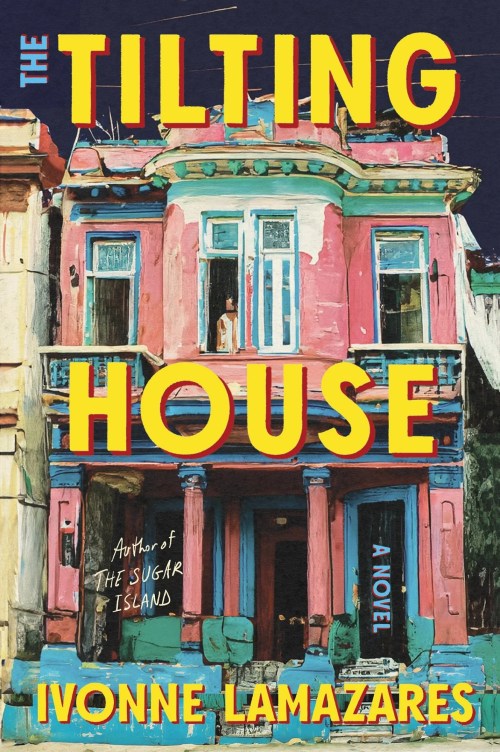
FICTION
The Tilting House
By Ivonne Lamazares
Counterpoint
Published July 22, 2025