


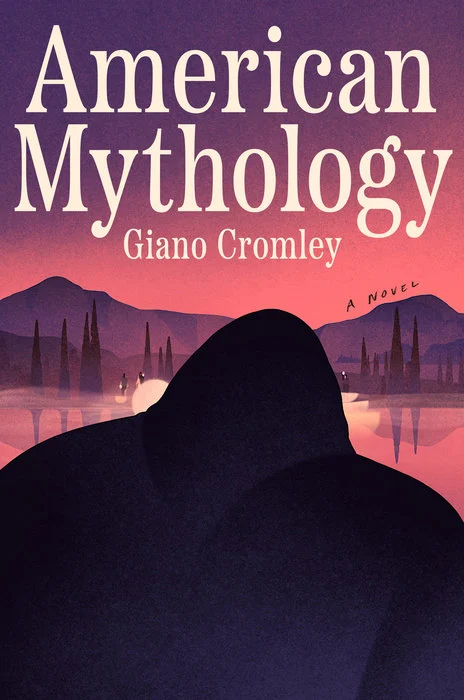
Every culture has its monster. For Americans, it’s Bigfoot. In a single metaphor, the ape-like behemoth summons Western colonial guilt, Manifest Destiny, and the civilized fear of the untamed, natural world. Likewise, the elusive Bigfoot has inspired the field of cryptozoology, serves as the subject of mass-produced truck-stop paraphernalia, and inspires bad reality television. Giano Cromley’s latest novel, American Mythology, takes one step further. The book not only centers the cultural icon; it unleashes him.
Navigating Cromley’s whispering woods and thin spaces is both terrifying and spellbinding. Lurking in the dark, flickering at the edges of our vision—Cromley’s Bigfoot manifests as a clarion call in the search for ourselves. Standing in at times for faith, climate change, and illness, Bigfoot is at once our father, our ancestor, our past, and our future. In their futile hunt for the unknown, his characters find not what they want but what they need. And his readers are not far behind.
This interview was edited for clarity and length.

Rachel Robbins
Have you always been interested in Bigfoot? How did you first find your way into this horrifying story?
Giano Cromley
For a lot of people my age, the television show In Search Of, starring Leonard Nimoy, was a gateway drug into the world of high strangeness. I knew I wanted to write a book about Bigfoot ever since I watched the episode exploring that mystery. Over the years, I made several attempts at writing what I affectionately referred to as my Great American Bigfoot Novel, but I never got far because I couldn’t settle on the right approach. Eventually, I stumbled upon my two protagonists, Jute and Vergil, and it felt like I’d cracked the code. Their friendship was key to the story I wanted to tell, and their never-ending quest to find Bigfoot was the perfect way to explore their relationship.
Rachel Robbins
At its center, the novel explores issues ranging from cancer to parenthood to faith. Did you set out to write a serious and probing novel masquerading as a monster book, or were you surprised when deeper themes emerged?
Giano Cromley
My initial charge when I set out on the first draft was to write a book about Bigfoot and friendship, and, honestly, there was a lot less Bigfoot in the earlier drafts. As the story evolved, however, Bigfoot found its way into the narrative more and more because I realized it works as a proxy for so many of the needs and desires of the characters themselves. They’re all looking for something elusive that will make their lives whole. Searching for Bigfoot—for each of them—is actually a quest to find that piece of themselves they’re missing.
Rachel Robbins
You write: “Because the fact is, no matter where you are, the most dangerous, most scary thing you can encounter is another human being” (179). With so much fear in the nosedive of our present reality, why do we still love being afraid of imaginary things?
Giano Cromley
Consuming frightening media helps us feel more capable of confronting the scary things we face in our daily lives. No, we won’t have to stare down an eight-foot primate in the dark woods, but maybe by experiencing that discomfort in a book, we can feel more confident the next time we have to sit through another awkward Thanksgiving meal with difficult relatives. In an age of omnipresent anxiety, reading something scary or watching a scary movie is like a dress rehearsal that helps us be a little less frightened by all the truly terrifying things we face daily.
Rachel Robbins
In the introduction to his essay collection, Monster Theory, Jeffrey Jerome Cohen posits that, among other incarnations, monsters represent culture, difference, the unknown, and ourselves. If, for example, Godzilla is a stand-in for the atomic bomb, and vampires signify repressed desire, what do you think Bigfoot represents? What makes Bigfoot uniquely American?
Giano Cromley
A lot of our earliest myths revolve around monsters because they’re the clearest reflection of our anxieties and preoccupations. But the best myths, if they’re going to endure, need to evolve as our conceptions of ourselves and the world around us change. In its earliest incarnations, Bigfoot represented an inner and outer wildness that needed to be tamed – this strange, vast land that was rapidly being settled, and also this wildness in ourselves that needed to be brought to heel. During the 1970s and 1980s, as the environmental movement picked up steam, Bigfoot came to represent the loss of nature and wild spaces. It was an avatar for the destruction of something primal in ourselves. Now, in the twenty-first century, I think Bigfoot’s meaning is shifting once again. It’s come to be viewed as a reaction against the digital age. In a world of hyper-surveillance, of having every scrap of our lives coded and cataloged, Bigfoot represents the idea of being off the grid—the ultimate freedom from digital hegemony.
Rachel Robbins
You write: “There’s more evidence for the existence of Bigfoot than God” (215). Why did you choose to utilize Bigfoot as a sort of conduit for discourse around faith?
Giano Cromley
To me, Bigfoot is the perfect Rorschach test for faith. What you choose to believe about it tells me way more about you than it does about whether there’s actually a bipedal ape roaming the forests of North America. Bigfoot is a concept that tests a person’s comfort with uncertainty. Recognizing there are things out there we don’t know or haven’t figured out is terrifying because it means we might not have as much control over our own lives as we’d like to believe. Most people are so unsettled by this thought that they’d rather dismiss these possibilities out of hand. While that certainly makes it easier to sleep at night, it sure as hell makes the world a more boring place to live.
Rachel Robbins
Not solely in its dreamy and dreadful content, but also in its mesmeric and haunted prose, this novel teeters between beauty and terror. Do you find horror beautiful?
Giano Cromley
I do find horror beautiful. When it’s done right, it distills some really essential human emotions in ways that make them accessible to a wide audience. Strangely enough, though, I didn’t consciously set out to write a horror novel with this book. And I was surprised when my agent and editors started noting the horror in it. Genre is interesting that way. It’s a lot harder for me to pull it off when I try to write it intentionally. It’s much easier when it happens through happy accident. I’m thrilled that people consider this book part of the horror genre.
Rachel Robbins
Throughout the novel, you weave in the journals of past travelers with eerie encounters. What is the role of these narratives embedded within the story? What did you hope to do by linking the main characters to the history that preceded them?
Giano Cromley
The journal entries sprinkled throughout the book serve as a mythmaking device. They establish that strange and mystical things are afoot in the Elkhorn Mountains where Jute and Vergil’s Bigfoot expedition is taking place. The journal entries also help the reader better understand the land these characters are entering—the dangers and the consequences for those who trespass. Lastly, by showing these events as firsthand accounts and then planting echoes of those events within the narrative of the story, I hoped to demonstrate how stories evolve into legends and how legends can eventually become myths.
Rachel Robbins
You seem to be toeing the line between a fear of nature and a healthy respect for it. Why?
Giano Cromley
A healthy combination of fear and respect is the only way one should ever approach nature. It’s easy to forget, in the age of GPS and cell signals, just how vast and unexplored our wild spaces are. Despite humanity’s best efforts, we still have places where one wrong turn, one misstep, and all our well-groomed plans can turn into a disaster. I’m in awe of nature and how it still can remain untamed.

Rachel Robbins
There are subtle nods to concerns about climate and extinction throughout the novel. In what ways is this book a call to arms to protect the natural world?
Giano Cromley
It would be hard to write about nature and not bring up themes of conservation. I grew up watching Mutual of Omaha’s Wild Kingdom every Saturday morning after cartoons. Each episode of that show ended with a warning: If we don’t do something to protect these creatures, they won’t be around for future generations to enjoy. I guess you could say those ideas got hardwired into my brain.
Rachel Robbins
The novel reads like a love letter to the whole mythos of horror, but also as a celebration of subcultures and oral traditions. What books or other art forms most inspired your writing?
Giano Cromley
Bigfoot’s origins are rooted in indigenous storytelling. To this day, the Bigfoot phenomenon largely survives as stories people tell one another. In researching this novel, I consumed an incredible number of books that simply recount other people’s narratives. In addition, I read a lot of comparative religion books that talk about sacred spaces—how they come to be considered sacred, the ways they should be treated and respected, and what they represent. I also listened to a zillion Great Courses lectures on world mythology to make sure the mythmaking in this novel corresponds to larger mythical traditions.
Rachel Robbins
In closing, I want to ask about the personalization of the mesmeric state that several of the characters experience towards personal fulfillment—Rye hears her mother calling from the trees, and Jute finds his father after a trance pulls him across the lake. Why do you think the most terrifying monster of all is inside our own heads and our own ancestries?
Giano Cromley
Some of the scariest things we can encounter are the demons in our own heads. Most of the time, we do a good job keeping them at bay, locked up and out of sight. But every so often, we enter a liminal state where they suddenly get free rein. It’s utterly terrifying, but that’s also when we learn the most about ourselves. And if we can pull through, we are better, more whole people for the experience.
NONFICTION
By Giano Cromley
Doubleday
Published July 15, 2025


