


It’s true, though, isn’t it?
Over the last five years, this quip became a refrain, uttered in response to my elevator pitch of this project, a study of a trope I identify as proliferating in American popular media over the past forty years: that straight white men can’t dance.
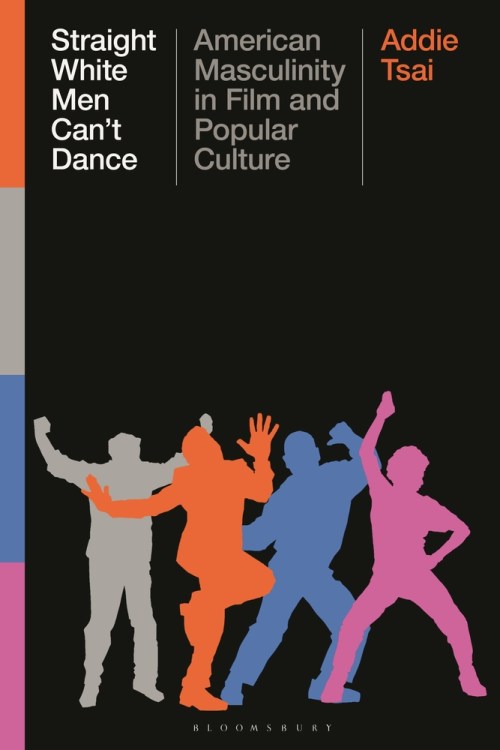
This book’s title, Straight White Men Can’t Dance: American Masculinity in Film and Popular Culture, points to a particularly American notion that cishet white men are unable to dance well. What does can’t dance mean? This long-running gag stands on many legs. That cishet white men have no sense of rhythm. That cishet white men dance to the lyrics instead of the beat. That, when cishet white men dance, they are too enthusiastic, and as a result, their movements are too big, too exaggerated, uncontrolled. That cishet white men have no sense of their body in space moving among other moving bodies. That cishet white men dance one move across different musical styles, rather than respond to the structure of the song being played.
Certainly (hopefully) we can agree there is nothing intrinsically universal in an able-bodied cishet white man’s embodied cognition that would prove straight white men are unable to dance. On the concert dance stage, the street, and the televisual/cinematic screen many cishet white men have proven themselves able to dance. Fred Astaire, Gene Kelly, John Travolta, Channing Tatum, and Patrick Swayze are just a few cishet white male dancers who made a name for themselves in Hollywood as adept movers.
Because a partner dance between white men and women affirms a man’s supposed heterosexuality, this book focuses dominantly on white men who dance alone. With that in mind, I find it important to travel backward to the rise of the early 1960s dance fad the Twist, the occasion largely agreed upon by dance scholars as the beginning of freestyle dancing. Another reason the Twist is relevant is that, as Tim Wall argues, “the dance moves of black youth were to become the most significant influence on white teenage dance.”
Popularized on Dick Clark’s nationally syndicated dance television show, American Bandstand, the Twist initially began as a “noncontact couples dance . . . to Chubby Checker’s recording of the same name.” American Bandstand, which influenced other similar music and dance-based television programs such as Soul Train and Top of the Pops, was a crucial televisual text for delivering American dance trends to a wide public, especially regarding the biracial transfer of black dance forms to a young white audience, both on the set of the show as well as in living rooms across America: “The teen dance show became a key means for artists and dances from African American culture to cross over to white dance culture.” The influence of American Bandstand, which aired on network television from 1952 until 1989, also crossed over into the early evolution of the White Man Dance trope, discussed further in later chapters. It is revealing the show was cancelled just as this trope gained momentum in American culture.
American Bandstand established what Wall refers to as “a powerful means of transmitting dance moves” from Black dancers to a larger white audience, in which white viewers began to copy the moves they witnessed. Of course, historically speaking, this cross-racial theft did not begin in the 1980s, but the ease the technological advances of the television provided accelerated this process. American Bandstand, as well as dancing as a learned, social practice, started its decline just as this trope began to rise in popularity in American popular culture, centering a style of dance based on a certain kind of athletic play rather than on replicating a traditional value of what dance should look like.
The Twist, which American Bandstand helped popularize, is widely agreed upon as a social dance form that helped eradicate couple dancing in American social dance, breaking from the etiquette-based social dance forms preceding it. The Twist sets up a more contemporary stage and cross-racial dynamic. By splitting the couple in American social dance, it offered an opportunity for the white male to dance on his own, requiring an element other than a female partner to affirm his masculinity. The Twist freed both partners from leading and following, enabling each dancer to become their own spontaneous innovator. It also broadened access, reducing barriers to dance in terms of class and proximity to the social and educational settings in which one could formally learn the steps to partner dances. The male dancer could now lose himself in the play of the dance because he no longer had to occupy his attention with the intricacy of learned dance steps within the structure of the embrace. As a result, physical comedy and other artistic responses could now be integrated into individual dancing. Tangentially, this split also freed the female from requiring a lead to dance in social and informal dance settings. The Twist is one of the most prominent examples of a major black dance fad that young white movers began to borrow or copy, creating a blueprint for cross-racial dance transfer in a communal setting.
This historical moment of the Twist acts as a foundation for the White Man Dance. The Twist gave rise to white men dancing alone, specifically later in the disco-era of the 1970s and then in the White Man Dance-defining era of the 1980s. Further, the dance epitomizes a cross-racial appropriation of black dance forms by white bodies via American popular culture. This becomes an offshoot of a significant aspect of the White Man Dance trope in which white men appropriate black dance in their movement as a sincere replication or a parody of themselves trying to replicate the form. The Twist’s simplicity of movement offered Americans a dance in which the dancer did not need an established dance background or expertise in physical coordination to properly execute it. It contributed to an eventual rise in spontaneous, happenstance, and freestyle dance movement within American popular culture. The Twist (and similar dance forms) enabled a more athletic style of dancing having more to do with creativity than with technique because the dances and dancers were freed from the reliance upon choreographed partnering. This solo style of dancing brought about a completely new way of embodying dance movement, and therefore, dancing began to shift into a kind of creative athleticism.
My study considers the mainstream attitudes of cishet white men dancing offered in organized moving images as a vaudevillian buffoonery throughout American popular culture, emerging in the mid-1980s. American Bandstand’s decline in the early 1980s leading to its cancellation at the end of the decade illustrates the inevitable waning interest in dancing. American masculinities were shifting as a result of changing heroic models and in response to the Vietnam War and Watergate, as well as women entering the workforce and challenging gender roles. A new image of masculinity came to the forefront, what Michael Kimmel refers to as the great American wimp: a man who detests sports, is “the sensitive New Age guy,” and no longer hones his physique. Although this new man was welcomed by women and the culture at large, many critiqued this new model, giving birth to a new kind of effeminophobia, closely linked to homophobia. This wasn’t particularly surprising given the homophobic panic surrounding the AIDS epidemic as it was largely through the AIDS epidemic homosexuality was first thrust into the spotlight. Dance became one of the markers used to scrutinize (white) men’s position within homosexuality and masculinity. The worse a man danced, the further he could distance himself from the confusion and fears surrounding AIDS and homosexuality. One could then misperform good dancing as a way to more securely sit within hegemonic masculinity, R.W. Connell’s foundational concept she defines as “the configuration of gender practice which embodies the currently accepted answer to the problem of the legitimacy of patriarchy, which guarantees (or is taken to guarantee) the dominant position of men,” constructed in relation to women and subordinated masculinities such as blackness or homosexuality.
The stock buffoonery trope on which this entire book hinges is no laughing matter. Although structurally speaking this trope emerged from the confluence of factors arising in the mid-1980s, its long, complicated racialized history extends all the way back to blackface minstrelsy. These buffoonish vernacular movement sequences stand in for “dancing white.” What does that mean? As Martin Lund reminds us, “‘whiteness’ only becomes meaningful in a social setting: it’s defined, interpreted, and categorized in historical and cultural contexts. . . . shaped and reshaped over time.” No vernacular movement practice as connected to physical comedy and ethnic mimicry is more foundational to this trope than that of blackface minstrelsy, a nineteenth-century theatrical practice in which white men, largely from the urban north, mocked and mimicked Black men (often dancing) for entertainment. As Eric Lott explains, white men’s “cross-racial desire” of Black men was fundamental to minstrelsy (both the enduring performance and consumption of it), and white men’s burlesqued embodiment of black masculinity was in fact a response to their “panic, anxiety, terror, and pleasure” when it came to Black male bodies and embodiments. The origin of white male vernacular movement in the United States does not stem from their own movement practices, whether informal or codified, but from a theft of, fascination with, and fear of what they witnessed (and oftentimes, as slaveowners, forbade) in the Black men whose lives and movements they considered to possess through the institution of slavery. Deeply wedded to vaudeville—a nineteenth century theatrical practice of entertainment in the form of the variety show which became America’s first popular culture, setting the stage for ethnic mimicry as a way to contend with the varying European unassimilated identities who migrated to the United States—blackface minstrelsy is the shadow underlying white men’s own self-mockery, as the very inception of that mockery is its origin story.

The (straight) White Man Dance trope is not only caught up in blackness due to the shadow of minstrelsy embedded in its comic mockery, but also as set against the allowable template for a cishet white man to dance well. In other words, this trope determines that a cishet white man can hold on to his position within hegemonic masculinity and dance if he dances badly or if he, in an appropriative exchange, dances “black.” Blackness then, at least where dancing is concerned, becomes the currency through which a cishet white man’s hip masculinity can be affirmed. As E. Patrick Johnson contends, “when white-identified subjects perform ‘black’ signifiers—normative or otherwise—the effect is already entangled in the discourse of otherness; the historical weight of white skin privilege necessarily engenders a tense relationship with others.” We will see in the examples of focus that at times this will mean appropriating an actual black dance text as his own, such as Her’s Theodore (Joaquin Phoenix) performing the choreography from the music video for Michael Jackson’s “Beat It” to impress his girlfriend/operating system Samantha, or when Can’t Buy Me Love’s Ronald Miller (Patrick Dempsey) unintentionally performs an African anteater ritual at a school dance to impress his new popular “friends.” It also means dancing in association with virtuosic Black dancers without performing the dances themselves while remaining in the position of power and attention, such as Justin Bieber and his Black backup dancers in his music video for “Somebody to Love,” when Her’s Theodore pauses to contemplate busker Lil Buck performing a somber jookin sequence meant to reflect Theodore’s emotional interior, or when Ferris Bueller (Matthew Broderick) in Ferris Bueller’s Day Off hijacks a parade float and lip syncs to The Beatles’ cover of “Twist and Shout” while an ensemble of Black dancers joins in with a unison choreography reminiscent of mid-twentieth century black vernacular dance.
In the face of white men’s destabilizing position of whiteness, masculinity, and dance, white men continue to assert power and authority over Black dancing bodies through the currencies of theft and positionality. I consider how, in the sequences that include Black dancers specifically, it is they who perform highly athletic, virtuosic, and controlled movement while the white men at the center barely move or are sloppy and foolish in comparison. What underlies the racialized complexities of this trope raises questions undergirding much of black-white dynamics of privilege and systemic oppressions, a question orbiting the controversy surrounding 2024 Olympics white contestant Rachael Gunn, aka “Raygun,” who represented Australia in Breakdancing’s debut at the Olympics, only to seemingly mock the competition and the sport with her buffoonish moves, coached and encouraged by her white husband, not to mention the dance practice she infiltrated, created by Black and brown youth on the streets of the Bronx in the 1980s: Who gets to present themselves as flawed, imperfect, underprepared? How is the dance performed by these Black bodies forced in the periphery or background of these white performers being consumed as a capitalistic labor in service of white supremacy?
The dominant, recurring spoofed image of cishet white men dancing over the last forty years in American popular culture operates as this book’s nucleus. In so doing, this book includes critical readings of moving images of white men dancing that extend outward from this central inquiry, enacted in an interchange to that foundational representation or that contribute to the ways white men’s position within white masculinity is troubled through the lens of dance for a widespread American public.
NONFICTION
Straight White Men Can’t Dance
By Addie Tsai
Bloomsbury Academic
Will be published September 18, 2025 and is available for preorder


