Literary retellings have always been popular but recently these stories have drawn in a wider audience by adding racially and sexually diverse characters to original retellings of the mostly white literary canon. This is a trend I hope remains and it is one exemplified by Kyra Davis Lurie’s new novel, The Great Mann, which coincidentally comes out one hundred years after The Great Gatsby was first published. It’s one of the few mandated high school reading books that I loved so I was excited to discover a new version of the story centering around Black characters. The Great Mann is set in the world of the Los Angeles Black upper class shortly after World War II, and it creatively reimagines the memorable Gatsby plot and characters with some remarkable twists, a compelling real-life court case and a vividly drawn historical backdrop.
This interview was edited for clarity and length.

Ariana Valderrama
The timing of The Great Mann was impeccable, publishing the same year as the American literary world celebrated one hundred years of The Great Gatsby. Have you always had this idea and the timing was fortuitous, or did inspiration strike when you realized the anniversary was coming up in 2025? Did you ever consider a modern Black Great Gatsby retelling or was it always going to be historical?
Kyra Davis Lurie
The idea for The Great Mann came to me at the end of 2021 from a story on my public radio station about Sugar Hill, a 1940s Los Angeles neighborhood in which affluent African Americans lived in mansions and where Hattie McDaniel would throw gala soirees with guests that included Clark Gable, Bing Crosby and Lena Horne and had Duke Ellington as the entertainment. At the time my first thought was, that’s The Great Gatsby . . . except it’s real, and it’s Black. I was aware that Gatsby’s hundred-year anniversary was coming up, which is probably why it was top of mind, but the genesis for my novel started with the history. If I hadn’t heard about Sugar Hill it would never have occurred to me to reimagine Fitzgerald’s work.
Ariana Valderrama
I imagine writing a retelling is both invigorating and complicated as you get to put your own spin on things. Given the source material, which character was hardest to write? The most fun? Avoiding spoilers I will just say Anna was my favorite secondary character, which pleasantly surprised me since I found Jordan Baker so boring in the original!
Kyra Davis Lurie
One of the interesting things about The Great Gatsby is that the main character isn’t the protagonist. Nick is there to be readers’ eyes and ears but it’s Gatsby we’re asked to invest in. That’s why the only relationship in Nick’s life that’s truly compelling for readers is his relationship with Gatsby. Jordan is an ancillary character at best. I took a different approach with The Great Mann. Charlie, my main character, is also my protagonist. Therefore, all his relationships are important, including his romance with Anna. And that meant Anna had to be more developed than Jordan was.
I don’t know that any of the fictional characters were hard to write. I took some very basic traits from the Gatsby characters from which they were inspired but then really did make them my own by giving them different backstories and motivations. I gave them different strengths too. That’s not all that different from creating a character from scratch. Usually you know the character you’re going to create must have a specific quality. For instance in my Pure Sin series I needed a female character who had a thirst for revenge and then I just developed her from there. For me the challenge came from trying to write the characters that were based on real people (Hattie McDaniel, Lena Horne and so on). I needed them to be nuanced but I didn’t feel comfortable giving them flaws or traits they didn’t actually have. That would have been disrespectful. Yet I still needed to fictionalize them. I had to make up their conversations, interactions and even confrontations. It was a tricky balance.
Ariana Valderrama
I really loved how you showed the diversity of the Black experience in 1940s LA. We had Charlie, a newly arrived migrant from the South but also a World War II soldier. We had Dr. John Somerville, a Jamaican immigrant, and obviously there are frequent mentions of Black Hollywood stars. How did you decide which stories you wanted to tell? Was there any story or real-life character you wish you could have included?
Kyra Davis Lurie
Oh my God, there are so many stories I wish I had been able to fit into the novel. I wanted to include Sugar Hill resident and actress Frances Elizabeth Williams. She starred in several all-Black independent films, was a political activist and in 1948 ran for California’s State Assembly, an audacious move for a Black woman at the time. I also would have liked to have included Wonderful Smith, a comedian who doubled as Hattie McDaniel’s chauffeur. And I really wish I could have found a way to spend more time with Ethel Waters. Waters was notoriously “difficult” on set and not well liked, but I think in her case “difficult” meant that she wasn’t willing to put up with a lot of BS from racist directors and studio heads and frequently called a spade a spade even when it got her into trouble.
In the end, I chose to include the historical figures who would be most likely to interact with Charlie. Actress Louise Beavers really did rent out some of her rooms to boarders, which was a perfect way to provide housing to Charlie and bring him into the community. Louise was also best friends with Hattie McDaniel, so that’s how Hattie got in there. Then Charlie gets a job at Golden State Mutual, which was run by Sugar Hill resident Norman Houston, who was friends with John Somerville and Lena Horne (McDaniel was also friends with Horne). I included Loren Miller because he was a lawyer who was representing all the residents of Sugar Hill. But again, there are a ridiculous number of people whose stories I long to tell yet wasn’t able to get to. I’m seriously thinking about writing another novel set in 1940s LA so I can correct that.
Ariana Valderrama
You provide a list of resources on 1940s Black LA in your author’s note but were there books on the Black elite you read and recommend to readers who might want to learn more? I kept thinking of Our Kind of People (the book, not the show), which has a chapter that briefly covers the Black upper class in LA.
Kyra Davis Lurie
I really enjoyed Ethel Waters’s autobiography, His Eye Is on the Sparrow. It gives you a strong sense of what Black female performers had to deal with during her lifetime. Plus she was a true spitfire. I fell a little bit in love with her just by reading that book. I also recommend Langston Hughes and the Chicago Defender: Essays on Race, Politics, and Culture, 1942–62, edited by Christopher C. De Santis. It’s a collection of the think pieces Hughes wrote for the Black newspaper between 1942 and 1962. So many of the essays feel just as relevant today as they must have felt then.
Ariana Valderrama
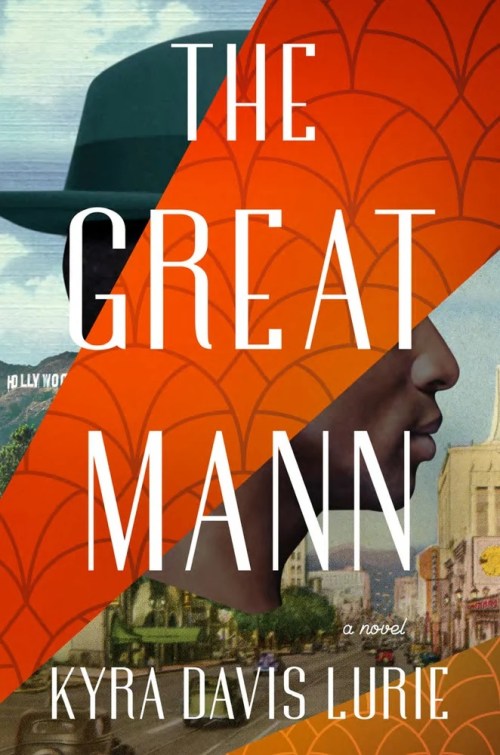
The cover and title of The Great Mann are striking! I read about your title inspiration but I wanted to specifically ask about the cover. I assume the background image is of Sugar Hill but how did you or your team find the image? Did you have a moodboard? Any details you can provide sans spoilers.
Kyra Davis Lurie
I adore my cover! The city you see in the picture is 1940s LA, but not Sugar Hill specifically, which was purely residential with mostly palatial homes. The truth is, when it comes to this cover, the only thing I can take any credit for at all is the style of the character’s hat! [I loved the hat! —Ariana] Oh, and I thought we needed something that screamed LA, which is how the Hollywood sign got in there. But I really need to give the credit for the concept and art to Crown and my editor, Shannon Criss. I know Shannon really advocated to get this book a spectacular cover and she succeeded.
Ariana Valderrama
As a lover of the Golden Age of Hollywood I must ask about your film research (if applicable). Did you watch any films with Louise Beavers, Lena Horne or Hattie McDaniel and if so did you have a favorite or one you recommend?
Kyra Davis Lurie

I did watch a lot of old films. I needed to get a sense of what the landscape was for Black actors during the lifetime of my characters, not just the films they were cast in (although I watched those too) but also the films they grew up with. The movies that really stuck with me, and I encourage others to watch, are the ones made by Black director and producer Oscar Micheaux. I was totally taken by his silent films. Everyone should go to YouTube and watch Within Our Gates. Here we have a Black director, with an all-Black cast, confronting the issues of racism within the context of a commercial film from 1920. For me, it really highlighted what African Americans hoped would be their future in film and adds a layer of tragedy to how pioneers like Micheaux were eventually sidelined and actors like Louise Beavers and Hattie McDaniel felt compelled to frequently take roles that were beneath them just to make a living.
Ariana Valderrama
If someone was to visit Sugar Hill/West Adam Heights are there sites you recommend? Understanding that many homes were destroyed for the construction of a highway, I’m curious if work has been done to preserve the homes that do remain or if historical markers are present.
Kyra Davis Lurie
Hattie McDaniel’s house still stands. It’s no longer quite at its former glory. Some of the grounds have been paved over, but it’s still impressive. It’s listed as a historical landmark but it’s also a private residence so anyone visiting should be respectful of that. The address is:
2203 S. Harvard Blvd
Los Angeles, CA 90018
If you start there and just walk around you can also see some of the other mansions that remain in the area. A few of them have been long neglected but you can absolutely sense the grandeur of what was once Sugar Hill.
Ariana Valderrama
You’ve gotten to talk about the book quite a bit prelaunch but is there anything you haven’t been asked that you want to share or discuss?
Kyra Davis Lurie
Oh Gosh, that’s a tough one . . . I guess I would just like to circle back and put emphasis on how diligently I researched the historical figures I included in my novel. I didn’t just examine their lives and actions in the 1940s but also did a deep dive into each one of their childhoods. I know about how Loren Miller stole his aunt’s copy of Narrative of the Life of Frederick Douglass as a kid so he could learn about Black history. I know Hattie McDaniel’s father was an escaped slave and hero in the Union army and how, as a child, Hattie helped him write letters to the government in hopes of getting her father the pension and medical care he earned but was being denied. I know John Alexander Somerville washed dishes to put himself through USC and how he had to come to class smelling of fish as a result but still graduated at the top of his class. I know about the divorce of Norman O. Houston’s parents. Again, with fictional characters you can just invent a backstory. But these were real people and I needed to make sure that whatever they said and did made sense through the lens of their actual life experience. While I don’t go into these details in the book, I do hope that on the page, each of these individuals comes across as fully realized. They were great men and women and I pray that I did them justice.
FICTION
The Great Mann
By Kyra Davis Lurie
Crown
Published June 10, 2025