


This will certainly reveal more about me than Megan Abbott, who, as the author of the new tense and atmospheric novel El Dorado Drive, is the true subject of this piece. But here we go: Megan Abbott is the source of an intense gothic ambivalence for me. I want to be her very best friend, have her teach me everything she knows as a writer—and, also, she scares me.
If you met her in person, you’d think I was telling you a slant tale. She’s small, elegant, delightful, funny. Personable.
But Megan Abbott is one of the darkest dark horses of crime fiction, popping up in the rearview mirror with a knife when you think you might be about to settle in with a nice rah-rah story about cheerleaders, about Olympic-hopeful gymnasts, about sisters who run a ballet school. Little girls in tutus? Cute.
Fiction is full of stories of best friends and sisters, but not best friends and sisters like Megan Abbott’s. Buckle up. No one writes about the secret lives and desires of girls and women quite like her. Girls and women in Tinseltown, in shady back offices of gangsters, but also the competitive environments of… childhood, high school, of parenting, of white-collar workplaces and suburban neighborhoods that seem a little too much like our own. She writes about the seething rage and desires of women that many people would like to disbelieve or disavow. Stephen King called Abbott’s novel about the ballet school, The Turnout, “Impossible to put down, creepy and claustrophobic. It’s ‘Whatever Happened to Baby Jane’ in ballet shoes.” When The Turnout was chosen as a Today Show #ReadWithJenna pick, I remember wondering… Is Jenna doing OK?
Confession: It’s Megan Abbott’s talent that scares me. She’s been nominated for the gold standard of crime fiction writing, the Edgar Award, five times. (And won once, Best Paperback Original for her second novel, Queenpin.) More important than that sort of recognition is the reading experience. I have never finished one of her books without my own quiet, seething rage at how good she is, how effortless her prose feels, even as it cuts, deep, into the soft, fleshy bits of family bonds, friendships, and community—right through the thin ties that are supposed to keep society together.
Her latest, El Dorado Drive, is a work well worthy of writerly envy, as well as TODAY Show book club-level sales. The story centers on Harper, one of the three Bishop sisters born into the privilege of the golden era of suburban Detroit just as the luster of American-made wore off. But nothing shines like new money. Harper Bishop returns to town with a debt hanging over her head, only to find that her two sisters’ lives are looking up. Pam and Debra have tapped into their network of neighborhood ladies in a scheme known as “the Wheel” to finally get a slice of the American dream for themselves. Is it as easy as that?
You already know it won’t be. Jenna will freaking love it.
I talked with Megan Abbott by email about sisterhood, female ambition and desire, and the “nearly religious” experiences of Tupperware parties. At the end of the emailed answers to the interview to follow, Megan typed an “xo, see you soon” to me, remembering me from some past crime fiction community encounter. Like a switchblade, that one. We might be friends!
This interview has been lightly edited for clarity.
Lori Rader-Day:
Harper Bishop is a horse girl, grown up. She’s actually still a horse girl. Before we get going here, I want to ask, because you write a lot about girlhood, what kind of girl was little Megan Abbott? What does it say next to your photo in the senior yearbook, or what did she care the most about?
Megan Abbott:
It turns out I write a lot about the girl I wasn’t (cheerleader, gymnast, ballet dancer, horse girl). I lacked the athleticism, the grace, and, in some cases, the budget. Instead, I was the editor of my high school newspaper, the North Pointe—that fact and my general studiousness are probably why I was voted “most likely to succeed.” At the time, I probably cared most about R.E.M., gangster movies, true-crime books, and biding my time before I moved to New York City—or at least the New York City of my movie-made fantasies.
Lori Rader-Day:
“Most Likely to Succeed” is probably what they say about ambitious girls. (That is also what it says in my yearbook, about me.)
Harper is one of three sisters raised in family wealth that couldn’t be sustained. She is pretty laid back, but she gets caught up in a money-making scheme alongside her sisters, Pam and Debra. What is it about sisterhood that drew you into writing about the Bishop sisters? (I get only child vibes from you, but I’m not sure why.)
Megan Abbott:
Not an only child! I have a brother Josh, a prosecuting attorney on whom I rely regularly for fact-checking purposes. We’re only a year apart and were even roommates at the University of Michigan for a while. Maybe for just that reason, I’ve written about siblings, sisters, a few times, most recently in The Turnout. I think they intrigue me in part because they are the ne plus ultra of complicated relationships between and among women. Competition, loyalty, microaggressions, decades-long grudges, and deep, unshakeable love. I was especially drawn to Harper as the sister who leads the least conventional life of the three, which frees her from some of the pressures Pam and Debra face, but also means she’s a little taken for granted, or even dismissed. It gives her a unique perspective, always a bit on the outside, looking in.
Lori Rader-Day:
The rise and fall of the Bishop family is tightly connected to the fate of the American car industry and the city and suburbs of Detroit. This is not just a setting, but where you’re from. What, if any, relationship did your family have to the auto industry or its failure? What was it like writing about your hometown in this way? What do you think the reaction will be back in Grosse Pointe?
Megan Abbott:
I grew up in suburban Detroit in the ’70s and ’80s and, while my parents were East Coast transplants, almost everyone we knew had been raised there. I just remember the constant feeling of “belatedness”—that the glory days of the city were past. Detroit had such a complicated history, steeped in troubling racial politics, but it was also a “company town” in many ways, and I remember the constant anxiety of the shrinking and even collapsing auto industry—layoffs, labor disputes, bankruptcies. Recently, Detroit has truly, beautifully reinvented itself, but in those years, it felt like nothing was working—all these efforts to revitalize the city (the Renaissance Center, the People Mover and, um, casino gambling) kept sinking. As a result, Detroit had a kind of haunted glamour to me. A reminder that empires end and the “good times” are really only good for some people.
I don’t know what the reaction back in Grosse Pointe will be—it’s changed so much since. But, back then, Grosse Pointe was in many ways this pocket of outsized privilege. Even though my family was solidly middle-class, I was always aware of what I didn’t have access to: country club memberships, a closet of Ralph Lauren clothing, BMWs, skiing trips, all these symbols of careless wealth. It really shaped my view of money, privilege, security. I never felt like I belonged and I guess that’s what makes so many of us writers, right?
Lori Rader-Day:
The Midwestern sensibility gets a few pokes, too, in that Harper points out that Midwesterners don’t like to “talk about feelings, ever.” We don’t talk about money, either, as a matter of fact, but Harper comes to the realization that “Money is rarely about money.” What’s money about, for the Bishop sisters?
Megan Abbott:
What is it about for any of us, right? Security, independence, freedom, power, revenge. I think it’s different for each sister, but all those elements are constantly in play. For Pam, coming off a monstrous divorce, money promises a new beginning. For Harper, who’s in debt, it’s a boot off her neck. For Debra, it’s fundamentally practical. Her husband is sick and they’re drowning in bills. But what happens when money is flowing? Then it shifts again. It’s not just about survival anymore. They grew up in relative affluence and then saw it all taken away as the auto industry cratered. The fear of losing it again never goes away.
(By the way, I should confess that I didn’t mean to poke Midwesterners. Well, let’s call it a loving poke. For better or worse, I will always have that fundamental Midwestern reticence, and that respect for privacy and boundaries. Mind your own business. And I don’t think I’ve ever been accused of oversharing!)
Lori Rader-Day:
Midwesterners just like to be remembered in publishing.
Since we’re on the topic of taboos… women (and girls, as you have written elsewhere) are not supposed to want so much. But the Bishop sisters and the women pulled into the myth of the Wheel are freed up, in a way, to desire. What’s attractive to you about writing characters who desire—and take it too far?
Megan Abbott:
I think because desire is still so forbidden for women of middle age or beyond. They’re supposed to be content with what they have. They’re supposed to be selfless mothers, supportive wives, reliable coworkers. I think, as a culture, we’re still alarmed by any expression of open desire from a woman in her forties and beyond. It’s either pathologized, or turned into camp or comedy. What I wanted to do in El Dorado Drive is celebrate women—especially Pam, the “hungriest” sister—who refuse to conceal or tamp down their desires. I admire it so much.
Lori Rader-Day:

I caught a whiff of the Tupperware and Avon parties I used to attend with my mom as I read about the Wheel parties upgrading their snack tables and finding creative ways to present the money. I can see the montage in the TV show very clearly. And it just seemed like you were having so much fun with this book in that moment. We’re just amusing ourselves, really, when we write. How do you keep having fun with your writing or keep stretching yourself?
Megan Abbott:
As you know, a novel is a long effort! We spend two years or more with these characters, this world. The story has to feel endlessly fascinating, full of layers and surprises, and—for me at least, and I suspect you too—each one has to present a new challenge. And, even in dark stories, it has to offer expressions of joy. That’s often the bigger stretch—tonally—when you’re dealing with crime. I loved writing the party scenes in El Dorado Drive because, to me, they were these ecstatic experiences—nearly religious—for these women. I wanted to bring readers to the parties too. All books are an invitation, after all. Come in, have a drink, take your shoes off.
Lori Rader-Day:
Your work gets called noir. What does that genre label mean to you? What are the hallmarks of noir, in your opinion, that fit your work and/or that you push against?
Megan Abbott:
I suppose I consider noir less as a genre and more of a mood, a feeling—one characterized by a kind of dark glamour. In noir, characters are beset by primal emotions—lust, greed, rage, fear—and those emotions get the better of them. They’re a way of exploring what might happen if we gave into those universal feelings without having to actually, say, murder our spouses or rob a bank. I confess that I consider all my books noir not because I set out to write a novel in that tradition, but because, for better or worse, it reflects my world view. Maybe it’s the Catholic (and Freudian) impulse in me!
That said, traditional noir—if you go back to the mid(last)century—was dominated by male protagonists, with scant full-blooded, realistic, complex female characters. I don’t have any interest in writing about empty femme fatales or nagging wives or other staple female characters of the tradition. I want to write about complicated women for the rest of my life!
Lori Rader-Day:
Which stories brought you to the crime fiction genre? What stories do you return to again and again for inspiration?
Megan Abbott:
First it was falling in love with film noir as a kid, then true crime and ultimately, in my 20s, the hardboiled masterpieces of Raymond Chandler, James M. Cain, Dashiell Hammett, Dorothy B. Hughes, Jim Thompson—the big guns of the 1930s-50s. Then, the sinister works of Patricia Highsmith. Once I started reading those, I never looked back!
Lori Rader-Day:
You’ve worked in TV/film, had your own work translated to visual medium, and will be writing El Dorado Drive for TV. How do you have to think about your own novel differently to write the episodic script for it? What is exciting or daunting about the prospect?
Megan Abbott:
It’s always a little bit like a breakup. You have to break up with the book to start a new relationship, with the script. You lose the intimacy and voice that novels alone offer, but you gain so much more in terms of the power of visual storytelling. You have to reorient yourself and start thinking in terms of images and what they can convey. In El Dorado Drive, I’ve been loving writing all these chaotic party scenes, all these scenes with cash, luxury goods, imagining the way the camera can fetishize it all. And there’s such a thrill when you realize what took you six pages to set up in the book can come to life in one striking image on screen.
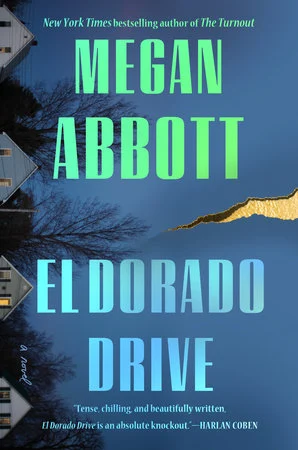
FICTION
El Dorado Drive
By Megan Abbott
G.P. Putnam’s Sons
Published June 24, 2025


