


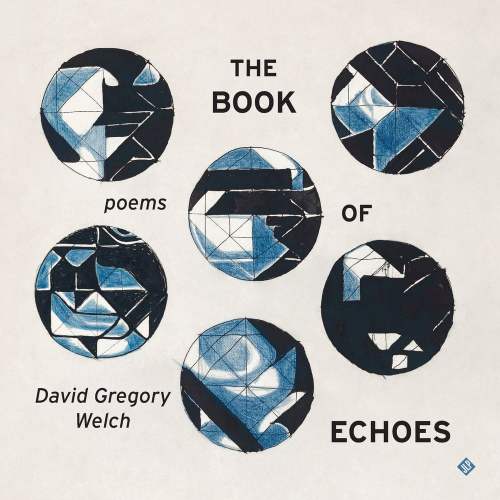
Scientifically, an echo is both the repetition of a sound caused by the reflection of sound waves and the resulting sound due to such reflection. A sound’s reflection, however, is never an exact mirror of what came. The soundwave is altered by everything with which it interacts. The entirety of the sum is the echo. David Gregory Welch’s latest book, The Book of Echoes, is successful to this end. The sonic elements, ideas, and images in this collection interweave the preoccupations of poets past and present in a joyous celebration of the art.
All artists stand on the shoulders of those who came before them. In this collection, Welch celebrates the works that have inspired him. He intentionally weaves direct lines and gestures of 29 artists (31, if we include Lorca and Dante as the sources for Jack Spicer and Marcel Dzama’s works) to create a cacophony of sound that masterfully represents the fundamental human experience. This collection comprises 49 poems organized into 5 sections, and includes both original works and pieces in conversation with the found lines and gestures of the attributed artists, which include poets such as Linda Bierds, So Chu, and Ko Un. The experimental, imaginative, and contemporary collection makes modern ancient poetic forms, such as the cento and ghazal—dating back to the third/fourth and seventh centuries, respectively.
Artist Jack Spicer also seems to have served as significant inspiration for Welch. In Spicer’s collection, After Lorca, the artist and poet ‘posthumously’ collaborated with 19th century playwright Federico García Lorca in a playful interpretation and reimagining of Lorca’s work. Spicer called these “translations.” Welch retells eight of the poems from this collection in similar spirit. He dubs them “English-to-English translations.” The title poem, “The Book of Echoes,” is another retelling. It is a cento composed of lines, in order, from each poem in Ted Berrigan’s The Sonnets (another experimental work in which Barrigan reimagines the sonnet. Lines are shared by multiple poems and create their own echoes within the work.). Welch’s poems explore how context informs meaning, the beloved, and the body, and furthers the conversation through the lens of a speaker we assume is living with Tourette’s Syndrome.
The collection starts with poems directly related to Tourette’s Syndrome (“Look, I cannot move the way you hope I do, a blanket / in the breeze of its own control.” and “I do not ask/ by any means, to be more/ human). Though our bodies may not be as thin, neurotypical, or abled as we each might like, none of us can live outside of the confines of a body. We begin grounded in one man’s body, but later the preoccupations of the poet expand to the breadth of the human experience. The effect is like a camera lens that begins zoomed in on a weary, malfunctioning mouth, to the wide woven patchwork (the Latin translation of cento) of life itself. And while I do wish I would have known more about Welch’s approach before picking up this collection, the pieces do seem to mostly stand on their own. I found the original works to be more resonant than Welch’s retellings, but I might have felt differently had I been more familiar with the original works to start.
This collection goes on to explore love, the body’s failings, and what happens when dreams we’ve accomplished end up being different than we had imagined (“The wish to be pregnant arrives inside a very old man./ What am I going to do with you, he says, as the shape inside him grows. But there’s nowhere for you to go.”). Welch’s love for the sound of language also shines through the wordplay and assonance of his speaker (“the mouth is/a field full of holes”). This is perhaps a continuation of the dance between the speaker and audience Welch explored in his first collection, Everyone Who is Dead, which imagined a direct dialogue between a boy and his audience.
At the time of this writing, Welch has not publicly commented on his personal experience with Tourette’s Syndrome and why it served as the inspiration for this collection. Nor has he mentioned why these specific pieces were selected. In a 2019 interview with Neon Pajamas, Welch shared that he wished his next collection were inspired by Lorca, which, I can only assume, is why he turns to Jack Spicer’s work so often in this collection. But the rest of the meaning-making is left to my imagination. Some of the poets attributed have publicly shared struggles with mental illness, though none seem to have direct ties to Tourette’s specifically.

If Welch’s desire for this collection was to capture the voices of those of those who struggle with bodies that betray them, and to say that they too exist and go on to do the things everyone else does: possess insecurities, find safe havens in the arms of their lovers, fret about the fate of the world, and such—then I would call this collection a triumph. It respectfully upholds the humanity of such voices. It also truly functions as a celebration of the artists who inspired this book, and further, the artists who inspired those respective works. In this way, this collection successfully functions as an echo, one that has personally left me in deep gratitude for art and all of the people who make it.
POETRY
The Book of Echoes
By David Gregory Welch
Jackleg Press
Published June 16, 2025


