


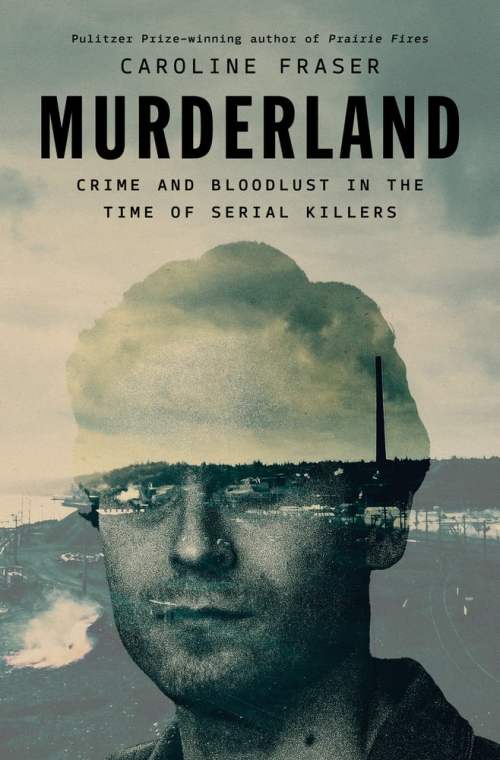
Raised on Mercer Island outside of Seattle, Pulitzer Prize-winning writer Caroline Fraser reveals in Murderland: Crime and Bloodlust in the Time of Serial Killers that, as a child, she fantasized about murdering her father, a sailing enthusiast and follower of Christian Science. What kid hasn’t daydreamed about killing off one or both of their parents? Yet Fraser casts a sinister pall over missed opportunities to make dad’s death look like a boating accident. At the time of her upbringing, the region was propagating multiple violent serial rapists and murderers. The author connects this Pacific Northwest phenomenon, which spanned the 1960s to the 1990s, to toxic dumping. Could Fraser’s murderous musings have been activated by dangerously high lead and arsenic levels in the soil, air, and water?
The author’s childhood reminiscences are sprinkled throughout Murderland, an expansive book alternating between chapters on the following: the egregious 20th century environmental crimes of smelter executives (most notably at the notorious Tacoma American Smelter and Refining Company, ASARCO); an ill-conceived floating bridge between Seattle and Mercer Island; and the gruesome activities of serial killers whose names and monikers—Ted Bundy, the Green River Killer, BTK, et al, ad nauseum—are the subject of countless true crime books, documentaries, and trading cards.
The mid-20th century history of bridges designed to connect Seattle eastward across Lake Washington is fascinating, though its relationship to serial killers and toxic waste seems tenuous. Unless, of course, Fraser means to demonstrate that the many engineering and traffic-planning failings that led to a bridge collapse and numerous horrific driving-related accidents are further evidence of the brain dysfunction and loss of mental acuity that exposure to lead can cause.
Fraser’s contribution to the true crime canon is her postulation that many of the era’s serial killers were exposed to high levels of lead. Bundy, for one, grew up in Tacoma, home of ASARCO. The law school dropout gets special attention from Fraser, who even notes specific dates when Bundy filled his VW beetle with leaded gas at the height of his rape and murder spree in the 1970s. There’s no need to demand the receipts for lead exposure in this case.
The source of Fraser’s hypothesis is a 1974 article that appeared in the British Journal The Ecologist, “Does Lead Create Criminals?” The journal’s cover story says that lead emissions may play a role in increased crime. At the time of the article’s publication, exposure to lead would have been difficult to avoid in Britain and the US. It was in paint, the soil, air, water, pipes, and in car exhaust, to say nothing of the experience people had while pumping gas. Fraser hints at a connection between this theory and a 1974 FBI report that indicated crime in Washington State was nearly three times the national average.
While the lead-crime hypothesis is provocative, Murderland provides limited substantive evidence to support causality between lead exposure and violent crime in the 1970s, 80s, and 90s. Toxic metals in the body may very well serve as an activator for violence under the right circumstances, yet the theory seems in need of testing.
Fraser acknowledges that personal trauma and culture contribute to the making of serial killers. For many readers, the power of misogyny and entitlement are worth a second look. What are the circumstances that make men—it is usually men—feel as if they are entitled to control and abuse the bodies of women and members of marginalized groups? While the gruesome acts of rape, torture, and necrophilia described in Murderland are well documented elsewhere, the mass indirect murders committed by corporate executives and scientists are less so. This, the sense of entitlement that propels already-powerful figures to increase their wealth at all costs, is a story worth telling and one that struck me as the most intriguing aspect of the book.
Consider Gulf Resources and Chemical Corporation executive Frank Woodruff, who in 1974 mulled over what to do about the Bunker Hill smelter in Kellogg, Idaho. Woodruff knew the smelter was releasing toxic emissions, yet lead prices were climbing. The parent company could have shut the smelter down, reduced emissions, or simply lied about the hazards and continued operating. They chose the last option. Even after calculating payouts of up to $12,000 per affected child in the area, Woodruff and his colleagues decided to stay operational and increase production, thereby coming out some $10 to $11 million dollars ahead.Woodruff is not the only white-collar villain in Murderland. Take, for example, Dr. Sherman Pinto who, though not the convicted Green River Killer, did serve as nearby ASARCO’s medical director. Pinto initially lied to employees and the public, claiming that excess lung cancer deaths among Tacoma smelter workers were attributable to pneumonia. One wishes Fraser had devoted more pages to exposing corporate criminals such as Woodruff and Pinto than to better-known serial killers such as Bundy and his ilk.
NONFICTION
Murderland: Crime and Bloodlust in the Time of Serial Killers

by Caroline Fraser
Penguin Press
Published on June 10, 2025


