


How much does the past inform the present? For Aram Mrjoian, that’s an open question, impossible to answer, but equally impossible not to ask. His stunning debut novel, Waterline, follows a family of Armenian Americans whose intergenerational trauma—with family members having died or dramatically escaped from the Armenian genocide—is completely overwhelmed by their present-day trauma when a young woman commits suicide in the middle of Lake Michigan. The story centers around her absence like planets revolving around a black hole as her family members deal with their grief in radically different ways—through exercise, through anger, through a cross-country solo road trip, through reading about their family history, with everyone expressing a deep need to understand.
The novel moves with striking emotional clarity, alternating between poetic introspection and grounded realism. Mrjoian’s writing is restrained but never distant, bringing the reader into the heads of his core characters with ease and depth.
This interview has been edited for length and clarity.
Denise Robbins
The book begins with a gripping portrayal of a scene from the Armenian genocide, but most of it takes place in modern day. Did you feel more comfortable writing the contemporary parts or the historical fiction?
Aram Mrjoian
I set out to write this book with a firm goal of less than 10% of the word count being about the Armenian Genocide. That was a really intentional part of the project. I didn’t want it to be a historical trauma narrative. That was really freeing in a way, because it allowed me to focus on the contemporary. The novel was always going to have some historical elements of the Armenian Genocide in it, but it was really important to me to pare that down as much as possible, so that it was a decentralized plot within the book and I could think about the way that our memory and historical understanding and family history is fragmented today. A family like this would not necessarily have a ton of personal information on an atrocity that happened to them over a hundred years ago.
Denise Robbins
I imagine you did a lot of reading about the Armenian Genocide. Which was more informative, reading historical fiction or nonfiction?
Aram Mrjoian
They were informative in different ways. Reading historical fiction reinforced my intention to do things differently, because there are a lot of novels I really love, these beautiful intergenerational stories, that spend more time in the deep past in-scene. I adore these books, but I wanted to shift where the camera lens was focused. I read a lot of nonfiction, too, even to the point of going to Florida State’s archives and requesting old copies of The Nation from 1915. So it was a mix of both, and I think they both provided different perspectives. The historical fiction definitely gave me more to think about in terms of the craft. And the nonfiction gave me way more to think about in terms of how I wanted to represent the past.
Denise Robbins
There is a historical fiction novel in the book called The 40 days of Musa Dagh which is formative for the characters in the book. Was that also formative for you?
Aram Mrjoian
Absolutely. The 40 Days of Musa Dagh was a bestseller when the English translation came out in the 1930s. Copies of it were burned in Nazi Germany because it was considered this transgressive tale of uprising that would maybe inspire a similar uprising among people who were facing the Holocaust. And this book is huge. It’s about 900 pages. Franz Werfel did all of this deep digging and historical research to make it as accurate as possible. In Werfel’s biography, an Armenian priest is quoted saying Franz Werfel gave Armenians a voice and a soul. So the book was really popular in its moment. But it’s also really melodramatic. And there are some huge problems with racism and a weird fetishization of ethnicity. I haven’t met that many people who really grappled with the novel that much. But I also feel like a lot of Armenians I’ve talked to, it’s on their bookshelf. It’s always there. It was on my parents’ bookshelf growing up. But I didn’t actually read it until my late 20s. That’s when I felt ready for it. Everything about it is interesting too because that story has been historically suppressed. The 40 Days of Musa Dagh was going to be a film in the 1930s. MGM was ready to release a movie adaptation with Clark Gable in it. And the Turkish government came in and talked to U.S. diplomats and essentially quashed the film. Sylvester Stallone tried to revive it at one point and basically was forced out of doing it.
Denise Robbins
Another key book is The Awakening. What is the role of books and unread stories in this book?
Aram Mrjoian
If we look at older books, for a long time they were more intertextual or had more references to art in general. So much of what the novel is about in relation to memory and storytelling, those books as references help contribute to that. There’s this very real question around The 40 Days of Musa Dagh that this family is asking. Gregor, who’s the old family patriarch who survived the genocide, has these stories from this very traumatic time in his life that have been passed down. How much of that is his actual memory and how much of it are we filling in from this historical fictional text? And how are those stories combining into something grander? And then with The Awakening, it’s a question of, how is reading it encouraging characters to act a certain way and influencing their decision-making process? These books are there in part because they’ve been instrumental to me in my own thinking, but also because within the book itself, they’re doing a lot of heavy lifting.
Denise Robbins
I love the line in the book that family histories are like an enormous generational game of telephone. How do you think your book fits into that?
Aram Mrjoian
When I asked about our family history, I got a one-page typed word document from my great aunt that was like, this is what we know. It was pretty concise. We know what towns we were in, where we came from, and like, what happened to everybody and who came over and when. But there’s not a grand narrative around it other than the really bleak statistics of a lot of family members being murdered and some of them escaping. I think for me, that game of telephone, what does that identity look like today when it’s a couple generations removed and when it’s not necessarily something that this family is thinking about all the time, but it’s still very present in their lives? It still has an influence, it still has an effect on how they act and navigate the world, but it’s not necessarily central to their identity all the time. It’s that game of telephone, of feeling like there’s something here, and I know this story, but also there’s still so much missing.
Denise Robbins

In this book a lot of your characters deal with grief through motion: running, walking, going on bike rides. Yet I often read that grief can be paralyzing—when motion stops. Do you think motion is connected with grief?
Aram Mrjoian
Some of the characters deal with grief with excessive alcohol consumption and other less than great habits. But for me, I’ve always been a distance runner. I love hiking. I just came from playing two hours of pickup basketball before this call. The motion does help me process. It’s easy to translate that onto other people and to think about it in terms of how that looks healthy or unhealthy for different characters. For Karo, he’s in the basement. He’s drinking, he’s brooding, he’s not really moving. We see how toxic that is, how much the tragedy of losing a daughter is overwhelming. It stops him. It puts him in one spot, and he can’t seem to move. Whereas his wife, Hova, is the opposite, like, I don’t want to drink at all because that’s going to affect my memory, and right now, all that’s important to me are these really vivid memories of my daughter who I’ve just lost. And dealing with that through walking, in some ways it’s healthier but in others it’s a little repressive or isolating. Everyone deals with grief in different ways.
Denise Robbins
You have a lot of environmental loss themes threaded throughout here as well. Was it a conscious parallel to have environmental loss alongside fear of cultural loss?
Aram Mrjoian
I think that’s a really natural connection to make. For me, anyway, environmental loss is a constant fear and source of stress. I have climate anxiety on a regular basis. I think a lot of people do, and it just exacerbates and complicates all of the other stuff we’re dealing with. It’s devastating to see the ways we’ve been very rapidly destroying a livable planet. When you see the places you care about fall apart or lose their environmental integrity, it’s easy to equate that with a loss of culture or loss of identity, because we’re so attached to place, where we live and where we come from. For me, it’s the Great Lakes.
Denise Robbins
Are there similar strategies for restoration on cultural loss and environmental loss? Can we “replant” cultural trees metaphorically with stories?
Aram Mrjoian
I do think narratives can help us think about our environment in new ways. But I don’t want to always think that narrative is enough—that we can have these didactic fictional situations about how to be better to our planet that will result in concrete steps to save it. But that said, literature is an important part of our culture. And I think the reason we’re seeing so many writers focus on this issue is because a lot of artists want their work to have urgency and value. And collectively, if enough of those stories are told, maybe they can make a difference, maybe they can contribute to something. But we also still need to be better to our planet. We need to stop mining for oil and accepting so many systems that are violent and detrimental to our collective health and sustainability.
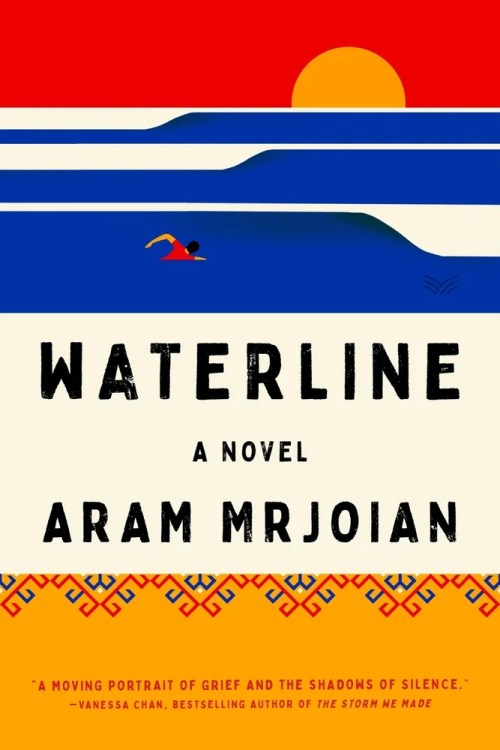
Fiction
Waterline
By Aram Mrjoian
HarperVia
Published June 3, 2025


