


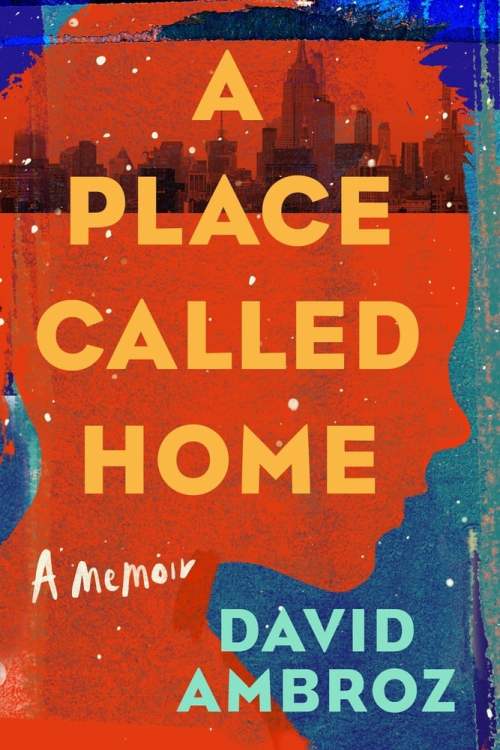
I’ve worked in child welfare on and off for over twenty years, and in that time, the limited media portrayals of foster care have disheartened me. Many depictions are flat and riddled with easy stereotypes, often written by people without lived experience within the system. An exception is David Ambroz’s memoir, A Place Called Home—released in paperback earlier this month. The book recounts how Ambroz grew up homeless with his siblings and a mother who struggled with mental illness; the kids ended up in foster care, an especially harrowing experience for him as a gay youth in the late 80s/early 90s. Today, Ambroz is a foster parent himself, as well as a national advocate and expert on child poverty and foster care.
On a call with Ambroz, I noted my frustration with the two-dimensional representation of foster care in books, and he agreed that those depictions don’t help move the national conversation forward. “Foster care needs a rebrand, and part of the rebrand is not just portrayals—which are vital—it’s also how we talk about it as a community.” He hopes his book helps offer the opportunity to have a more productive conversation about this complex topic. A Place Called Home ends with a list of famous former youth in foster care in all different industries to “emphasize that your perception is wrong, and therefore the reflection in our media is wrong, therefore our policy is not as potent and helpful as it might be.”
I asked Ambroz why there aren’t more honest, accurate books about foster care. “I was told when I started this project, ‘no one wants to read a book about child abuse.’ And it’s such a distillation of the problem, which is we as a country flow around the issue that 10 million kids are living in poverty…We’re very busy people; we have a lot of stuff on our mind, and it’s easy to pigeonhole this…[to] not have to deal with it, and just call it the system, and then walk away from it.”
To disrupt that narrative, Ambroz makes a compelling craft choice in A Place Called Home: the book is primarily told in present tense—though at times, an older, wiser voice adds commentary. The present tense allows the reader to be with him during the grueling events of his childhood—and later, as he’s a teen and young adult—in an immediate way. And the editorializing offers context to how his experiences fit into the child welfare system. This older, wiser voice is often poetic, sometimes offering only a single sentence, such as, “Poverty is one long line.” Whether a brief metaphoric line or a longer explanation of policy changes, marrying his experiences with this commentary helps readers grasp the reality of poverty, hunger, mental illness, and foster care.
Ambroz says that was an important decision in writing this book, and compares it to passing a car accident on the side of the road. “Because for many people, we don’t know the names of the victims, but I want you to stop. I want you to relate to this person. I want you not to just drive by and think, ‘Gosh, that’s a tragedy,’ but really get out of your damn car.” An avid reader who especially loves memoirs, he acknowledges how books that inspire us often don’t tell us what to do to take action. A book can make you aware of an issue, but you don’t know what to do, so you’re off to your next read. Ambroz decided to share how to do things differently, sprinkling policy ideas throughout as both a tool and tactic. In one example, the reader “accompanies” his mother to the welfare office as she is asked to fill out endless paperwork and told she should get a job when she has no childcare and is suffering from mental health issues… “I thought, if I put the person in my shoes that cold morning when we were evicted from Grand Central, and near death, and [I’m] urinating on myself, you are going to feel and smell the cold. And next time you see a homeless kid, you’ll be like, ‘Why aren’t we solving this?’… That’s my hope with putting you in the moment. Then I give you direction; inspire you to take those ideas and [take] action.” Ambroz has a clear goal: kids should not have to grow up the way he did. “We’ve tried fear, we’ve tried ignoring it…I thought, ‘How do I reach that part of the American spirit and soul that recognizes these kids and these families for who they are?’”
What Ambroz was initially told when he started writing—that no one wants to read about child abuse—turned out to be wrong: A Place Called Home has sold so well that it’s taken three years for the book to come out in paperback. “I never believe[d] that people don’t want to hear hard stories. Americans are very durable people… We are literally many different people in this country and this world, and we want to see ourselves reflected. And my book is a reflection of the human story.”
I began rereading A Place Called Home after attending the annual Hands Around the Courthouse in Rockford, Illinois. Each April, community members pin blue ribbons on our chests and gather to raise awareness about child abuse and neglect for Child Abuse Awareness Month. It’s brief: a few speakers talk about local abuse and neglect statistics, and how it’s up to each of us to bring that number down to zero; then everyone forms a circle and a giant blue ribbon is passed around, which we each hold during a moment of silence to contemplate the impact these abuses have on our community. Because we must grapple with this reality before we can change it, and A Place Called Home is an invitation to do just that.
Ambroz shared a parting sentiment that will speak to us bibliophiles: “People that read books can change the world. I want to triple underline that…People that read books talk about the issues they read [about], people that read give books to other people. We are a storytelling people. My realization is that [book readers] are a sort of Dumbledore’s Army. And we need to be called to action to not [just] passively consume, but realize that we are powerful.” A Place Called Home isn’t only a powerful story and call to action, it’s a reminder of our individual capacity to change things for the better—one we all need these days.

To Learn About Fostering: FosterMore
MEMOIR
A Place Called Home
By David Ambroz
Legacy Lit
Paperback released May 6, 2025


