


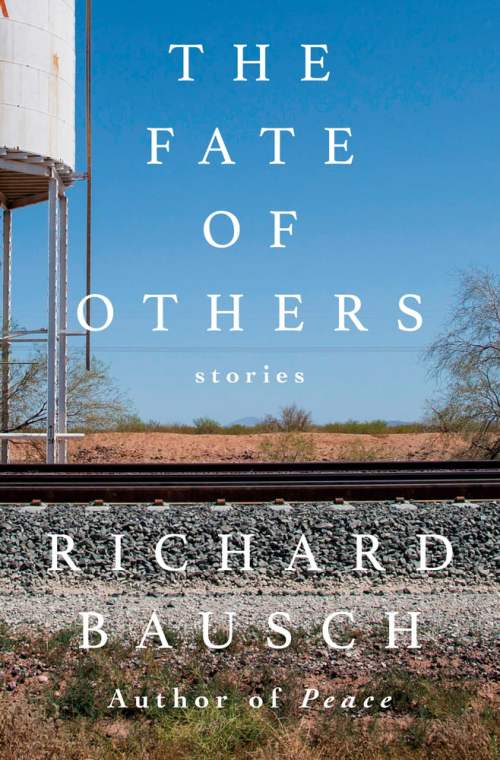
I carried The Fate of Others with me nearly everywhere. I read “In that Time” in the quietness of my living room, tickled by the character of Ernest Hemingway evading questions from exasperating reporters and telling stories about killing lions and buffalos. On the way to an appointment, I held my breath as I sat with the weight of “A Memory and Sorrow,” a touching tribute Bausch pays to his twin brother, Bobby, and an unflinching exploration of the mental turmoil and lingering terror of their lives in the Air Force. I have no recollection of where I was when I read “The Fate of Others” and “Blue” and perhaps it is because I was so urgently yanked into their worlds, intrigued by the complexities of the characters, the realness of how they sound and feel, the thrilling sense that right before my eyes is the unfurling of vivid, forceful, and memorable lives and I get to witness it, too. Bausch’s writing of human portraiture is as delicate and striking as his prose.
At the end of each story, a quiet emotion rises, and it is one that stays with you much longer than you would expect. It is not eruptive. It is not loud or glaring, such that you take in the high and it disappears just as quickly as it came. In this collection of short stories, you will find that no matter the situation—irredeemable loss and grief, unconditional love and steady devotion—there’s a slow arrival of some kind: a terrible knowing that sits heavy in one’s throat, a sweet reconciliation that takes its time, an unspoken resignation that fills the silence, and an unpredictable tenderness that overtakes the reader, wherever they may be.
The stories of Richard Bausch are a delightful and intimate companion—a gift for all seasons.
This conversation has been edited for length and clarity.

Tryphena Yeboah
Richard, I want to start with humor in your writing, a quality I can admit does not end on the page with you. You’ve shared some good jokes with me over the years and even when I’ve forgotten parts of it, I always remember the sound of laughter across the room. This translates into your work, and often under unexpected circumstances. I found the dialogue between Ernest Hemingway and the characters in “In That Time” hilarious, and while Susan’s grief in “The Widow’s Tale” is palpable, it is shrouded by a comedic atmosphere of superstition. Can you speak on your relationship with humor—both on and off the page?
Richard Bausch
I never think of humor, per se, when writing anything. Nor do I think of tragedy or any of those kinds of conceptual things—I’m always just trying to be as clear as I can about the moment that’s coming to me in my imagination, and indeed, if something ends up being funny, I often don’t quite notice it. Getting it down right is all I’m thinking about. For instance, the story, “In That Time” began one evening when Lisa [Richard’s wife] and I were sitting sipping coffee, and I said, “Hey, let’s play a game. Let’s both sit here and write an opening line, and then read them to each other.” The idea interested her and we both sat there quiet, concentrating, and then scribbling. I thought it would be fun just to be silly, so I wrote the most outlandish thing I could think of: “Back in 1949, when I was twelve years old, I spent a morning with Ernest Hemingway.” It was just to be silly, and as far out as I could make it. And she said, “Oh, I like that. That’s a story. You’ve got to write that.”
Regarding the humor in “The Widow’s Tale” that all came out of wanting to write toward something I heard—an 84-year-old famous writer I knew who’d had six previous wives and was sitting with his seventh, at a table during one of those PEN/Faulkner Award galas we used to have back in the 80s and early 90s, in Washington DC. The seventh wife was in her late twenties, and a woman across the table said to her, in a kindly, clearly wishing-to-be-inclusive voice, “Do you travel with your grandfather often?” The seventh wife reacted exactly as my fictional seventh wife reacted. “I’m MRS…” All umbrage and outrage. Anyway, that’s what I began with as something I would work to bring about in “The Widow’s Tale.” And I knew when I saw the exchange that I would write it one day. Just not where or when. All the rest of the story just came to me in the writing as I imagined the circumstance, and I simply went along with it, making it up. I especially liked the old, epically ugly poet who quotes Keats. I don’t know where he came from, but I felt great empathy for him, trying so hard to be kind. Because so much of every story I write is made up, I dislike being called a realist; I paraphrase for people the line from Mary Anne Moore: “I’m making up imaginary gardens with real toads in them.”
Regarding the jokes, it delighted me recently to learn that Chekhov loved telling jokes and making puns, and of so many of the writers I have admired and with whom I’ve spent time like or liked trading them: Robert Stone, CK Williams, James Dickey, George Garrett, Mary Lee Settle, Kay Gibbon, Allen Wier, Ernest Gaines, Mark Strand, RHW Dillard, brother Bobby, who was the all among them admired master of the form, and Wesley Brown, Ann Beattie, Jill McCorkle, Alan Shapiro, Joyce Carol Oates, so many. And I think it’s because jokes are little stories, which—when they’re good—involve a wonderful economy of language and characterization, while highlighting and puncturing our pieties and assumptions. Remember, I said “when they’re good.” I don’t tell the kind of nudge-nudge wink-wink ones that are only reinforcement for prejudices and casual cruelty. But the good ones—praise heaven for them.
Tryphena Yeboah
After reading “Blue,” I could not shake off the kind of shock and distress Hart felt from witnessing a man die right in front of him. You demonstrate such command over capturing intense and unspoken moments of distress. In “Forensics,” when Casado wrestles with the weight of his job as a detective, he admits that what he feels is “a discouragement so deep it drained and weakened him.” How do you approach writing about the internal and disarrayed world of a character without plainly giving away what it is happening because the characters, too, are grappling with it?
Richard Bausch
I’m not sure I can explain this well enough. I don’t really know myself, in fact, quite how any of it gets into the language I find to express it. I start setting things down as action or speech or event, and things occur to me to say about it all in context. I wrote “Blue” out of a story I heard someone tell of witnessing an accident, and someone finding a pair of shoes on the floor of the car, and how a man came talking out of the brush next to the road in stocking feet, who was a terrible shade of blue. Every capillary broken in his face and no outward bleeding, and dead-walking. I heard it told when I was in my late twenties and never forgot it. And when I began writing the story I thought how awful it would be if the person witnessing it was a painter, and got obsessed with the color. So I created Hart, who loves his wife and his mother-in-law, and they’ve been dealing with the losses of the pandemic, and I just went with it, writing through it and trying to be clear. In “Forensics,” I just had the image of someone finding a prosthetic leg with a suede shoe on the foot. I have no idea where it came from—and I knew when it occurred to me that it would be a detective at a murder scene involving hoarders, à la the Conyer brothers, in NY. My character is also a man who loves his wife and his teenage stepson, and he has come to a place where he wants to do anything but what he is doing every day on the homicide squad. And I simply made it up as I went along.
Tryphena Yeboah
A number of the stories in the collection seem to be written and set during the Covid-19 pandemic including “Three Feet in the Evening,” “A Local Habitation and a Name,” and “Isolation.” I am curious to hear about your process of creativity during lockdown, if you approached these stories any differently than your other work and what you remember from working on these stories at that time.
Richard Bausch
The first one I set in the pandemic was “Isolation,” which was inspired by the fact that Katherine Anne Porter wrote her great story “Pale Horse, Pale Rider” during the Black Flu pandemic of 1918. I actually had the conscious thought, “This is the Pandemic of 2021, and why not. I’m gonna write my own story set in a plague.” I started with Christine, going out on the balcony and looking at the bare streets and sidewalks. When I wrote the line about her thinking of throwing herself off the balcony, I had not known I would write it. It surprised me. And so I went with it, imagining the lover out there, and then it came to me to write from the lover’s point of view as well. And then it developed as I dreamed it up that she’s in love with her husband and the man Gavin, the lover. And that the lover’s sore throat and cold is in fact Covid.
“Three Feet in the Evening” began way back in 1993, a story called “Marauders”—and the only surviving things from that long ago attempt are the hallway shining like a lake with sun on it, Ms. Gable and the gift portrait of Clark Gable, and the big building blocking the view of three old men who, in that incarnation, decide to band together and burn down that building. I had several attempts over the years, including one beginning with an affidavit about the burned down building, but none of them felt right. None of them opened up. Then, during the height of the lockdown, when I was working very hard on finishing Playhouse, I remembered the story of William Saroyan and his last days in a home, believing that his three children hated him, and dying with that in his heart. And “Three Feet in the Evening” began to take on new life, with Clement Dyson, the minor poet, who on his 89th birthday has a daughter he’s never seen coming to visit him. I had no idea what would come of that visit. Ms. Gable’s story about her own life and troubles with her son came out for me literally as I was describing the two of them walking down that shining hallway to greet the daughter on her arrival. I had been going round and round wondering what his daughter was going to ask or demand from him or tell him about her life and the lives he’s missed, but that pass between him and Ms. Gable made me see that it was her story, too, and when Clement’s daughter, a stranger to him, says that she has come to see Clement Dyson, I heard him say, in a quavering voice, “That would be me,” and knew—to my utter surprise—that that was the last line of the story.
Tryphena Yeboah
Your depiction of marriage in these stories is perhaps one of my favorite things about the collection. You write about its highs and lows, “the years of faltering and sorrow” and all the simple and complicated ways we live with those we love. Even as we follow Angela’s life after divorce in “Donnaiolo,” we also catch a glimpse of the relationship between her parents and the different ways they respond to conflict. When Jordan is certain his father-in-law is dead in “The Fate of Others,” his first thought is whether his marriage would survive the loss. You work to reveal so much about characters within the context of their relationships. They are like a story within a story. Are there specific elements you enjoy about exploring the layers of different kinds of relationships? Who are some other writers you’ll say do this exceptionally well?
Richard Bausch
I think of all stories—all good stories—as what Updike called “the human news,” and what George Garrett called “news of the spirit.” I’m always seeking to give forth that kind of news, which happens when the writer creates the inside landscape of a dreamed up someone’s being, in terms of whatever the situation is—that is, whatever the context is—who is the person living through it all. Context and situation to me are words I use when others use the word conflict. For me, stories occur or suggest themselves always in terms of these matters. Jesus says to Lazarus “I know a woman who gave two pennies.” And Lazarus says, “What is two pennies?” And Jesus gives the context: “It was all she had.” Now add situation: say she had just spent everything but the two pennies buying rags for her two hungry children and only eating a crust of bread because she’s spent everything earlier to feed those children and she’s going to be working into the long night carrying stones to make enough for tomorrow’s crusts of bread and pennies. That’s situation and character, right? And she does it all cheerfully and never lets anyone see how much her feet hurt her or how hungry she really is. That’s character. All oversimplification, of course, but with this present day’s nightmarish complexities and sorrows, the pattern is true and inexhaustible and you can write stories for a lifetime out of it if you’re faithful enough and lucky enough.
In the novella that ends the collection, “Broken House,” for instance, I took a story I’d begun at the Iowa Workshop, fifty-one years ago, called “The Most Terrible of Private Crimes,” involving something that actually took place: Bobby [Richard’s brother] and me and 30 other altar boys on a bus into the mountains of West Virginia to visit a monastery. (It was Bobby, by the way, who, when the priest held up the shining chalice and told us that it was made of pure gold and that only the priest could touch it, reached, from daydreaming and not listening, past my head and took hold of the chalice to say, “Is that gold?” And I have told the story many, many dozens of times.) And when we got up to the monastery the monk actually did say “There’s an old, old house down that way through the woods, y’all can go on down there and tear that apart if you want to.” And the line in that long ago story, before the boys head to the house, was “Irony is lost on the young.” In the new version I added the phrase, as we all know. And we did go down there and we did tear the house all the way to the ground. But that story, all those years ago, ended with the torn down house and, at the time I wrote it, the revelations about the pedophile priesthood hadn’t begun to appear, and I’d never experienced anything like it. (Ironic, isn’t it, that the title of the apprenticeship story all those years ago should seem almost the more appropriate one for the final completed work.) But in writing “Broken House,” I knew from ruminating about it all that the house would be a metaphor now of the very Church itself, the whole edifice, and so it began to grow from the 21-page description of the destruction of a house, into the 100-page novella of the lifelong fascination of Vance Bourdan for his friend Phillip Chorros, and Phillip’s struggle after having been advanced upon by a priest. All made up, but as I wrote the story, things came up about my own experience dreaming in my youth of becoming a priest, and the Church as we all knew it then. Plus the now-elderly gratitude and appreciation for the love of our father and mother, as we grew up—that devout house, with that love, while the evils of the particular time and place were happening around us.
My models for this kind of writing? Why, of course the Russians, (Tolstoy, Chekhov, Dostoyevsky—no equals, there), and too many writers from America and Europe and the world, and from my fairly recent past and very near contemporaries—too many to name, Lisa Cupolo and thyself among them.
Tryphena Yeboah

Lisa is a favorite! And thank you, Richard—I am in such legendary company! “A Memory, and Sorrow” is a beautiful and vulnerable tribute to your brother tucked between the fictional pieces in the collection. Reading it made me wonder if you journal and how, if at all, the practice informs how you pay attention to the world. I was also curious about how differently you approach writing nonfiction, particularly about a subject so close to you.
Richard Bausch
I’ve never kept a journal successfully. I kept something like one over about a week in 1976, and discovered that I was becoming overly dramatic and self-pitying and too conscious of some possible future audience, so I threw it all away (about eight or nine pages) and forgot about it. About the interval, it just made a pressure to be included. The moment it describes, of Bobby coming toward me out of the cold and dark, is still emotionally and exactly clear in my memory, and I think of it often. So it just felt right to include it. All my writing life, the work has been a matter of discipline—I used to say, as I think many others have said, I don’t like to write, I love to have written. It was always discipline and it always felt a bit scattered and disorganized, catch-as-catch-can, as the saying goes—always feeling that I wasn’t getting enough done. But since I lost Bobby, the writing has become a refuge for me, and I finished Playhouse and wrote eight new stories, two full-length novellas, and the first 166 pages of another novel, Chopin’s Ghost: A Fable, in the first three years after the loss, in October of 2018. So I thought why not publish the interval in this new book, and pay that respect to him in print, though it is really more about my grief than anything else.
About my feelings concerning the writing of non-fiction—I’ve written many reviews, and quite a few prose essays on various subjects. But it has always felt like homework for me, and perhaps I’m just not very good at it. I got C’s in my English classes, pretty consistently.
Tryphena Yeboah
I have a prompt for you, Richard: “Only in writing does this ever happen to me…”
Richard Bausch
I come upon a profound truth about some aspect of life and experience that I had no notion that I knew. I can’t think of anywhere else this can happen in life, except in reading, and I tell my students to trust this; truly, just this: that when you come upon such surprises in what you’re reading, you should understand the fact that the writer was just as surprised getting there writing it, as you are getting there reading it. That’s why reading is such an intimate and beautiful experience, and it’s what Robert Frost was talking about when he said, “No surprises for the writer, no surprises for the reader.”
FICTION
by Richard Bausch
Knopf
Published May 20, 2025


