


In her debut novel, Misophonia, originally published in Germany in August 2023, Dana Vowinckel tells a deeply evocative coming-of-age story of 15-year-old Margarita as she spends a restless summer with her maternal grandparents in Chicago. Raised by her father, Avi, who works as a cantor in a synagogue in Berlin, Margarita is abruptly thrust into a reluctant reunion when she’s sent to visit her mother, Marsha, in Israel. Vowinckel, who was born in Berlin into an American-Jewish-German family and grew up between Chicago and Berlin, captures the messy, tender dynamics of a family pulled across continents and histories.
We recently spoke about how the aftermath of October 7 renders this book a historical novel, capturing the nuances of teenage girlhood, and why reconciliation with that which has wronged you is not always a worthwhile goal.
This interview has been lightly edited for length and clarity.
Marisa Wright
This novel was originally published about three months before the October 7 attack and subsequent war in Gaza. In a previous interview, you said that event rendered this book a historical novel set in a world that no longer exists, and in this edition, you include an author note about the conflict. Which ideas in the book are the same post-October 7, and which are different?
Dana Vowinckel
I don’t feel like it’s obsolete, but the world I set the book in doesn’t exist anymore. I realized this very shortly after October 7 and the beginning of the war. During the trip Margarita and her mom take together, they drive through the West Bank, and this is not something a mom would do with her 15-year-old right now. A certain sense of relative security I wrote it with has changed, and I think also a perspective on Israeli society I had has changed and is still evolving because societies evolve very quickly.
At that time, it had been so much about what happened on October 7 and the war afterward, and how Israeli society has changed and been pretty much complicit in large parts with what’s going on in Gaza. And then I was thinking today about how the book is becoming historical again because it’s also set on the University of Chicago campus, which also had relative security. It’s set in two societies where we’re seeing democracy fall apart. Most German Jews I know always saw Germany as not the safest place to live in, and there was always the option of America, and there was always the option of Israel. In that sense, maybe the book has become historical again because right now, I feel more peaceful living in Germany as a German Jew than in the U.S. or Israel.
Marisa Wright
The book features an unusual point-of-view combination, switching between Margarita, a teenage girl, and her father, Avi. How did their voices come to you, and how did you think about balancing them in the overall narrative?
Dana Vowinckel
It started just from an idea. I think cantors in Jewish communities are kind of enigmatic figures, and I was sitting in synagogue and wondering, “What does he do with his life?” I think people usually assume Margarita would have been there first because I look more like a 15-year-old girl than like a middle-aged man, so they assume Margarita is me and Avi is my dad. My dad thinks it’s hilarious because nothing is further from him than being a religious cantor in a synagogue. He’s a secular American Jew, not Israeli, so there’s a lot of fiction in there.
I think it was very helpful for me to have a protagonist with a very specific job description because that gives you rhythm to the text. It made it very easy for me to start this big novel project with this very calm, laconic voice, and then mix it with Margarita. Only having Margarita wouldn’t have worked because it would have just been too much, and only having Avi wouldn’t have worked because it would have become boring. For me, anytime I became annoyed or bored with one perspective, I would just switch. Both perspectives were very interesting to me. With a 15-year-old, there’s early sexuality and kind of being lost in the world, contrasted with the very lonely, quiet life of Avi.
Marisa Wright
One of the most striking parts of the book is how it vividly captures the complexities and emotional nuances of teenage girlhood in a way that feels deeply authentic. But those details feel hard to conjure after leaving that time of life behind, so what was your process for accessing and translating Margarita’s interiority onto the page?
Dana Vowinckel
Nobody’s ever asked me that. My access to her was very physical and very sensual. I feel like my experience as a woman is still that way. Now I know it’s not completely freakish to have this experience because I’ve spoken to all the people around me, but I tried to keep that kind of outsider feeling of that time, and I think that messiness really helped. I also read a bunch of young adult fiction that I loved reading back then. I reread The Sisterhood of the Traveling Pants and Are You There God? It’s Me, Margaret. American young adult stuff really helped me, though I think it was less about cultural identity for me. A lot of people read this book as the problem of being Jewish, but to me, there’s not really a problem in it.
I think the issues are made by patriarchy. Margarita doesn’t understand why she hates her body, but she kind of hates it, and she doesn’t understand why boys her age make her feel so awful. But I can kind of look back and understand why people made me feel so awful—because of power. My goal was to make her more grown than you would normally see in a 15-year-old because fiction about girls at that age can often be very belittling or condescending, and I wanted to take her seriously in the way she thinks and in the way she makes decisions.
Marisa Wright

The book begins in Chicago, but some parts are set in Berlin and Israel. In a previous interview, you said, “[A]ll of these places have a significant literary potential for me – they are political places, contested places.” What, to you, is Chicago’s literary potential? What feels political and/or contested about it?
Dana Vowinckel
I know Chicago very well because I spent a lot of time there as a kid. Hyde Park is this little island of wealth and academia, and then there are certain streets you just don’t cross. That’s always felt really extreme because I grew up in a city where I would take the subway to school to a completely different part of town alone starting at age 11. The city I grew up in gave me a huge amount of freedom because it’s safe, and for me, the unsafety of Chicago has always been very political and very interesting. The idea of somebody being allowed to own a gun, for instance, is extremely scary to me. Jewish life in the U.S. also feels political because it’s not as much of an issue as in Germany or Israel. In the U.S., you are Jewish and eat Jewish food and go to shul, and there are other Jews around. In my apartment building in Berlin, there are no other Jews living here except for the people who were deported, and we have little plaques for them in front of our building. That’s what makes it feel political.
Marisa Wright
I was struck by the thread of estrangement in the book as it’s a theme I am noticing more and more in contemporary fiction. What do these characters show us about the possibility of internal and external reconciliation in the face of estrangement?
Dana Vowinckel
I think that’s a really interesting last question because that’s something I’ve actually been thinking about in the last couple of weeks. Germans are obsessed with reconciliation. Forgiveness is a core value of Protestant German society, and people are obsessed with Jews forgiving the Germans. In mainstream German society, you’re a good Jew if you’ve forgiven the Germans. There’s a huge emphasis on the word “forgive,” which means “reconciliation.” There’s this quote from Angels in America, “Catholics believe in forgiveness. Jews believe in guilt.” I believe in guilt. I think people around me are really guilty, and I think this obsession with reconciliation is an excuse not to have to do any work for actual Jewish communities. Jews in Germany are really very poor. Many immigrated from the Soviet Union, and they are treated terribly and only receive a little bit of Social Security. The state does nothing for them, and our last government tried canceling the reparation payments. So there’s this huge deal about reconciliation, and on the other hand, nobody’s really doing jack shit for Jews who are alive because they’ve “forgiven” the Germans.
I think the dynamic between Marsha and Margarita is not broken, but it’s also not something that’s reconciled in the end, and neither is the one between her and Avi. I think they have fairly normal family dynamics. It’s not super normal for a mom to leave her family, but it’s pretty normal that a dad does, so I think Marsha is kind of emancipated in this whole thing. I don’t think that reconciliation would necessarily mean something good. It’s okay that there’s conflict, and I think that also for the broader political scheme in Germany. I don’t think reconciliation is the main goal Jews need to have in Germany, and it isn’t mine as a writer.
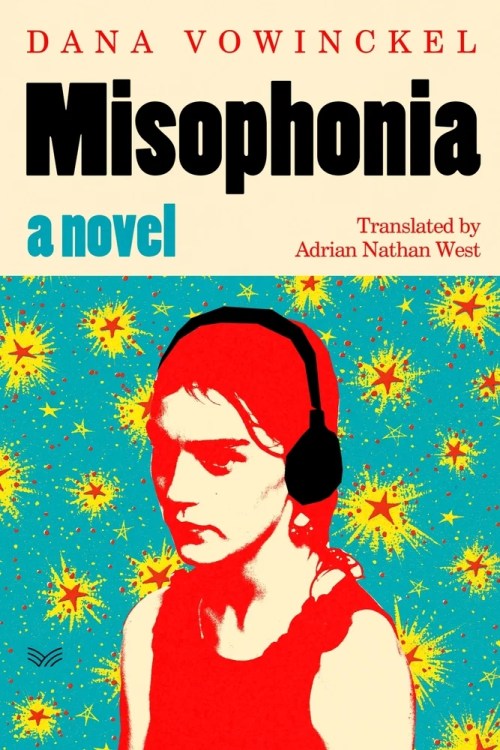
FICTION
Misophonia
By Dana Vowinckel
Translated by Adrian Nathan West
HarperVia
Published May 6, 2025


