


John Pistelli likes books that have “all the stuff”: chapter titles, epigraphs, maximalist plots, and unforgettable characters. He self-published five novels, and the last one, Major Arcana, gained traction through serialization on his popular Substack, then was picked up by Belt Publishing, to be published on April 22, 2025.
It’s hard to introduce a book as ambitious as Major Arcana when the author has already done it so well himself. In a foreword to the preface, Pistelli promises to “put discourse itself in swift motion”—and the novel delivers. Blending a freewheeling, deeply moving narrative with intellectual and artistic debates, Major Arcana follows graphic novelists, dreamers, and lovers of big ideas through chaotic but deeply felt lives. John Pistelli is an author with a crystal-clear vision of what he wants to achieve—and, even more impressively, he succeeds. He aims high, inviting readers to follow him into a bold, exhilarating, and intellectually stimulating story.
We spoke about his book, Tarot, super heroes, and more.

Denise S. Robbins
You serialized this book on Substack, then self-published a print version, and now are getting it published by a traditional publisher. When you were serializing it, did you plan it out ahead of time or would you write as you went along?
John Pistelli
It was a hybrid. Some of the chapters that ended up going into the book came from an abortive project I worked on the year before. I was looking to put them somewhere, and made the decision to serialize the book on Substack before I decided what the book would be about. I gave myself a timeline to start serializing in early 2023 and wrote my way into it. I ended up changing things around over the course of the book. What’s now in part three—the introduction of the character Ash del Greco— was going to be the beginning of the novel, with a Mrs. Dalloway-type structure where the introduction wouldn’t be that long and the characters would glancingly remember various things. As I wrote it, I began to understand that I had to explain it in a somewhat linear fashion for it to work. Only when I was about a quarter of the way through did I have the structure fully in place.
Denise S. Robbins
So the four-part structure wasn’t planned from the beginning?
John Pistelli
Right. I assume you’re asking because one of the characters makes a grand speech about the significance of the number four, which probably makes it seem like I planned it, but I didn’t—I added the grand speech after I discovered the structure.
If it were a five-part book, the grand speech would have been about the perfection of the number five.
Denise S. Robbins
Exactly.
Tarot is a major theme of the book—no pun intended—from the book’s title to the decks that come up throughout the story. What drew your interest to writing about Tarot and how do you relate to it?
John Pistelli
The answer will be somewhat embarrassing, which is that I always wanted to get into Tarot because it seemed cool, but I never had. I essentially taught myself Tarot to write this book. Once I realized the startling fact that a novel had never been titled Major Arcana, which I was really surprised to learn, I thought, well, there has to be a novel titled Major Arcana, so I might as well write it. I considered using Tarot to plot the novel in the way that Philip K. Dick famously used the I-Ching to plot his novel, The Man in the High Castle. But I didn’t do that. The logic of the plot overrode that. But it was very fun to learn.
Tarot is very literary. There’s a scene in the book when one of the characters is explaining Tarot and compares it to a modernist poem where there are archetypes arranged in a fragmentary and aleatory form, which is up to you to assemble and find the significance of yourself. I was able to resonate with Tarot on that level. I also made a practice of it while writing the book, testing its divinatory power. But those images are so open to interpretation that I don’t know how well it works as a simple divinatory tool. It might be a mirror of your unconscious at the time you’re using it.
Denise S. Robbins
The other central motif of the book is superheroes and comic book writing. Did you grow up reading superhero comics?
John Pistelli
Yes, that was something I didn’t need to do any research on. I grew up reading superhero comics. Now I’m teaching at a school based in Minneapolis, teaching online now that I’ve moved to Pittsburgh. I’ve taught there for ten years and the classes I was most asked to teach were about comics and graphic novels. The superhero became a hegemonic force in culture in the 2010s. So I thought it would be good to write a novel exploring the influence of superheroes, particularly the dark take on superheroes that predominated in the late 20th century and can be seen in the legacy of the Christopher Nolan Batman movies. I was interested in the comic book writer as a star, which was something that started in the 80s and went on into the 90s and 2000s. These stars were sometimes modeled on rock or pop stars, sometimes with scandalous and troubled lives, which has unfortunately really come to the fore lately in the revelations about Neil Gaiman. And so I wanted to reflect on that, on the archetype of the star writer who tried to write dark superhero comics for adults.
What joins the two themes is that a lot of the real life comic book writers who did that were occultists, practicing magicians such as Alan Moore and Grant Morrison. And so I created my own troubled, occultist, dark comic book writer star and followed that character’s life.
Denise S. Robbins
I didn’t know that so many comic book artists were occultists. Were they all part of the same movement?
John Pistelli
No. Alan Moore was an orthodox Aleister Crowley follower. And then his rival, Grant Morrison, pursued the path of chaos magic. Alan Moore was more like a ceremonial magician. He wears robes and rings and has a staff. They had this magical feud, almost like Catholic versus Protestant. Like, do you have to do the rituals and the hierarchy, or can you just stand naked before the metaphysical universe?
Denise S. Robbins
You’ve said this book is part of the neo-Romanticism movement. Can you define that and how your book achieves it?
John Pistelli

What I had in mind there, beyond a crass self-marketing, self-branding strategy which we all need these days, was the idea that Western literary fiction seems to have gone down two very divergent paths in the 21st century. First there is autofiction, which has been recently written in a deliberately unadorned style, influenced by European figures like Knausgaard or Sebald. There’s nothing wrong with those writers necessarily, but that’s not really my favorite kind of fiction. On the other hand, there’s been a rise in genre fiction: literary horror, literary fantasy, literary science fiction. By contrast, when I was starting out in the 90s, when I was outgrowing superheroes as a teenager and starting to read literary fiction, the major writers were Don DeLillo and Toni Morrison, who were able to write fiction that was realistic but had a heightened element and was written in a very stylistically rich and beautiful prose. Those are the novels I like. They had intricate plots, they were crowded with events, they had fascinating characters, they were very stylish. They weren’t necessarily autobiographical, or it didn’t matter if they were, but they weren’t fully in the camp of something like science fiction or fantasy.
So I wanted to bring that idea back into fiction, this idea of imagination. That’s the Romantic element, the power of the imagination applied to the present, which is the realist element, thus Romantic realism. Major Arcana is not autobiographical, and it has a number of fairly striking characters. And there is a magical realist element, the intrusion of the marvelous and fantastic into the present-day lives of the characters.
Denise S. Robbins
In the book, your characters argue about the idea of suffering as a precursor to becoming an artist, suffering in art itself. Do you think suffering is necessary to become an artist or to create great art?
John Pistelli
I sometimes get frustrated about this conversation because it’s often people saying, “You mustn’t romanticize suffering as if it’s necessary to become an artist.” The reason I get frustrated with that is because you are going to suffer anyway, just as a person. There are natural difficulties that beset a human being. You’re going to struggle with family problems, health problems, romantic problems, financial problems. Even rich people have a lot of problems. So you’re going to suffer and it is going to be fodder for your art. I agree you shouldn’t romanticize it to the point where you are deliberately throwing yourself into bad behavior. But naturally you will suffer and the suffering will become part of the art.
Denise S. Robbins
This is an ensemble book, but it has two main characters, Simon Magnus and Ash del Greco. They make some questionable decisions and could be described as unlikable. Do you find them likable? And do you think unlikable characters are important in fiction?
John Pistelli
I knew that Simon Magnus would be unlikable in a certain way because he’s projecting himself onto the image of a decadent, late 19th-century Satanic artist. He’s almost courting bad behavior, as I was describing earlier, to become this major artist, so I knew that there would be something remote or repellent about that figure. He’s very arrogant, too. He’s funny in that way. As for some of the other characters, though, I love Ash del Greco. I think she’s delightful in a strange way. Some readers don’t. And one of the reviews described all of the characters as monstrously self-absorbed. That never occurred to me about anyone other than Simon Magnus. I don’t really think in those moral terms. I do like most of the characters.
Denise S. Robbins
First and last names are used for every character throughout the entire story. Simon is never called Simon, it’s Simon Magnus. Why?
John Pistelli
Part of the conceit of the novel is that Simon Magnus, for various reasons, is skeptical about the practices around sharing pronouns in academic or metropolitan or liberal spaces. And he decides that he will not be referred to by any pronoun at all. And I honor the request until the end, when he does relent on that; but I honor the request throughout the whole novel that he be called Simon Magnus. And I thought that to balance that out a little, while I would use pronouns for the other characters, I would also, when I referred to them by name, refer to them by their full names. That was an intuitive decision, but on reflection, it has the effect of creating the characters on a more mythic level. Because you’re not on a first name basis with them, you encounter them as their full name every time they’re mentioned. And so that puts them on a slightly higher level than the people you know in real life. That helps with the Romantic aspect of the Romantic realism of this book. Novels should create their own style and have their own stylistic peculiarities just to help create it as its own world.
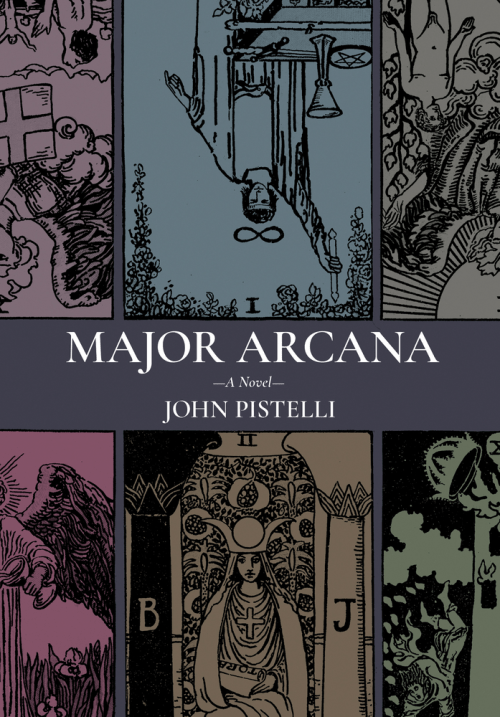
FICTION
Major Arcana
By John Pistelli
Belt Publishing
Published April 22, 2025


