


When the Harvest Comes is a groundbreaking, breathtaking stunner of a debut novel. Tender and deeply felt, it takes up timely questions about identity, family, and forgiveness, but never wavers from its true purpose: delivering to readers a love story for the ages. That it’s also written by one of my favorite literary friends, the inimitable Denne Michele Norris, is only the icing on the wedding cake.
I spoke with Denne Michele on Zoom last month about the novel’s lengthy path to publication, what makes her writing distinctly Midwestern, the book’s notable sex scenes, and more.
This conversation has been edited for clarity and length.

Marisa Siegel:
Tell me about this book’s journey to becoming a finished novel—it’s been a long road!
Denne Michele Norris:
It took fourteen years! I was twenty-five when I started this novel. At the time I thought, This might take me five years, but I was learning how to be a grown-up: how to pay utility bills, how to get around New York City, how to make friends and build community. The first few years, I wrote steadily but slowly. Then, as my life grew, I found it even more difficult to make time to write. I began applying to residencies as a way of giving myself time—I first finished a full draft of the novel at MacDowell in 2017. This became a part of my process; residencies allowed me the opportunity to save up my artistic and creative energy, and then arrive at these spaces where all the noise in my life had been cleared away and I could just write.
Marisa Siegel:
How finished was the manuscript when it sold in 2022?
Denne Michele Norris:
I always tell people, I sold a first draft. There were many parts of the book that had been rewritten again and again, because I struggle to get through a first draft. I’m always rewriting obsessively until the narrative line reveals enough of itself to me.
Part of the trouble is that I don’t write in narrative order, and I love to play with jumps in time and point of view. The many variables make it difficult for me to move on until I feel like the scene I’m working through is on solid ground. I’ve tried to train myself out of the habit, but I can’t seem to do so. If I showed you my Moleskines, you’d see pages and pages of the same paragraph with things crossed out and moved around. It looks like A Beautiful Mind. For years I used to say that the sentences were the most important thing; if I had the sentences, then that’s all I cared about. As an editor, I’ve learned that is not all that matters in fiction. But it’s still at the core of my sensibility.
Marisa Siegel:
The novel is structured in three parts. How did you conceive of the story’s shape?
Denne Michele Norris:
It was difficult to figure out the structure of this novel. I understood the backstory needed to be woven into the present-moment timeline, but for many years the balance was off. I spent so much time discovering the backstory that the present-moment narrative suffered. The structure only began to emerge when I realized I could use the wedding day as a narrative framing device. I could slow the narrative down, slow the characters down, and dig into the details and take them through all the memories and questions that a wedding might trigger, particularly for a queer, interracial couple. My editor was insightful in helping me focus the narrative into three distinct sections, and in helping me see the novel needed to live in the wedding day for the first few chapters to really show this couple, Davis and Everett, at their best—at their most joyful, at their most in love, in order for the turmoil that follows to hit for a reader.
Marisa Siegel:
You’re from Cleveland. Talk to me about the Midwest—is this a ‘regional novel’?
Denne Michele Norris:
I don’t know that I think of novels as being regional, but I certainly do think this novel’s roots are in the Midwest, even though most of its action takes place on the East Coast. Much of my writing is either set vaguely in the Midwest, or I’m writing about characters who are from the Midwest but who’ve fled for greener—or perhaps bluer—more coastal pastures.
When I was in high school, and I played the viola—typically the most maligned of the string instruments, in favor of the violin and the cello—an orchestra conductor once told me that the reason why Beethoven, Brahms, and so many important composers played the viola was because it placed them in the middle of the orchestra’s sound. They could hear every instrument, every line in the orchestra. I’ve equated this with being from the Midwest. We hear everything, are privy to every point of view, in every machination. This allows us a unique way of understanding multiple perspectives, and also of understanding how vastly different the multiple perspectives that occupy the American imagination can be. Many of my characters are naturally imbued with this ability, and I think it’s central in my fiction.
Elizabeth Strout is the first writer I loved who wrote about a specific part of the country, or at least she’s the first writer I read whose work made me aware of it. I’m grateful to her because she gave me permission to lean into my own Midwestern roots. Doing so only makes my work more specific, more distinctive, and more authentic to my own unique point of view. I don’t know if all of my work will be connected to the Midwest in this way, but the novel I’m beginning to work on now is even more Midwestern, set squarely in small town Ohio.
Marisa Siegel:
Speaking of your real life, other details in the novel seem to be pulled from it. How much here is “autofiction”?
Denne Michele Norris:
Readers who know me personally might think that this book is based on my life a lot more than it is. Most aspects of the book and its characters started in some way as being close to me. I made this choice as a matter of convenience: if I could pepper this project—at the time, it was intended to be a short story—with basic details from my life, then the bulk of my writerly attention could go to the emotional heart of the book. As my characters necessarily developed, and I began to understand their motivations, their histories, their relationships to each other, I wrote in the narrative distance. I had to write with total loyalty to the story—not to myself, not to people that I love, not even to what I thought I wanted the story to be about. I had to be loyal to the story as its own living, breathing thing.
I have a theory that when it comes to fiction there are two kinds of writers: those who start close to themselves and then write away, and those who start far from their own experiences and write toward themselves. I start closer to my lived experiences, or at least I have thus far. But, again, this book really is fictional. It’s true that my father was a minister, that I played the viola, and that I went to an all-boys private school. It’s also true that I’ve never been married, that I didn’t grow up in Chagrin Falls, and that my mother is still alive. As a writer, I love living in all of this—it’s where the fictive work lies, for me.
Marisa Siegel:
Is there a character who you felt particularly connected to over these past fourteen years?
Denne Michele Norris:

Obviously Davis, who I very intentionally, for political and personal reasons, designed to resemble me on the surface. Surprisingly, I also felt close to the character of Caleb. I was at MacDowell in April and May of 2017, just a few months into the first Trump administration. I’m there writing this novel about a gay, interracial relationship, and I’d always wanted the novel to feel current to its time. Almost every white person I knew had at least one person in their family who was supporting Trump, and I was interested in that. At first it was going to be Everett’s father, but then I became far more interested in young men who’d been radicalized, in the Bernie bro to MAGA bro pipeline. Caleb sprang from that impulse and I had a lot of fun working through how to render him on the page.
The hardest character to write was Everett. When I first began the novel, I felt intensely connected to him; he arrived immediately. Then I spent many years working on Davis and the Reverend, and Everett sort of got pushed aside. When it was finally time to return to him, I had to work to get back to my connection to the character. Part of it is that he’s so different from me in certain core ways—he moves through the world differently. With Everett, I was also writing a character who didn’t have the full picture. He had these blind spots to navigate, in spite of his integrity. He was a little bit of a Golden Retriever of a character, not stupid, but simple in a way that can make fiction more challenging.
Marisa Siegel:
You’ve accomplished something tremendous in portraying Davis and Everett’s relationship on the page. I was especially impressed by the sex scenes!
Denne Michele Norris:
I thought about this deeply while I was writing. I’ve always had this idea that if you truly supported me and my identity as a queer person, you had to be able to deal with all of it. You couldn’t only accept me for my relatively traditional dream of a white picket fence, you also had to be able to listen to me talk about taking it up the ass. I’ve never had patience for anything that cuts out the more salacious or “ugly” parts of my identity, so any book I wrote dealing with queerness was going to have sex on the page, front and center.
Davis is a character who is effeminate, who is the receptive partner in his relationship. He suffers the loss of his father and suddenly feels that the person who could never accept his queerness can now see that part of his relationship in action, and so for a period of time, he shuts it down. At its core, one of the central themes in this novel is bottom shaming.
When I was in college, I would meet gay guys who would say things like, Oh, you’re so great, but I’m not attracted to femme people, or, Oh, you’re so great, but I’m not attracted to Black people. These things were just acceptable to say. In the earliest days of writing this novel, I wanted to take a character who was often devalued in traditional gay spaces and put him in a relationship with the man who would be the king, the prize, in those spaces. And then I wanted to play with the power dynamic of having that man be the one whose devotion to the relationship is so complete, and to have Davis be the one in the relationship to have the power to ruin what they’ve built, and to do it more through negligence than willful bad behavior. There’s a dismissiveness that Davis adopts in his grief, though it’s much lessened in this draft, because it was important for their iconic love to shine brighter than anything else on the page.
I also wanted to underscore the tenderness in gay sex. Tenderness is a natural, necessary part of sex between two AMAB people, at least at the ‘point of entry,’ so to speak—it has to be! People don’t talk about this or portray this often enough. To wrap that up in a character anyone would want to treat tenderly, like Davis, and a character who has the size and strength to be a brute, like Everett, felt important to me.
Marisa Siegel:
Let’s be reductive—what’s the one thing you want readers to take away from When the Harvest Comes?
Denne Michele Norris:
My hope is that this book is a safe space for anyone who lives like Davis, but also for any queer person who’s had to deal with a complicated family, where love and acceptance might not be freely given. Clearly, Davis has dealt with homophobia and will deal with homophobia again, but for the here and now of the novel, I wanted to make a space where that wasn’t the central conflict. I was inspired by Schitt’s Creek, and the intentional way in which homophobia never rears its head in that world. One of the privileges of being a creative person is that we get to use art to help create the world that we need to live in.
I’m proud that the book is coming out at the moment it is. Literature is great at activating empathy, and we live in a world right now where we have to shout loud and proud that empathy and compassion and kindness are strengths rather than weaknesses, because we live under a barbaric regime that hopes to shape us all in its image. It’s so important that creative work exists—that art exists—that will affirm everyone’s humanity and that will awaken the lost humanity in those who need it most.
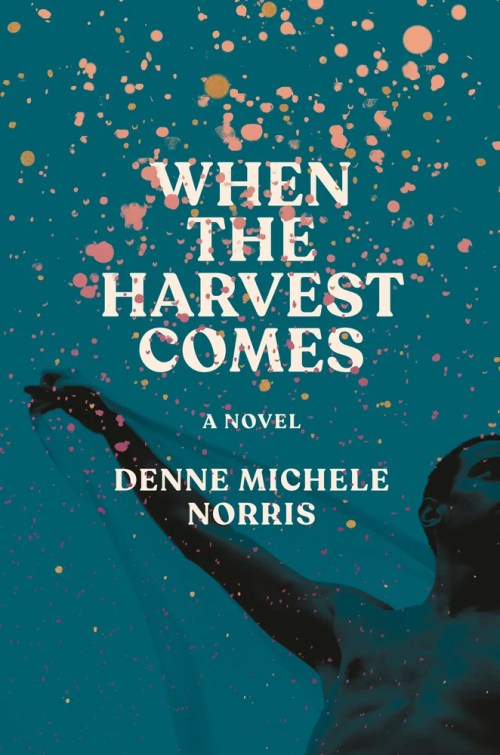
FICTION
When the Harvest Comes
by Denne Michele Norris
Random House
Published April 15, 2025


