


Just like the mischievous narrator of his second novel, author Kurt Baumeister is a bit of a shapeshifter. In addition to his work as a much-heralded novelist of the absurd, and an acquisitions editor for 7.13 Books, Baumeister has plied his trade as an accountant, a stock trader, president of his sixth-grade class, and as a self-proclaimed “metaphysical detective of quite small repute.”
All of Baumeister’s talents are on full display in Twilight of the Gods, a totally bonkers satire involving Norse gods, neo-Nazis, recovering novelists, populist presidential candidates, assassinations both attempted and thwarted, and a Wheel of Fate that just might lead to the end of the world. With its off-center wit and wink-wink reality, the novel complicates our often binary assumptions regarding good and evil, free will and fate, the individual and society, the sacred and the profane, all the while asking the reader to reckon with their small part in the march of history.
While it would’ve been more fitting to chat with Baumeister over drinking horns full of mead, I was still delighted to have a chance to ask him a few questions about his writing, his obsession with Norse mythology, the role of small presses, and his inevitable Neil Gaiman PTSD.

Jeremy T. Wilson
Late in your novel, the narrator Loki asks the character Kurt, “Even after dealing with the reality of my life, you still want to write a novel about it?” I have a similar question for the real Kurt. Given the many representations of Loki in popular culture, what made you want to write a novel about him?
Kurt Baumeister
Man, I have been trying to incorporate Norse mythology in a novel since grad school in the late 90s. I first tried with my thesis, Tolstoy’s Children, a tortured mess about a famous Russian-American writer who fakes his own death then returns, taking on the guise of a billionaire comic book mogul in order to surreptitiously torment his ex-wives and twin-aged sons, one of whom is a comic book artist working on a comic about a character named Doomlord. Doomlord is a sort of Hercules-goes-Norse type character, son of Odin, constantly beset by the machinations of the Norse force of evil aka Loki. Did I mention it was a tortured mess?
I guess part of what made me come back to the Norse myths again, in another entirely different project, is that I always empathized with Loki more than I knew or at least cared to admit. Maybe the fact that I empathize with the downtrodden, ostracized “force of evil” was one thing that kept Tolstoy’s Children from working. Maybe I hadn’t figured out that the thing that interests me so much about good and evil is that they’re so easily transposed; they’re not real, strictly speaking, not in this world at least.
Jeremy T. Wilson
One of the more popular representations of Loki is from Neil Gaiman’s American Gods. Without getting too deep into the good art/bad person discourse, was American Gods an influence on your novel? What books or other artistic works have had the biggest influence?
Kurt Baumeister
I read American Gods a few years ago, long after I started writing Twilight of the Gods. I liked the book, though I wouldn’t call it a masterpiece by any stretch. I’d say with respect to Gaiman, I was consciously trying not to draw on him or American Gods. In fact, I moved the book’s main action to Germany partly for that reason. I’m fairly certain that by the end of my book tour I will have American Gods and Neil Gaiman PTSD.
In terms of actual influences: depression, a terrible childhood, bad eyesight, limited people skills, poor choices in women, Shakespeare, Dickens, Nabokov, Vonnegut, DeLillo, Martin Amis, Milton, Dungeons and Dragons, Rushdie, Winterson, Hemingway, Michael Moorcock, Kundera, Franklin W. Dixon, Stan Lee, U2, The Clash, Zeppelin, Bob Marley, sitcoms, The Book of Revelation and St. John the Insane, Tarantino, Oliver Stone, Nancy Drew, Icewind Dale, Civilization, Medieval Total War, Snow White and the Seven Dwarfs, Tolkien, Peter Jackson, Game of Thrones, Mad Men, Vikings, Deadwood, True Detective.
Jeremy T. Wilson
Your novel contains a contentious election between a well-qualified woman and a popular fascist, right-wing extremists drunk with power, and a consistent it’s-the-end-of-the-world-as-we-know-it vibe. Yet it’s funny! What’s the role of humor, and satire specifically, in our era of doom scrolling and ever-increasing cruelty?
Kurt Baumeister
Yeah, so… In my quest to block out the perpetual buzzkill that is our current reality, I guess I try to make fun of things like death, sickness, and pain. I don’t think it’s necessarily healthy, probably far from it, but that’s how I deal with things. I just try to laugh and forget. (Shout out to Milan Kundera’s The Book of Laughter and Forgetting.)
Jeremy T. Wilson
You mentioned that a certain big publisher rejected your book precisely because they couldn’t imagine another Loki. How did the book land with Stalking Horse Press and what is the larger role of small, independent presses in addressing these types of myopic reactions from big publishers?
Kurt Baumeister
Stalking Horse published my first book, Pax Americana, in 2017. That book went through a similar, even longer process, in finding a home. I looked for an agent for Pax Americana twice, shopping the book in very different forms. The first time, it was well over 100,000 words and had seven different first-person narrators.
You know the story: I got some requests, most of them ending with a terse, canned reply after multiple follow-ups, the “favorable” ones concluding in brief pep talks about the manuscript’s positives and some variation on the theme of the agent in question “cheering me on from the sidelines,” but no offers. Much as I tried to make that book commercial in its final form, I guess it just wasn’t. Not enough at least. But it did put me in touch with Stalking Horse, which was a positive.
With Twilight of the Gods, I’d spoken to James Reich, publisher of Stalking Horse, early in the process, just after the book was rejected by that large publisher. James had accepted it, but told me he thought I should try to get an agent again, and see if that would help me land with a larger publisher than Stalking Horse. That’s the great thing about James and all really good small press editors and publishers, many of whom are writers. They want to see you succeed.
Jeremy T. Wilson
This may look like three different questions, but they’re all touching on the same topic. I’d like to know how your work as an editor for 7.13 Books influences your writing and vice versa. More specifically, what lessons have you learned from being on both sides of the writer/editor fence? And what do you wish more writers knew about the work of editors?
Kurt Baumeister
As an editor, and now as an author marketing my second book, I’ve become convinced you have to get going at least six months before publication. This is something large publishers do as a matter of course because most trades require they be contacted four, five, or six months out. The truth is, larger presses are often more than a year ahead getting out there via all sorts of channels of contact. They’ve got the staff and the budget to make that really work for them too. In my experience a lot of small presses are far behind that curve, sometimes only starting to promote a book a month out.

I wish more writers would recognize that most small press editors and publishers are doing what they do as a public service, not to make money. Which means that unless you’re selling a lot of books, at least three hundred to five hundred units of a title, don’t spend too much time worrying about money. And even if you’re over five hundred units, perhaps up to a thousand, you’re just not talking about a lot of money, so don’t treat the relationship like it’s some sort of financial death match. Vet people before you work with them. Publishers and editors who are ethical and financial “bad apples” are known. Don’t work with them. Assuming you’ve done that vetting, don’t make your editors and publishers miserable over tiny amounts of money. Ninety-nine percent of these people are absolutely not trying to get over on writers.
Jeremy T. Wilson
You recently resurrected your interview series “Six Ridiculous Questions” for Vol. 1 Brooklyn. I thought I might turn the tables on you with one final ridiculous question. Will you please describe your novel as if you’re a server introducing the specials at a family-style Italian restaurant?
Kurt Baumeister
I love this question but it leaves me wondering if I’ve spent enough time in family-style Italian restaurants. I guess to give a bastardized version of “local flavor,” I’ll answer in the sort of “Italianized” English I learned watching Scorcese and The Sopranos.
“Ohhhh! Get a load of this one with his ‘specials.’ Alright, how’s this? Lil’ Tony went out on the boat last night and caught a whole school of satires. We bring ‘em out in a tank, you reach in and grab one with your hands, family-style. We grill ‘em up right in front of you, lemon, garlic, olive oil, beauty-full. We got mythology cutlets, breaded and fried nice and crispy, philosophical rigatoni in marinara. For tableside, we bring a lil red wagon full of dialogue Fra Diavolo. Nobody goes hungry here. Nobody!”
I also think I’m going to bequeath Six Ridiculous Questions to you when I go, Jeremy. You’ve proven yourself.
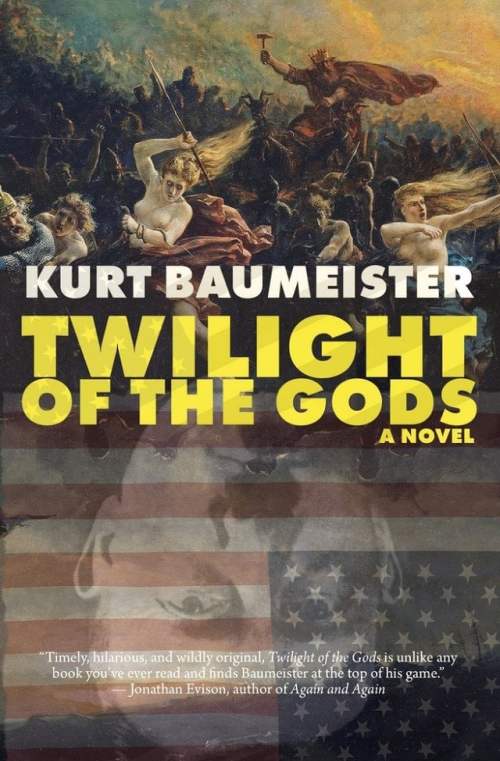
FICTION
by Kurt Baumeister
Stalking Horse Press
Published on March 11, 2025


