


Yesterday I spent 50 cents to communicate with someone who is incarcerated. It was a cheap day. He gets one free video visit a week and, this week, he used it on me. I know his family is supporting him, putting money on his books, so I feel guilty each time I’m the one he uses his free visit on. But his family is typically working during the free video visit windows (Monday, Wednesday, Friday from 8am-4pm), and anyway, we’re friends now, he reminds me.
I didn’t know him until three months ago. We started communicating because while I was collecting stories for an anthology, I became aware of his. We set up a time for him to call me collect, and I listened, learning he’s been locked up for over 5 years without a conviction. Let that sink in: He’s been kept in a cell, away from everything he loves, cut off from his family and society, his words and movements monitored and restricted for going on six years when there has not only been no conviction, a witness to the crime can attest to his innocence. Our time was cut off, but he called back to thank me for listening and said there was much more to tell. And that led to more phone calls, messages through the Getting Out app, and video visits that also go through that app. We continue to talk because he wants to share his story. And every time we do, I feel humbled that he’s trusting me with that, which he wants to share in the hope it could possibly help someone else.
Video visits cost 25 cents a minute, phone calls 20 cents. They’re limited to a maximum of 15 minutes, and there is a service fee of $3 for each visit or call. I can send messages, essentially like a text or DM, and those run 25 cents per message. Those involve fees too, though it’s harder to quantify as it’s pulled from the money I put on my Getting Out account, and each time I add to it, I’m charged a fee. I’ve spent over $60 to communicate with him these past few months.
All our communication—the messages, phone calls, and video visits—is monitored. He has paid for messages that never reached me, perhaps because someone (a guard? an administrator?) deemed them unacceptable. I can’t help but think how whoever is monitoring our interactions can’t be too happy about him telling me about the conditions inside the Winnebago County Jail—such as how I now know about what the people incarcerated there call “rat burgers.” They were served rat burgers the other night, and this person—my friend—bought noodles from the commissary, not only for himself, but two inmates who didn’t have money on their books, so they wouldn’t go hungry since, as you can imagine, “rat burgers” are more or less inedible.
I share all this because while I’d heard about the commodification of the prison system, I’ve seen firsthand how much of a profit is made; how some of the most central facets the human experience—connecting with others, eating edible meals—are flipped for profit at the expense of some of the most marginal people in society. I know that the jail charges $6 if an inmate wishes to wear deodorant as this item must be purchased from the commissary. I know how in order to set up a video visit or call, I must send a 25 cent message sharing my availability for the week. I know how fast these charges add up.
*
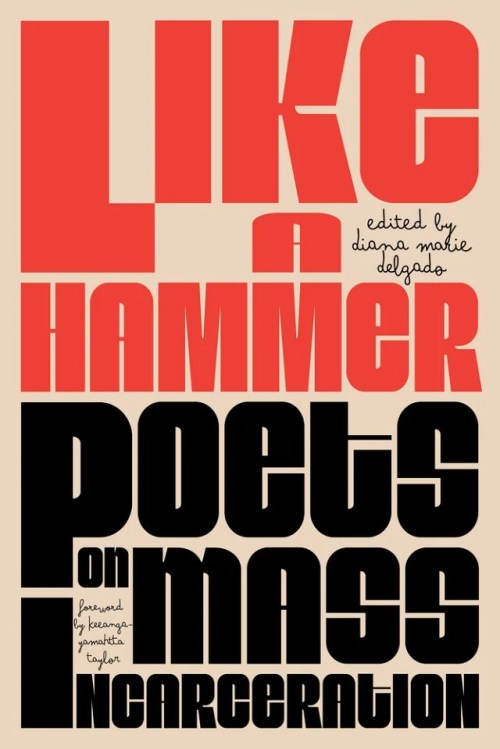
The context around when we read books shapes how we experience them, and I picked up Like a Hammer: Poets on Mass Incarceration at a time when each week I am personally witnessing the effects of mass incarceration. I read it as I’m spending money to communicate with someone that I didn’t even know existed four months ago. I read it when I’ve been spending Saturday afternoons volunteering as a court watcher for the ACLU to monitor initial appearance hearings and document what happens to the accused, particularly those who might be undocumented. I read this book inside the courtroom, during lulls in between people appearing in shackles before a judge, hoping to be released. In other words, I read this book at a time when I have been within the larger ecosystem of mass incarceration in a way I hadn’t last year. And so my reading experience was filled with recognition of what I’ve seen and heard. It was filled with gratitude for the work that editor Diana Marie Delgado did to edit and assemble this anthology, for all the poets who contributed, and for Haymarket Books for not only publishing it, but for their Books Not Bars program.
The anthology includes such literary luminaries as Patricia Smith, Hanif Abdurraqib, Ada Limón, Natalie Diaz, Nikky Finney, and many more. It begins with a foreword by Keeanga-Yamahtta Taylor, who speaks about visiting a Texas prison in the eighties as part of the “Scared Straight” program. I was immediately hooked, and would be remiss to not quote at least one of Taylor’s sizzling sentences: “No civilized society should rely upon the threat of violence, brutality, and banishment as a response to loneliness, sadness, hunger, and despair.” From there comes Delgado’s introduction, which does a beautiful job offering context on how the book came out, how it’s structured, and how to read it.
I’ve never reviewed a book of poetry because while I love poems, I worry I lack technical knowledge about the genre to do a decent job analyzing one. Yet I didn’t think twice about asking to cover this book because of my interest in the topic and the contributing poets—the ones whose work I’d previously known and loved, and those who the anthology introduced me to. But here we are, at the point where I should speak to individual poems, and I want to cop out and say: They’re all good.
Lumping them together to say they have merit is true. To describe them all as “good,” the cop out. Because some of the poems are more narrative, others more abstract. In some the speakers reckon with being incarcerated themselves, in others the speaker is someone on the outside, loving someone locked up. There are images, there is an erasure poem, one is a triptych that looks like a diagram or outline. One repeats words over and over, sometimes in bold, sometimes without spaces, and the poetry is in the repetition. A few appear in Spanish, then in English. Abdurraqib has two poems called “All the TV Shows Are about Cops,” constructed differently. The last poem, by Smith, reads like an essay and made my heart ache. The range of voices and variety is what makes an anthology worth reading, and Like a Hammer offers the reader a kaleidoscope of textures. No weak poem exists within these pages; each is intensely vivid and sharp.

I worry my inexperience reviewing poetry books means I can’t adequately express what an important anthology Like a Hammer is. I couldn’t say it better than Delgado puts it in the introduction: “This anthology explores how art and imagination can serve as vehicles for endurance, offering us the hope to envision a different future.” At a time when each day offers another injustice to fight, many of us are looking at how to endure, searching for hope. So much chaos, so many political issues that feel unrelated. But if you look closely, they’re all connected by a shared thread: a person’s right to dignity—particularly if there is monetization involved (something Alexandria Ocasio-Cortez spoke eloquently about, connecting the push for mass deportations with mass incarceration).
The current administration continues its barrage of orders and cuts that undermine many people’s dignity, the legislative equivalent of forcing someone to eat a rat burger. We need to push back on the narrative that some people deserve less because of how they’re born, who they love, how they arrived here, or what they may have done in the past—or, in the case of my friend, did not do. It’s exhausting to face so many social justice battles these days, but the issue of mass incarceration is another important one. Like a Hammer is a welcome companion for the fight, offering the hope of envisioning a different future.
Poetry
Like a Hammer: Poets on Mass Incarceration
Edited by Diana Marie Delgado
Haymarket Books
Published March 4, 2025


