


If everything was falling apart, what would you save? If fires lapped up against the sides of your home, or floodwaters flooded your library, what would you grab? What you need to survive? The beautiful or the necessary?
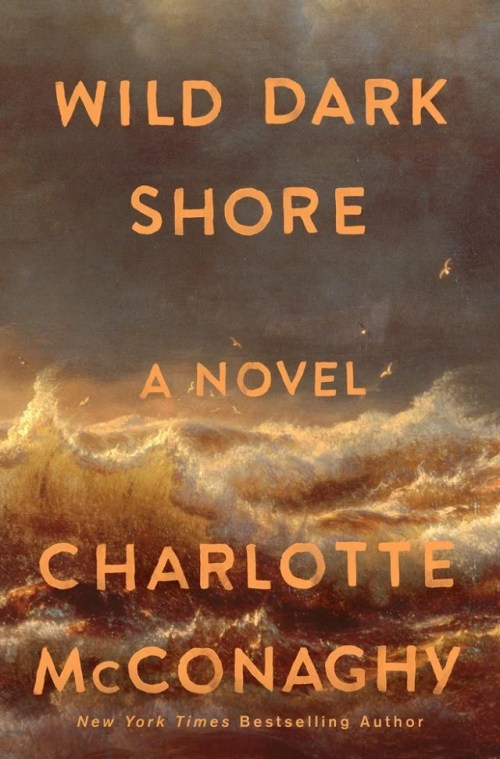
Charlotte McConaghy is no stranger to tales that commingle grief and climate; her novel Migrations brought together the last arctic albatross migration and a woman lost in her sorrow. Wild Dark Shore takes these themes to new heights, asking us not just what it takes to survive, but what kind of survival is worth having in the face of looming climate despair.
A troubled family lives alone in a remote landscape. Dominic, the father, is still grieving his wife who left them a decade ago. Fen, who chooses to sleep on the beach near the seals; Raff, mourning his only love; Orly, who hears the voices of the lost on the island, who knows more about the seeds in the seed bank than anyone. They’re all called to action when Rowan washes ashore. She came here for answers, and now she’s stranded, wondering if she’ll ever get them, growing quickly entangled with this isolated, complicated family.
The island is both at the mercy of climate change and apart from it. Their existence is careful and sustainable. They walk among penguins, watch birds nest, and watch daily miracles of nature. And yet the ocean is going to take this island. The beaches are disappearing. The history of the island is haunted by mass death of seals and whales at the hands of humanity. The seed bank is doomed, and they can only save a sparse selection of it. And they’re months away from being forced to leave this place and join a society that encroaches, builds, and ruins the natural world.
In the face of that loss, what can a person do?
McConaghy weaves her questions into a story filled with intensely real-feeling characters and their strong emotions. Rowan thinks she knows how to survive a large loss. Her home was lost to wildfires. She watched it burn to ash. It’s why she’s never wanted children: she’s never wanted to have to risk such a loss. And in a world of climate disaster, such loss feels inevitable. On the other end of the spectrum, Dominic’s children are his life support. He is almost too dependent on them, putting everything he has into them, as they find themselves worrying about him in turn.
It’s not for me to spoil the novel, with its rich twists and unexpected turns. But I will share this. Rowan built her home to withstand every fire, or so she thought. She gave it everything. And it still burned. Her husband cradled melted trophies, useless in his obsessive mourning—this man will, later in the novel, become so overwhelmed by climate despair that he ceases to be able to save anything at all. But despite her preparations and his useless grief, she discovers a wombat burrow among the burnt forest, in which several animals have managed to take shelter and survive. They knew more, instinctively. They knew how to survive, completely apart from all the couple’s efforts.
Humans will save themselves, McConaghy suggests, always. And when we reach for what seeds to save, perhaps we’ll choose only those we can eat or harvest. But the youngest son, Orly, is obsessed with stories of the hardy seeds, the beautiful ones. The ones that show how nature already has a plan for survival. And as the characters’ empathy for the natural world blooms, they’re able to help it along, urging it along the right path. Not intervening, but nudging. Even when it compromises their own survival, they help where they can. And ultimately, they also know when it’s time to turn to their own survival, and hope that nature can take care of itself. It usually can.
This in turn mixes with Dominic and Rowan’s views on parenthood, on what it means to try and foster a younger life. Both, in different ways, have to learn to let go of the children. To nudge, but also to know when to trust them to make their own choices, to follow their own remarkable instincts. To know when they have something to teach us.
It might sound as if McConaghy’s novel asks a lot of its readers, but in fact it’s a suspenseful, rushing read, full of short chapters, emotional twists, and a landscape it’s all too easy to sink into and live in. Wild Dark Shore is an exceptional book that hands readers a bittersweet helping of sorrow and joy, sounding a clarifying call towards a symbiotic survival that prioritizes our need to do more than simply subsist: to put trust in each other and in the nature that surrounds us.

FICTION
by Charlotte McConaghy
Flatiron Books
Published on March 4, 2025


