


A decade ago, after being selected by Rivka Galchen as the inaugural Fence Modern Prize in Prose, a rather unique novella about a drunken and murderous sailor was published. This literary debut was titled McGlue (2014), and its author was neither a sailor nor a murderer, although—as she admits in this interview—someone with a dipsomaniac, and somewhat amnesiac, past. Since then, Ottessa Moshfegh (Boston, 1981) has become a writer characterized by a cutting prose and a rare sense of humor that matches our stranger and agitated times. It all started with McGlue‘s, a novel of just 152 pages, loaded with a prose that reminds, and update, other literary works about sailors and exacerbated masculinities, such as Moby Dick (1851) and Benito Cereno (1855), both by Herman Melville. The novella’s premise is simple: McGlue is a sailor who wakes up chained to his bunk and accused of murder. All he knows, everything readers can glimpse amid his grotesque thoughts and language, is that McGlue is in a filthy cabin on the way to his native Salem. Once the alcoholic cloud clears, he is informed that his friend Johnson has been murdered. And that there is only one suspect: McGlue, of course.

Antonio Díaz Oliva
Let’s go back ten and plus years ago, when you were writing McGlue. Any specific moment that you remember from that process?
Ottessa Moshfegh
I mean, I know that this book would not exist if McGlue had not found me. And he found me because I was, like, obsessively scouring the online periodical archive at the library, looking at newspapers from mid-century New England. And the language of print journalism, back then in America, was hilarious. The feature stories and articles are really like snappy and full of attitude and very serious and comedic at the same time. It’s specific to New England actually, because we’re very sarcastic people. And then, you know, leafing through some pages I see that there’s a lot going on in 1851. And then I come across this tiny little announcement that’s titled McGlue. It went something like this: McGlue from Salem has been acquitted of the murder of Mr. Johnson in the port of Zanzibar, due to his having been out of his mind, at the time of the crime, because he was in a drunken blackout, and had suffered a head injury from moving off… jumping off a moving train, several months earlier.
Antonio Díaz Oliva
And that’s pretty much the premise of the novel!
Ottessa Moshfegh
Yeah. That was really the inspiration. And then, as I was writing McGlue, I felt like was conjuring or channeling some voice. Maybe it was his voice, maybe it was the voice in my head, or whatever, but the music of the project was sort of coming through me and out onto the page in this very specific way. And sometimes it felt excruciating. Even psychically, so frustrating, I don’t know. And this is going to sound so insane, and I don’t want to like spoil it for anyone who might read this, but I wrote most of the book, as the author, not understanding why McGlue killed Johnson. Like I truly didn’t understand that. McGlue is a very repressed character; the truth of himself and his desire and his fear are occluded by so much denial. And there I was in this headspace, writing the story without knowing where it had to go.
Antonio Díaz Oliva
And how did you deal with that?
Ottessa Moshfegh
So, I was living in Rhode Island. Every month I went to see this wonderful woman who was like…I don’t want to say she was a psychic healer, because she’s not so much healing, but she was a practitioner who had the ability to sort of touch you, and she would get an image, and share it with you, and then sort of like help you work through it…by releasing an energy or like screaming or whatever and it was just really interesting. She was so, so, so talented and in a way that I just can’t describe. And I went to her one day, and I was like: “I’m really feel like I’m in a blind spot, like, I don’t know how to finish this book.” And she asked: “Well what’s your book about?” And I said: “Well, it’s about the sailor.” And she was like: “Oh, and she said that’s why you’re wearing that jacket.” And I answered: “What are you talking about?” And I looked down and I was wearing a sailor’s jacket, which I hadn’t even noticed, like I’d been wearing it all winter. It was just like, yeah, it’s like a navy blue with like these big buttons on and I thought: “Oh, yeah that makes sense.” And then she’s saying something like: “Well, let’s see if McGlue is going to speak through your body to you, somehow.” Have in mind that this woman had never heard anything about the book at that point. And then she like touched my knees and gasped: “Oh.” And she basically just told me, straight up: “Johnson makes a move. And it’s terrifying.” My response was: “Of course! How else how else would it happen?” That literally made me finish the novel in a couple of days.
Antonio Díaz Oliva
It’s such a masculine story. I mean, the novel starts with an epigraph by Emerson that goes like this: “The young men were born with knives in their brain.” Did you ever think about gender as you wrote McGlue?
Ottessa Moshfegh
I knew McGlue and Johnson were men that had to coexist in a world, and, you know, that they were from different classes: McGlue from a lower-middle-class in New England, Salem, Massachusetts, and born in the 1820s or something; and Johnson as a very affluent man, the son of somebody who has had inherited wealth over generations. And I thought about the different kind of pressure each had. And so, I considered like what masculinity they needed to present to fit in and to survive in a world like that. And I also thought about their bodies, and their beauty, and what they looked like to one another, and why they were exciting for one another; like, why did they become friends?
Antonio Díaz Oliva
What about drinking alcohol? It’s another element very much present in the novel. And I know that in the past you have talked about your history with alcohol. Were you drinking when you were either writing or editing or none?
Ottessa Moshfegh

At the time, when I was writing that book, I was in rigorous recovery for alcoholism. This was a long time ago, and everyone has their path, and you know, I can talk about it now. It’s something that that I used to do—embrace sobriety. I would fully embrace the process, because when I found um sobriety I was like in my early 20s, and it really opened the door to a kind of appreciation of a spirituality that I had never touched before. And so, for me the idea of alcohol is like the imbibing of the spirit that makes you feel better and worse at the same time. And how that can distort your mind and your way of thinking and your imagination and your sense of self. That was very much on my mind at the time. So, this idea that McGlue would be like desperate in withdrawal, in the hold of this ship, just fucking suffering. And as he’s sobering up, and his mind is finding its footing again, and he has the clarity of really understanding what he did and why it’s so devastating.
Antonio Díaz Oliva
What did you expect from McGlue’s publication? Did you have any hopes?
Ottessa Moshfegh
I mean, I was so lucky. So, I put this book away, and then like two years later this experimental literary journal that had been publishing books of poetry was like: “Oh, we’re going to start this prize for a work of prose.” And I said to myself: “I’ll just send them McGlue.” The prize was the publication of the book. And so, I couldn’t have found like a better entree into the world for this book. It’s called Fence, the publisher. And really, my editor, Rebecca Wolfe, who’s a poet and a writer herself, someone who really had the sensitivity of a poet and someone who is committed to championing innovation in writing. So, I felt like I the book was being treated careful, you know, with the humor and reverence that I would want it to be. McGlue was shepherded into the world with care and that meant so much.
Antonio Díaz Oliva
Anything that surprised you when you published McGlue?
Ottessa Moshfegh
No, not really. I mean, it’s always really heartening when you do something that feels very weird, and people engage in it and take something from it, and then they even start talking about it. You realize that you’re connected with others through your creation. That’s why books, music, art, whatever, it connects us people through experience. What else can I say? McGlue was my first book. I was just overjoyed that it made into the world.
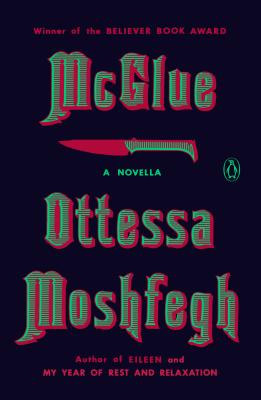
FICTION
McGlue
By Ottessa Moshfegh
Fence Books
First published in 2014
Republished by Penguin Books on January 8, 2019


