


As many in the American South continue to rebuild their lives in the wake of Hurricanes Helene and Milton, Olufunke Grace Bankole’s debut, The Edge of Water, feels unexpectedly timely, even twenty years after the historic storm at the novel’s center. This emotionally resonant book tells the story of three generations of women in a Nigerian-American family irrevocably changed by Hurricane Katrina. Through a remarkable range of perspectives, Bankole explores the interplay between fate and human agency—how her characters persist in pursuing their deepest longings even when forces beyond their control point to another outcome.
I had the pleasure of meeting Bankole at the 2024 Portland Book Festival at her workshop on writing a multi-vocal novel, and we spoke more recently over Zoom about her inspirations and influences and how she approached writing about Hurricane Katrina. We also discussed her passion for exploring her characters’ many layers of complexity and “in-betweenness,” through narrative choices ranging from the extremely subtle to the delightfully bold.
This conversation has been edited for length and clarity.

Jules Fitz Gerald
I understand from the letter to the reader before the book that you began writing pieces of this novel the year after Hurricane Katrina hit. Could you share about the experiences you had in New Orleans that inspired you?
Olufunke Grace Bankole
When I was finishing up law school, I won a fellowship through the Open Society Foundations, and my project was to go to New Orleans for a year to help create a program to support families of incarcerated children. I went down there to do that work, and I loved New Orleans. It was my first time having my own apartment as an adult, post-school, and it felt really new and exciting, so the city held a lot of significance for me. On my days off, I would wander the city, go into the French market, and I remember being called after by the African women in the market and being drawn to these women and having a strong sense of connection. But by the time Katrina struck, I had moved to another state, and I was watching with the rest of the world in horror.
One of the things that stuck in my mind is, when you tell people to evacuate, where do they go? When I lived there, I don’t know where I would have gone. I had colleagues, but you know how it is, you don’t want to impose. I thought about what would happen to someone who didn’t have a place to go during the storm. Where would they end up? The Louisiana Superdome was one of those places. And who were these individuals before they came to New Orleans? What were their dreams for their lives? So I wrote a short story around that time, my first short story, about a young Nigerian woman making a life in the U.S. who finds herself in that kind of circumstance. It was published in the Michigan Quarterly Review, and the editor kindly wrote me an encouraging note that gave me a confidence boost and really started me on my path.
Jules Fitz Gerald
You also mention in an endnote that you diverge somewhat from the historical details of Katrina. What kinds of details did it make sense to treat more loosely, versus which ones felt important to represent with accuracy?
Olufunke Grace Bankole
One thing that was really important to me, because I have so much love and respect for New Orleans and the people I met there, was to try to tell the story in a way that respects the magnitude of how it affected people’s lives but also to signal that I’m not a historian, I’m not a journalist, that this is not a historical novel about Hurricane Katrina. In preparing for writing certain sections of the novel, I went back to news footage from that time, the coverage before the storm and during the storm and after, and I wanted to get at, as much as I could, the horrors of Katrina and the days so many people spent in the Superdome without power or adequate food or medical care, but I know what I’ve written doesn’t compare to the real-life horrors. I also wanted to leave room to make the best decisions for the characters’ stories, because while the storm is central to the story, it’s about how this particular woman and this family are impacted by the choices they made leading up to the storm and during and after, trying to piece their lives back together. So, for instance, I believe the real-life Katrina came in the early morning, but I had it happen at night in the novel because I wanted to give the character a chance to make decisions and preparations during the day with that sense of urgency, that sense of still being at the market, trying to make your last few dollars for that day knowing that this terrible thing is about to land.
Jules Fitz Gerald
Yes, as much as the storm plays a key role, I appreciate how much you keep the primary tensions in the story centered in the characters.
Olufunke Grace Bankole
Maybe it’s because I’m an introvert, but I think so much of our lives happens internally, many of the decisions we make and the way that we spend time involves wanting more than where we are, wanting more than what life has given us at this moment. I wanted to write a character who has a lot of longing. And it wasn’t that life was so terrible in Nigeria, you know—by Nigerian standards, Amina had a middle-class family: educated parents, her father had been doing well at one time, her mother was a business owner. But life does not have to be the stereotype of extreme poverty in an African country for someone to want something different. I tried to create a character who, from a young age, knew that beyond the circumstances she found herself in, there was more for her. And America just happened to be the vehicle for seeking that. So when the storm comes, it’s something she’s up against, but the story doesn’t end there.
Jules Fitz Gerald
Though Amina is prominent as a protagonist, the book very much features an ensemble cast of narrators, like the letters from Amina’s mother Esther and the voice of the priestess Iyanifa. Could you talk more about your discovery of this multi-vocal approach as the right one for this project?
Olufunke Grace Bankole
I don’t come from an MFA background, so if there’s a way to write a novel, I didn’t really know! I just thought if I told it from point A to point B, linearly, I didn’t think it would be as interesting for me. I wanted it to be layered. The layers for me also speak to the complexity of the intersections of Nigerian, African, Christian, Yoruba cultures, first-generation, being a woman, being a young girl, all the ways that the stories that we tell at different stages of life, within different communities, are varied. With individual characters, I would often start in the first person and just sort of listen to it and make adjustments if it didn’t sound right. Amina is very internal and very dreamy, and the “I” felt right for her. For Esther, who is this very self-assured woman, very driven, with her own sense of how things should work and who wants to tell her daughter how to go about living this life, letters felt right. On the other side, I wanted the men to be third person, to have Iyanifa tell their stories. It was really fun to do that. One of my mentors years ago said to me, “You know, ‘novel’ means new, do it differently.” And that’s what I really love about the multi-perspective novel, or any novel—to ask, how can I do it differently in a way that’s interesting, that’s fun, even when telling a difficult story.
Jules Fitz Gerald
I was fascinated by how you interweave these stories—I read several chapters as they appeared in literary magazines and enjoyed seeing how they could stand alone in slightly different form—but the container you build that makes the book truly feel like a novel is the overarching voice of Iyanifa and the accompanying symbolic shapes of the cowrie shells as chapter headings. How did you come to that character and unifying frame?
Olufunke Grace Bankole
Thank you for that generous reading! There were several points in the revision process when my agent was like, “If you want to do a novel-in-stories, that’s great, if you want to do a collection, I support you, but this does not read cohesively.” I want to be transparent about that, because I know there are times when I listen to a writer talk about their work and think, “Wow, that was just fully-formed,” and it wasn’t like that at all for me. I really had to go back and think about what ties all of this together, these characters, where they grew up, the cultures. Such a strong part of Yoruba culture is the traditional religion and this idea that, even with individual free will, so much is determined for you. And so Iyanifa came in at that point. I wanted her to make pronouncements and to be the go-between between the several worlds and the characters’ desires. And the cowrie shells as a divination system shows, “This is what their fates could be, or ought to be,” but we still get a hint of how characters’ actions might change that. It also felt important that Iyanifa is someone who is living among the characters herself and is a part of the culture, and she’s in an in-between place, too.
Jules Fitz Gerald
Speaking of the “in-between,” in another endnote you discuss your choice to render Yoruba words without their diacritical marks. I’d love to hear more about your thinking behind that or if there are other craft choices where you were intentionally trying to explore those in-between places.
Olufunke Grace Bankole
Absolutely. There were moments where I thought, okay, my mother is a traditionalist, knows Yoruba culture in and out, and I could consult with her and get the marks right, but the truth is, I was born in the States and my parents took me back to Nigeria when I was a baby and I lived there until I was about eight, nine years old, so Yoruba was my first language. But with so many years of speaking English, I don’t remember when I thought in Yoruba or I didn’t speak in English, and because I stopped learning Yoruba formally in school at such a young age, I didn’t know a lot of the proper tonal marks. Yoruba is a language where one word can have various meanings depending on the intonation, but I genuinely didn’t know how to always denote that, and I wanted to be honest in a way that accurately reflects my in-betweenness as the author of this book. I speak Yoruba, but I speak it with an American accent.
There are a couple of characters, too, who talk about going back to Nigeria, and what does that mean if you don’t know the social trivia or latest dance that would make some people acknowledge you as a true Nigerian? I wanted the character of Amina’s daughter to have some of those internal battles about what does it mean to be African, what does it mean to be Nigerian, and where is she on that continuum? And even for Amina, I used the British English words for certain things in the Nigerian chapters, like “sofa” instead of “couch,” or “center table” instead of “coffee table,” and then when Amina gets to America, gradually—because that’s what she would start to do—shift to the American English words. And the way Esther would talk is different from how Amina would talk. Whether you’re Nigerian or from another background, I think we can all relate to this idea that how we use language is influenced by how we learned it and where we learned it. There’s even language at home. I am Olufunke Grace Bankole, but I also have inside-the-house names. We all have those private and public languages, and that in-between space is fascinating to me.

Jules Fitz Gerald
The letters from Esther to Amina are also very interesting formally. I read them as charting not just the physical distance but the emotional distance between Esther and her daughter as well. I also loved how the physical letters become elemental to the plot. Did you foresee that when you started out, or did that emerge during the writing process?
Olufunke Grace Bankole
That’s such a great question—your questions are so insightful. The letter form was inspired directly by this classic Senegalese writer Mariama Bâ, who wrote a novella called So Long a Letter, which involves this intimate letter-writing between her and a childhood best friend. I’d always been drawn to how letters can be intimate, but I didn’t want to do the traditional “Dear So-and-so” and a sign-off. I wanted to cut that, so that at certain times, it isn’t really clear whether Esther’s talking to Amina in her mind or if she’s talking to Amina in writing. I wanted to blur the lines in the conversation. As for the way the letters bridge the gap between the generations, that was not a decision I made until the very, very end. I didn’t want to make it gimmicky, but I also wanted a genuine way to connect the different generations of women, and the letters felt like a true way to do that.
Jules Fitz Gerald
I noticed several places where the narrator withholds something important until deep into the chapter, yet I didn’t feel manipulated, or if I did, I enjoyed it! I don’t want to spoil anything for readers, so I’ll just say these are two key moments where characters actively conceal something from other characters. I’m curious about how you approached writing these sections.
Olufunke Grace Bankole
Oh, I had fun writing those parts! For me it goes back to the idea of what makes the story more interesting to write. It’s also a way to see the humor in what is otherwise really hard and painful. That people are more dynamic, complex, and layered, that people aren’t always pure. Even if we have a sympathetic character, they are still complex human beings who do terrible things, who do mean things, who might do criminal things, and that kind of complexity should be allowed for every character, because that’s who we all are. We’re all operating in lightness and goodness, and shadows and darkness. Thank you for noticing that—that’s rewarding!
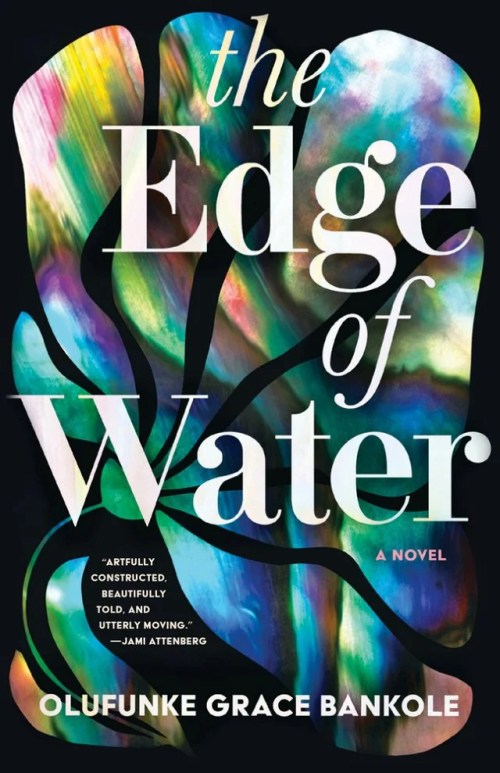
FICTION
by Olufunke Grace Bankole
Tin House Books
Published on February 4, 2025


