


Susan Barker’s previous novel The Incarnations, a New York Times Notable Book and finalist for the Kirkus Prize in Fiction, speeds readers in a taxi through the streets of Beijing, the driver of which has been receiving eerie letters from one claiming to be his soulmate throughout previous incarnations. Barker’s new novel, Old Soul, moves in a similar fashion, folding past and present inside a network of haunting, otherworldly communications. For decades and across continents, a mysterious woman (or entity?) has been predatorily feeding on the spirits of vulnerable people, leaving them desiccated husks of their prior selves. Having experienced his own horror at the hands of this woman, teacher Jake finds himself compelled to learn more about her, seeking out those who have also been traumatized by her sinister embrace and, in the process, unraveling her web of predation.
From the days of Poe, literary horror as less an amalgam of genre tricks and more a sensibility of artistic balance remains tricky territory for the novelist. How do you render metaphysical nuance in a prose of poetry and still retain the blunt force of the plot, a terror story that transcends prosaic imagination? Susan Barker deftly manages this balance. Her villain’s determination to keep her life at any cost reflects, in a glass darkly, the persistent, disturbing lineage of horror fiction’s finest literature.
This interview, which took place over email, has been edited for clarity and length.

Ryan Asmussen
In your latest novels, narratives spin confluences of past and present, more so than just an occasional dip into flashback. The temporal becomes a character in itself. Do you tend to understand your life this way as in your fiction? Or are you consciously attempting to render the process of time more for artistic reasons?
Susan Barker
‘The temporal becomes a character’–I love that! Most of my books are about the impact of the past on the present, and the past is resurrected through the characters’ storytelling, so it has the immediacy of the present day. In Old Soul, Jake gathers testimonies from individuals living in the aftermath or wreckage of traumatic events (namely, the loss of a loved one after they crossed paths with the same woman). Sometimes, these individuals are still processing what happened. Sometimes, they are irreparably broken, even though the encounter and devastating fallout were decades ago.
Most of the past testimonies are recounted in a conventional, linear arc—beginning with the character meeting Old Soul’s antagonist and the narrative escalating to the terrifying consequences. I’m a huge fan of the horror genre and its conventions, though I try to shake these conventions up as much as I try to honour them.
Beyond novel writing, I’m skeptical about this kind of narrativizing of the past. I’ve been in therapy on and off over the years, and I’m wary of the temptation to understand your own past through storytelling. It is helpful to understand the forces that shaped you to an extent, but having a fixed narrative of something that happened when you were ten, for example, is problematic because memory is deeply biased and flawed. When we ‘remember,’ it’s a memory of a memory that shifts us further away from the truth. My own belief is that looking back at the past is like looking through a kaleidoscope, with broken fragments of events constantly shifting about. There’s no coherent narrative—even of something that happened yesterday. Only these shards. The therapeutic focus should be how we respond to any emotional after-effects in the present moment.
Ryan Asmussen
Is the multilayered fabric of Old Soul’s narratives, their stories-within-stories nature, a more personal or artistic viewpoint? How carefully must you plot beforehand in the draft stages? Jake’s progress—his quest—is the central arc, yet we have five encounter tales spread across the globe, which are also part of the total story.
Susan Barker
I love writing expansive novels with stories-within-stories. Being limited to just one narrow timeframe would restrict what I want my novels to say about how consequences ripple across time and space and into the lives of others. I tend not to plot in advance. The eight years it took me to write Old Soul could be a cautionary tale about this approach. Creatively, I’m led by what I am fascinated by and what I would like to deepen my understanding of—the plot is a secondary consideration. For Old Soul, I wanted to learn more about the history of the former Eastern Bloc and ended up researching and writing stories set in the former GDR and Soviet-era Hungary. I also wanted to learn about Japanese butoh dancers, the New York art scene in the 80s, the Badlands of New Mexico, and so on…
I go about writing a book in a pretty haphazard and disorganised way. Generally, as I research, loose ideas for characters and the story surface from the note-making process. I research a chapter, write a clunky draft. Research some more, write a slightly better draft. And repeat the process until I’ve written something I can live with going out in the world. Jake’s over-arching narrative is a way of structuring all the stories-within-stories. With each encounter, he learns more about the woman’s modus operandi, and his quest unfolds.
Ryan Asmussen
While concerning many matters such as pre-determinism and identity, Old Soul may, in a deep sense, be working through layers of feminist theory. The woman-of-many-aliases, her fierce, unapologetic desire for life, and the many resistances she faces, in addition to the other struggling female characters in the novel, create a unique lens through which to see issues of female agency and power. Is there an allegorical element to your stories? How do you read this?
Susan Barker
Several of the female characters in Old Soul are oppressed and/or mistreated by controlling, abusive, or immature men. In some cases, the women (Ceridwen, Ursula, and Zsuzsanna, for example) appear to gain agency when the supernatural force enters their lives, empowering them to fight back against these men. The woman-of-many-aliases herself came from the origins of brutal oppression she was liberated from through the Faustian bargain she made. But in all these cases, is the agency genuine? Or have they just been delivered from patriarchy into the dominion of an even greater oppressor?
Putting the brainworm of pre-determinism aside, there is something I admire and even covet in the resilience and determination of the woman-of-many-aliases as she moves through the world. She herself is not a feminist as a true feminist wants to advance and improve the position of all women. She’s only out for herself, and many of her victims are vulnerable girls and women who she robs of agency to secure her own. That said, in a genre where most monsters are male and the female characters are either tormented victims or the plucky, resourceful final girl, centering the story around any female monster can be considered feminist. She subverts all the norms and expectations of how a woman should be or only performs these norms and expectations (e.g., kindness, empathy, maternal instinct) to lure in her victims.
Ryan Asmussen
I’m thinking of the character who seems the most vulnerable of all: Rosa, the seventeen-year-old YouTube influencer with whom the reader spends a lot of time. How easy or difficult was she to write? She’s unlike many of the other wounded souls in the novel.
Susan Barker
Rosa was so much fun to write. She’s a hustler but also childlike and naive. Her influencer ambitions sit at the confluence of entrepreneurial girlboss culture and the pseudo-spiritual trend of ‘manifestation’ by way of the Law of Attraction. Her vulnerability comes in part from her stubborn faith that she can elevate herself and overcome obstacles like poverty, lack of education, and connections just by performing this confident, expert, successful persona online. She sees YouTube and TikTok as a route to fame and fortune, and I totally get why. There are so many snake-oil influencers spouting nonsense on these platforms and doing very well for themselves.
For research, I watched a lot of YouTube videos with Gen Z influencers talking about how they manifested X or Y for themselves—usually a ‘glow up’ or lifestyle change or their YouTube career. The message is that to get what you want, you just have to will it hard enough and send some positive affirmations out to the universe. The apparent obliviousness to any systemic or socioeconomic barriers that may exist between an individual and their aspirations is disconcerting to me. Achieving what you want, it seems, is all within the locus of the self.
What’s fascinating about Rosa is that even though she’s one of the most disempowered characters in Old Soul, she is the least beaten down by her circumstances. She’s so optimistic and upbeat. She truly believes she is going to manifest her way into a better life.
Ryan Asmussen
Considering your Japanese background and the theme of reincarnation in The Incarnations and this novel, I wonder how much Buddhist philosophy has influenced your writing and your everyday life.
Susan Barker

There’s a lot about Buddhism that appeals to me, but I’m an atheist. I don’t believe in reincarnation, and I don’t think Buddhist tenets of reincarnation particularly influenced my previous novel The Incarnations. But one thing I have taken from Buddhist teachings is that suffering is fundamental to human existence and originates in our desires, our intolerance of impermanence, and our ignorance. This insight is something I believe deep in my bones and really resonates with my approach to character and, subsequently, plot. Nearly all of my characters are suffering in some way because of loss or the ferocity of their desires, and this often becomes the propulsive narrative force.
Ryan Asmussen
The book has been called a “metaphysical mystery.” A difficult question I realize, but what metaphysics do you think we are dealing with? What, finally, is this story’s existential viewpoint?
Susan Barker
The metaphysical mystery in Old Soul has to do with the nature of reality. The novel takes place in the reality of three-dimensional space in which Jake, the woman-of-many-aliases, and all the other characters exist. But there’s the higher, fourth dimension of space in Old Soul within which the book’s ultimate antagonist resides. Lovecraftian cosmic horror was an influence here, as well as the idea of beings from higher spheres of existence intruding on the human world, moving characters about like pieces on a chess board while they—in their limited, three-dimensional perception—remain oblivious to these machinations.
The fourth dimension of space has been a preoccupation of mine since my debut novel, Sayonara Bar, in which a character believes he’s achieved a kind of omniscience by ascending there and seeing all three-dimensional space spread out beneath him. The fourth dimension is just theoretical, really. But its theoretical existence has always fascinated me. And the mechanics of moving between dimensions explain why some of Old Soul’s characters end up reversed from left to right.
There is no free will when a higher-dimensional puppet master is pulling your strings, so perhaps Old Soul’s existential viewpoint is pre-deterministic. But beyond the scope of the characters who encounter the woman, I’m not so sure. Perhaps there’s free will. Free will and chaos.
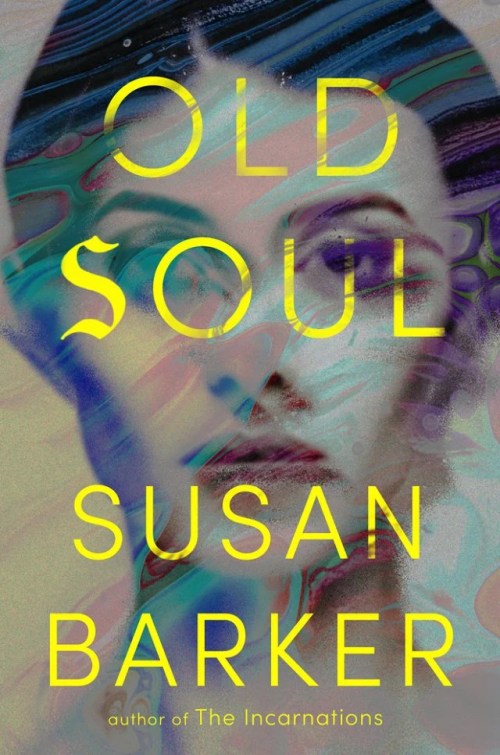
FICTION
By Susan Barker
G.P. Putnam’s Sons
Published January 28, 2025


