


The Chicago Review of Books is proud to partner with The Chills at Will Podcast to share new audio interviews with today’s brightest literary stars, including Jonathan Escoffery, Morgan Talty, Deesha Philyaw, Luis Alberto Urrea, and more. Hosted by Peter Riehl, The Chills at Will Podcast is a celebration of the visceral beauty of literature and the passages that thrills us as readers.

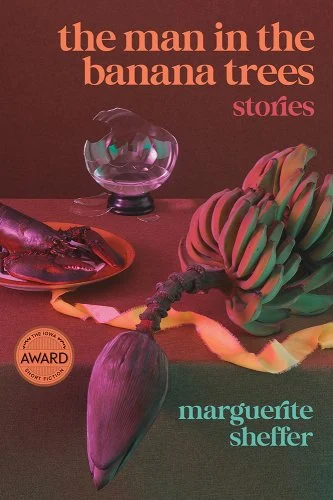
Maggie Sheffer’s debut story collection, The Man in the Banana Trees, is the 2024 winner of the Iowa Short Fiction Award, and it beautifully defies categorization.
Judge Jamil Jan Kochai wrote in his commendation, “The Man in the Banana Trees kicks ass. Every story is a surprise. The dexterity of Marguerite Sheffer’s prose is absolutely awe-inspiring. By turns heartbreaking and brilliant, Sheffer’s stories remind one of George Saunders and Amy Hempel in their playfulness and through their special eye for tragedy.”
I spoke with Maggie about writing a collection that is eccentric and varied with eminently memorable and sympathetic characters, and at whose heart is a playfulness and reverent solemnity for language and story.
This interview has been edited for length and clarity.
Pete Riehl
Your collection features so many varied characters and a lot of moral ambiguity regarding some of their choices.
Marguerite (Maggie) Sheffer
I think the great thing about fiction and short stories is that both can be true at once—we can judge the character and recognize what she did wrong, and also understand why she was making those choices. The best thing about fiction for me is that I don’t have to have the answer of what she should have done. All I have to do is tell the story of how it goes wrong.
Pete Riehl
The collection features a living puppet, magnetic lobsters, revenge-seeking, an engaged couple nonchalantly exchanging cut off limbs, plotting animals, AI tigers. What was it that drew you to science fiction and the speculative?
Marguerite (Maggie) Sheffer
Sometimes it’s just because the premises are so cool. I do think escapism is in there, like thinking about magic and aliens and the Force. I’ve been thinking about this a lot recently, because I think even when I write science fiction, it’s still about the things in our world that we care about the most and trying to make sense of them, and sometimes I think it’s easier to make sense of complicated and complex and hard things, to look at them with a little slant through speculative fiction. So it seems like escapism, but actually it kind of is a way to face something that would otherwise be unfaceable.
Pete Riehl
Death is clearly a theme [in the collection]. “Tiger on My Roof” makes me think about one of S.E. Hinton’s characters saying that there’s just nothing like a young person dying, and there’s nothing like a young person dying of violence—so, so tragic.
The narrator is a man who’s been out of teaching for 12, 14 years. The [powerful] beginning of that story is “Because I was a coward. I skipped D’s funeral.” Tell us a little bit about “D” and the tiger and the Pokemon Go connection.
Marguerite (Maggie) Sheffer
“D” was one of the narrator’s students at the opening, and he dies in a violent, senseless act, and the narrator has sadly had this happen before. He’s been to several students’ funerals and really can’t take it anymore. So he doesn’t go to the funeral, but does go to a public art event in honor of D where he encounters these AR [“alternate reality”] tigers and then later finds out that one has followed him home via his phone..
This means that when he looks, he can only see the tigers through his phone. His personal tigers are transposed into whatever he’s looking at through his camera, so it seems like it’s always with him, but only when he opens his phone can he see.
Throughout the story, he navigates having this tiger and also is forced out of his comfort zone to keep remembering D and thinking about the inadequacy of his own grief and how there’s no real right answer.
Peter Riehl
I was so struck by the banality of grief and all of those things that come with grief. [The narrator] wonders, Should I talk about D in past tense? He had kept one of D’s art projects that was unfinished. I think he ends up giving it away.
Marguerite (Maggie) Sheffer
One sad line in the story is that he doesn’t even know what happened to it.
It was just lost.
Pete Riehl
There’s this parallel story with Jacob, the son of the narrator. There’s a lot in the story about worrying about him and all the things in the world that, as a parent, you cannot control, as in: you can’t keep anytone completely safe as hard as you try.
The last line [in “Tiger on My Roof”] is so beautiful, and it reminds me of one of the stories from The Best American Stories of the Century. Alice Elliott Dark’s “In the Gloaming” ends with a father asking a very simple question that’s maybe the beginning of a reconciliation with his wife after his son has died. And so that last line, that poignant question, where these people who have the tigers on the phone find each other in the grocery store, is [resonant] and opens up so much.
Marguerite (Maggie) Sheffer
It felt really important to end the story on a question, because I think there are really no answers there, but becoming willing to ask is the journey the narrator goes on, from the beginning when he skips the funeral to years later.
Pete Riehl
Misogyny is a prominent part of the [collection]. This is particularly true in “The Observers Cage,” with Lizzie the astronomer. She doesn’t get credit for her discovery of radio pulsars. [Her story] is just like that of Jocelyn Bell Burnell [the Northern Irish astrophysicist who discovered the pulsars in 1967], who I assume is the inspiration.
The blandness of the writing on Joycelyn’s Wikipedia page makes it even more sad and interesting. All that it says is something to the effect of, for the discovery, the Nobel Prize ‘was won.” It was a very passive voice, like “the Nobel Prize was won.” She did not win the Nobel Prize.
Tell us a little bit about that story and its inspiration.
Marguerite (Maggie) Sheffer
I had actually been working on a totally different story that never ended up coming to light, but it was a romance about astronomers, and I was so stuck. I got a History of Astronomy textbook, and every morning before work, I was flipping through the pages looking for something to get me unstuck. And I happened upon the story of Jocelyn Bell Burnell.
Her discovery of pulsars and the fact that she was not awarded the Nobel Prize for it was shocking. Her fellow researchers were awarded the Nobel Prize, even though she was the one to technically make the discovery.
Of course, I was filled with rage and curiosity by that, and I read up a little bit more on it about what the nature of the telescope was, and I used that in this story. And then I hit the point where I had done enough research and I didn’t want to learn any more. So I closed the book. The character of Lizzie is not at all, personality-wise or circumstance-wise, really based on Jocelyn. They have entirely different selves. But the circumstance of making such a big discovery and not receiving the credit for it was the seed that I was really intrigued by, and I didn’t want to be beholden to the truth. So I didn’t do any more research.
Pete Riehl
There is a lot about climate change in this collection, and specifically a lot about what has been lost. “At the Moment of Condensation” is the story where rain is controlled by the corporation for “stewardship.”
Marguerite (Maggie) Sheffer
Can I share a fun fact about this story? When I wrote it, it was for a science fiction magazine, and I thought I invented this idea, and then later I learned that Israel does try to prevent Palestinian people from gathering rainwater for their own personal use in the West Bank. I had been naive, thinking: wow, I’m making up something so dystopian.
That often happens when I’m writing fiction. I think I’m going out on a limb, and then a little bit of research shows me that a lot of the good and bad things I think I’m making up are already happening in the world.
Pete Riehl
“The Pantheon of Flavors” is a story [where the company touts] the comfort of charcoal ice cream, like an advertisement.
Marguerite (Maggie) Sheffer
As the world burns, people want to eat the ash. That’s the premise in a sentence.
Pete Riehl
There’s a lot of hope in this collection, but is this one a hopeful story? Is it simply poking fun at commercialism? Or is it like, Oh my God, we’re screwed. This is dystopian as heck?
Marguerite (Maggie) Sheffer

I would say that’s one of the least hopeful stories. The conceit is that the story takes place at a corporate conference for ice cream makers, and they’re talking about how to spin global tragedy so that they can sell more ice cream to people.
Pete Riehl
Now, unfortunately, with so much of our wildlife and our sea life dying off, [a fitting story is] “Local Specialty,” where the narrator and her coworker find these plentiful lobsters.
Marguerite (Maggie) Sheffer
Lobsters are threatened by climate change, for sure. It’s meant to be a bit mysterious in the story—an oil spill or some sort of accident.
Pete Riehl
I was very struck by the connection, wherein the lobsters become almost magnetized to the people.
Marguerite (Maggie) Sheffer
Right. They become able to be synchronized with each other’s brains, like one massive brain. There is hope in that story, as the characters find a way to spin the spill into something subversive.
Pete Riehl
You have so many… I think of them as “soft endings,” where you come around from home plate to home plate, so to speak, or wonderfully unexpected endings—the endings alone could be fodder for you to do a masterclass. For example, in “Yellow Ball Python”: “I didn’t want you to stop looking” is one of the last lines, which even without the context of it is so strong.
The [collection’s] stories are delightfully weird, right? These are just off the wall. Some of these stories [are wild], like “The Wedding Table,” where the prospective couple cut off their hands and put them on a grill.
In stories like these, how much are you purposely going for symbolism and allegory, and how much is just, This is a pretty weird and cool story?
Marguerite (Maggie) Sheffer
Definitely the latter. When I’m writing, I’m in weird, cool ideation mode and I’m really not sitting there thinking, Oh, I need a symbol for codependency. My experience of writing is that I’ll generate a lot of ideas and then only later will I realize what I have done.
The ideas hit first and the stories hit first; the meaning kicks in later. For instance, I wrote this whole collection and I saw these stories as so distinct from each other. Wildly unlinked. I assumed no one would want to publish this as a short story collection. It has no “aboutness.”
Now that the book is out in the world, some people are like, Oh, this is a collection about grief. And now I can see it. But I wasn’t sitting at my desk being like, Today I’m going to write another story about grief. I was thinking about writing these real cool stories about spaceships and such, but now I can totally see the thematic throughlines. Those early readers are right, and it’s a very weird experience to have someone tell me what was going on in my own brain during the years I was writing these stories.
This interview is excerpted from Episode 264 of the Chills at Will Podcast. Listen to the complete conversation here.
FICTION
by Marguerite Sheffer
University of Iowa Press
Published on November 5, 2024


