


The relationship between art and political history can be difficult to discern. Since the beginning of recorded history, art known as “propaganda” has directly served political aims. This type of art, however, is usually tied to a limited cultural point in time, and is often quickly rejected by later generations. Arguably, the works of literature and poetry that survive the longest are those most universal in scope, able to be enjoyed by diverse groups of peoples separated by centuries of time, and accordingly, are less biased. John Milton’s seventeenth-century epic poem, Paradise Lost, makes for a curious balance. The poem has been celebrated both as a masterpiece of the Western Canon (or former Western Canon, depending on your position) and as a favorite of political revolutionaries, speaking to them like a universal spirit of rebellion.
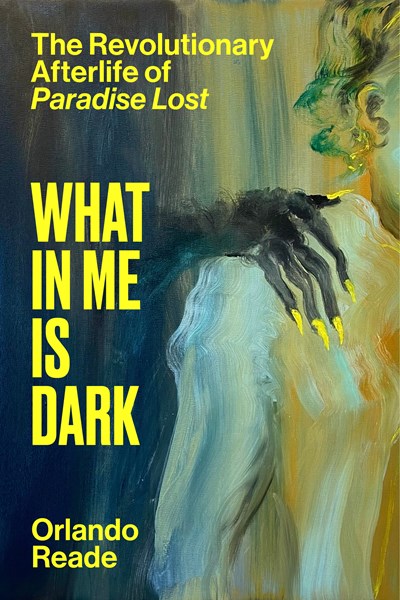
Orlando Reade’s What in Me Is Dark: The Revolutionary Afterlife of Paradise Lost (hereafter referred to as Dark) follows this course, focusing on twelve historical readers or groups of readers. Reade discusses Thomas Jefferson and the founders of the American Revolution, Baron Vastey of the Haitian Revolution, later writers like William Wordsworth and Virginia Woolf, minister and Black Nationalist leader Malcolm X, all the way to living interpreters of Paradise Lost such as Canadian psychologist Jordan Peterson. Helpfully, Dark also summarizes the plot of Paradise Lost in lucid English, moving chronologically through the plot alongside the discussion of historic readers.
A review of Paradise Lost may be appropriate. It is a poem on the grandest of scales, as Reade explains, “modelled on the epic poems of ancient Greece and Rome. […] Its subject is the Fall of Adam and Eve […], and it also describes what happened before the creation of the world, when one angel leads an uprising in Heaven against God’s authority. After the uprising is defeated, and the rebel angels fall down to Hell, they debate what to do. Their leader volunteers to travel up to the world that God has just created, intending to ruin it by tempting the new humans to disobey their Creator. We then see the fatal consequences of that decision.”
Reade is a professor at Northeastern University London. His BA and PhD were in English Literature, and he holds an MA in Renaissance Studies. For five years he taught in New Jersey prisons with the NJ-STEP education program, an experience described in Dark. The last chapter (and twelfth group of readers) is Reade’s own students from a prison class.
Though they rarely cite their source directly, many of the revolutionaries and writers discussed in Dark reference the leader of the rebellious angels, Satan, in their own works. Infamously, Satan makes for an often relatable character in Paradise Lost. As depicted in the poem, he is an individual exerting a right to freedom against an almighty, dominating authority. On the human political scale, it is easy to take inspiration here in one’s own struggle against abusive powers. The English poet William Blake even argued that Milton unconsciously preferred Satan to God, and this is why the most memorable parts of the poem are devoted to Hell and the pseudo-protagonist Satan. As the poem and Reade emphasize, however, Satan himself becomes his own tyrannical figure as soon as he is able, proclaiming himself as Hell’s sole ruler over the other devils cast down with him.
Reade describes the varying ways Paradise Lost’s readers have engaged with the poem. William Wordsworth and Dorothy Wordsworth looked to Milton as their great predecessor in English poetry, modelling some of his ideals into the English Romantic movement. The Mistick Crewe of New Orleans, a carnival society, performed their first parade as the “Demon Actors of Paradise Lost.” Malcolm X interpreted the actions of Satan as a symbol of white power, Europeans determined through rebellious force to reclaim an idea of “Paradise.”

Dark shows the diverse effects of Paradise Lost in political and cultural history. The politically oppressed and artistically oppressed found models of thinking through the work. At points Reade hints at a grander model of historical art, citing sociologist Max Weber’s suggestion that Paradise Lost, in its depiction of determined individuals, makes for the great poem of Protestantism. This is contrasted with the more “passive contemplation of the secrets of God” in Alighieri Dante’s Divine Comedy, argued as the great poem of Catholicism. In any case, as Reade notes, Paradise Lost is arguably the most influential poem in the English language. This fresh retrospective and exploration of such a foundational text is a pleasure to read.
NONFICTION
What in Me Is Dark: The Revolutionary Afterlife of Paradise Lost
By Orlando Reade
Astra House
Published December 10th, 2024


