


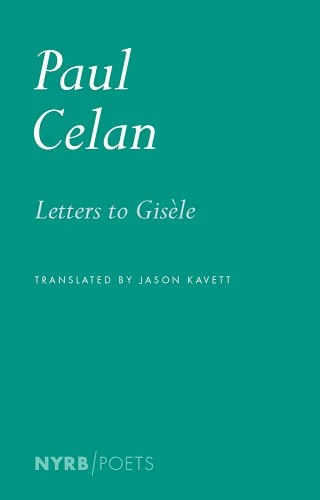
It’s not surprising that correspondence would be so crucial to the life of the poet Paul Celan, who spoke of the poem as a “message in a bottle” that might “wash up on the shoreline of the heart.” Once, he declared that he saw ”no difference between a poem and a handshake.” For Celan, the poem was always on its way, a mode of address in dialogue with its distant, unknown other. After a decade of translations and republications that have dramatically increased the amount of Celan’s writing available in English, Letters to Gisèle (translated by Jason Kavett) presents, for the first time, a sizeable selection of the correspondence between Celan and his wife, the French printmaker Gisèle Celan-Lestrange. The letters span almost twenty years, from the couple’s first encounters in the early 1950s right up until Celan’s suicide in 1970, and will surely be essential reading for anyone engaged with and moved by his poems.
Part of the endless fascination Celan’s non-literary material arouses stems from its intermundial position between two forms of darkness. First, that of the life: of the shadow of the Holocaust and the poet, a Romanian-born Jew from Chernivtsi, a Survivor who wrote in the language of the perpetrators, whose muttersprache, his mother-tongue, was spoken by those who murdered his own mother. Second, that of the poems themselves, whose density invites decipherment, an urge to look for clues elsewhere in the hope of illumination. The letters to Lestrange are scattered with poems, and being able to see the context, the everyday murmur, from which lines like the following emerge is reason enough alone to make Letters to Gisèle a vital volume:
WHO JOINED WITH YOU?
The lark-shaped
stone from the fallow.
No sound, only the light of agony
helps
to carry it.
The height
whirls itself
out, more violently still
than you both.
On a human level, the content of the letters and the intense personal and creative struggles faced by both artists make the book both disturbing and heart-rending. Indeed, these struggles were inextricably bound up with one another. Family and artistic practice represent crisis points precisely because they are perceived as lone anchors in a frightening world. Throughout, the need to ‘hold out’ against what Lestrange in one letter calls “this so cruel, detestable life” becomes an echoing refrain. Celan began to suffer delusional hallucinations in 1962. Several breakdowns followed, including a violent attack on Lestrange on 23rd November 1965 and a suicide attempt in January 1967, resulting in Celan’s hospitalization. Beyond the burden imposed by being a Survivor, Celan was plagued by false accusations of plagiarism. Beginning in 1953, these events, known as “the Goll affair,” reached the level of conspiracy in Celan’s mind (a conspiracy not entirely lacking in material foundation), continuing to disturb him until his death. During these periods of instability and derangement, Lestrange’s letters display an astonishing tenderness and commitment to Celan’s recovery, even after their separation, telling her husband: “Nothing that happens to you can be foreign to me.”
The sense of dialogue offered by including Lestrange’s letters is important far beyond the conventions of correspondence and any ‘fleshing out’ of marital relations. What they demonstrate, above all, is a shared conception of artistic practice in which dialogue itself is absolutely central. When Celan writes, “in your copper plates I recognize my poems,” just as surely as Lestrange writes: “Not one of my etchings would be there without you,” the dialogue underlies any material similarity. Both share a feeling for the world’s ‘secret encounters and almost mute comprehensions,’ the glimpses of “zeitlose,” the timeless, in the encounter. Fidelity to this encounter makes it intolerable for Celan if his work is not heard, just as Lestrange finds it unbearable when her copper plates “remain closed” or “the dialogue copper-Gisèle is not establishing itself.” The intimacy of dialogue, the event, is sedimented into the material, language, or copper, which reaches across time. One of Celan’s most important poetic formulations, “born from” Lestrange’s etchings, is also the title of their greatest collaboration: Atemkristall [breath-crystal], a compaction of the respiratory and the geological.

Intimacy, then, is at the heart of Letters to Gisèle—the need for it between lovers and between the work of art and the one it encounters. Celan’s critical and laudatory reception has tended to overstate his impenetrability. But doing so risks treating the poem as a puzzle rather than something to meet and listen to, pushing opacity away instead of recognizing its resilience as human. It also risks psychological reduction: the structural affinity between a difficult poem and hermetic mind can be used to turn both into patients. Against this, the letters between Celan and Lestrange show intimacy as an extraordinary force, working towards dialogue without ceding the irreducible complexity of the encounter: between husband and wife, artist and work, individual and history, even when such dialogue proves impossible.
POETRY
Paul Celan
New York Review of Books
Published December 10, 2024


