


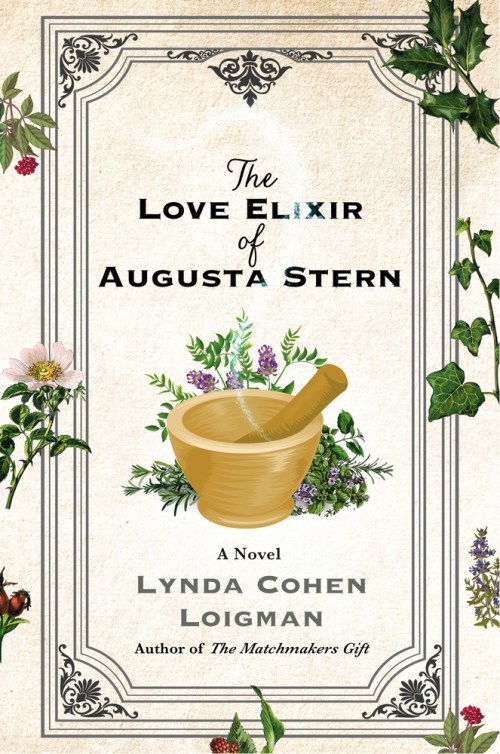
Lynda Cohen Loigman’s books span a variety of eras and locations—from 1960s Brooklyn to WWI-era Massachusetts—but can always be counted on for warm, intimate stories of families reckoning with emotion, expectation, and change. Her vivid historical settings leap to life along with her unforgettable characters. In her newest novel, The Love Elixir of Augusta Stern, she gives us the privilege of observing the title character at two very different points in her life: as a teenager in 1920s Brooklyn and as an 80-year-old in a Boca Raton retirement home. When the boy who once broke her heart reappears in her life, Augusta must reckon with their unresolved tension from so long ago. I sat down with Loigman to discuss inspiration, author communities, and how magic works its way into her stories.
Greer Macallister
Augusta is such a wonderful character, and one of the great joys of the book is getting to see her both as a teenager in the 1920s and years later as a nearly-80-year-old retiree. Was this always a dual-timeline book in your head? Did the 1920s Brooklyn plotline or the modern-day senior community plotline come to you first?
Lynda Cohen Loigman
After writing The Matchmaker’s Gift, I swore I would never attempt another dual timeline story. That project felt almost like writing two full novels with two fully separate character arcs, which made for a lot of mental gymnastics. But the more I thought about Augusta’s story, the more I was convinced that two timelines were necessary. I wanted readers to meet Augusta at eighty. I wanted them not only to feel her frustration but also to laugh at the absurdity of her situation. But for readers to fully understand how her life went off-course and truly empathize with both her and Irving, I had to introduce them to both characters during the complicated messiness of their Brooklyn youth.
There is a second reason why the story evolved the way it did, and that is because I began with two separate sources of inspiration. The 1920’s Brooklyn pharmacy setting was inspired by my husband’s great grandmother, who graduated from Fordham’s College of Pharmacy in 1921. But the idea of an octogenarian romance, and the voices of Augusta, Irving, and the others came from the experience of moving my father to a Boca Raton assisted living facility in 2021.
For a while, I wasn’t sure I could combine the two ideas and settings into one cohesive story. I made a false start that took me down a path where the pharmacy setting did not emerge as robustly. Eventually, by fully embracing the dual timeline narrative, the right balance for this novel emerged.
Greer Macallister
The touch of magic in The Love Elixir of Augusta Stern reminded me of the lightly supernatural touches in one of your previous books, The Matchmaker’s Gift. In contrast, your first two books (The Two-Family House and The Wartime Sisters) don’t have magical or supernatural elements. How do you make the decision on whether or not to add a touch of magic to the real world? Is it determined mainly by what the story requires?
Lynda Cohen Loigman
I adore stories with magical elements—fairytales, myths, folklore, full fantasy. Those have always been my comfort reads, the stories I turn to when I want to escape whatever the real world might be throwing my way. There is a huge difference, however, between reading magical stories and writing them. To me, those are the most ambitious and the most difficult novels to write well.
For my debut, The Two-Family House, my goal was to write a family story that I had been thinking about for fifteen years. That book was a multigenerational saga set in post-war Brooklyn, and there was really no place for anything magical to occur. Except I did add the tiniest bit of it to one of the chapters. Two babies are born in the middle of a blizzard and the nameless midwife blows in with the wind. Readers ask me a lot about that scene and the lollipop the midwife gives to one of the children. It wasn’t exactly magical, but I couldn’t resist throwing in a bit of enchantment. I think it worked in that novel because the events of that snowy evening demand a true suspension of disbelief from the reader. For my second book, I did nothing like that—it was a very traditional piece of historical fiction. But when it was time for me to write my third novel, the magical element was something I wanted to explore again and more deeply.
As much as I wanted to write that magic into The Matchmaker’s Gift, I was terrified that the addition would make the story silly or take away from the deeper meaning I was trying to convey. I wanted the magic to be a subtle layer that would add to the richness of the story. I worried a lot as I wrote that novel, and I held my breath while my editor read it. Luckily, she felt that it worked.
Now, I feel like I’m hooked. Before I wrote the first word of The Love Elixir of Augusta Stern, I knew I wanted there to be a magical element. The world of a 1920’s pharmacy is a perfect setting to add that sparkle (pills, powders, and potions!), which is one of the reasons I chose to write about it.
I’m not sure what I’ll do going forward. My next novel will have a small magical element, but I think it will be even more subtle than in my previous books. Part of me feels like I’ll never go back because when I am truly focused and fully committed to a story, the process always feels a bit other-worldly. I think every writer has that moment where we’re finishing up a manuscript and we honestly wonder how we ever got it done. If that’s not an example of real-world magic, I don’t know what is!
Greer Macallister
Several of your novels draw on inspiration from your own family history, like the setting for The Two-Family House coming from a similar house in which your mother and her sisters grew up in Brooklyn. Any particular benefits or challenges that you’ve found when working from family stories as source material? I imagine there might be both.
Lynda Cohen Loigman
I think all of my books draw from family experiences, but my debut, The Two-Family House, certainly was the most transparent. It was inspired by the house my mother grew up in, and by the relationship between my grandmother and her sister-in-law. The surprising thing about writing that novel was that when my relatives heard I was publishing it, a bunch of them contacted me. These were relatives of my father’s I hadn’t heard from in decades. The book had nothing to do with that side of my family, but they were worried that I might be writing something unflattering.
That experience definitely impacted me and made me skittish going forward. I never want to hurt anyone with my books or tell stories that I feel aren’t mine to tell.
Still, writing about families has a lot of advantages. When I push myself to write with emotional honesty, I find that readers connect more deeply with my characters. I sort of disagree with Leo Tolstoy’s line about happy and unhappy families. I believe all families resemble each other—happy or unhappy, large or small, whatever the background, culture, or ethnicity. We all have a grumpy uncle. Or a grandmother with no filter. Or a ne’er do well cousin who shows up unannounced.
My favorite emails are the ones I get from readers who tell me that my characters remind them of their own relatives. When readers see themselves and their families in a story, it can help them to process the wounds of their past or to see things from a perspective other than their own. I come from a family where there were many rifts, and so I always hope that reading my books will encourage empathy and forgiveness.
Greer Macallister
Writing can be an isolating lifestyle, but I know you belong to at least one great author group, The Thursday Authors. What are some of the best things about participating in a broader author community? Do you think all writers could benefit from groups or does it really depend on people’s personalities?

Lynda Cohen Loigman
I came to writing as a second career—my first book was published when I was 47 years old. At that age, the idea of making new friends can be an intimidating prospect. The most wonderful thing about author friends is that every one of them understands the ups and downs of this crazy process.
Author friends will listen to you drone on forever about the plot holes in your story. They will appreciate the minutiae that courses through your brain as you think about how to develop your characters.
I think every writer needs a community, no matter what their personality type. For some people, that might mean having a group where you read each other’s pages and offer comments. For others, the best fit might be a group that focuses less on craft and more on the business aspects of publishing that no one likes to talk about. Regardless of the focus, it’s always helpful to surround yourself with others who know what you’re going through. Publishing is a business where it is very easy to compare yourself to others and feel down when you don’t feel like you’re succeeding. That’s why it is so important to have a support system. The Thursday Authors are some of my favorite people in the world, and I am so grateful for them every day.
Greer Macallister
I don’t know if you can talk about what’s next for you yet, but as a fan, I’d love to hear a little bit about what you’re working on. Will it be historical, contemporary, or maybe both?
Lynda Cohen Loigman
This next book has been a bit of a bear to pin down. I did what I would advise others not to do—I got invested in a particular idea that I just couldn’t shake, even when the story wasn’t coming together in the meaningful way it needed to. After many months, I think I’ve finally cracked it, but it’s a completely different story than the one I started with.
My new story is a true “bookish” book. It begins with a woman who has the same dream for over 75 years—a dream about a particular book that she spends a good portion of her life searching for. It is about the books that save us, the books that ruin us, and the books that change our lives forever. I need to figure out the structure, but it will definitely have a lot of historical elements. And, of course, a dash of magic!
FICTION
The Love Elixir of Augusta Stern
by Lynda Cohen Loigman
St. Martin’s Press
Published October 8th, 2024


