


Nate Lippens’ new novel, Ripcord, a companion to his outstanding debut, My Dead Book, is a novel made of fragments, glimpses, and moments in time. The narrator, a middle-aged queer man living in Milwaukee, meditates on his current situation, a semi-affair with a married man, and the lives of his friends, who are, like him, struggling to make ends meet. Lippens’ novel is brimming with witty asides, pitch dark humor, tenderness, and pain. We follow him through catering and bartending shifts and conversations with friends, one an aging punk named Charlie, and another, a painter named Greer, who has never “made it” but still paints. With vibrant prose and surprising imagery, Lippens invites us into the mind of a queer man looking back with regret and grief to find moments of connection like street lights blinking to life in a dark alley.
Nate Lippens is a brilliant writer, and a much-needed voice among the new crop of queer novelists. His portrayals of working-class queers, ex-members of the queercore movement, recovering addicts, and artists feels new, though somehow also a part of a nearly lost family of queer thinkers: the writers and artists his characters still cherish.
I spoke to Lippens about time, fragments, and a lifelong writing practice, just before the release of Ripcord.

Richard Mirabella
Writing is a solitary act for the most part. We only have to answer to ourselves for much of the process. Tell me, how has it been suddenly having to talk about your work?
Nate Lippens
It’s a bit disorienting. You live in the book for quite a while and have this sort of hermetically sealed relationship to it. I only showed Ripcord to one other person early in the writing for some encouragement and no one saw it again until it was done. Now it’s out in the world, which is very gratifying, but I’m also figuring out how to be the best emissary for the book. I’m finding my sea legs. I’m also someone plagued by yapper’s regret, where I think about what I should have said or how I could have said it. It’s the editor in me. I want to get it perfect. If I directed films, I’d do endless takes. “We’re losing the light!” Just one more!
Richard Mirabella
“Yapper’s regret!” I love that. Both of your novels feel related to that concept. Ripcord is like visiting the mind of a person living this rather difficult moment, but he’s also looking back, sometimes with regret, sometimes with acceptance. Can you talk a little about writing the past in the specific way you do? These don’t feel like flashbacks. The past is very much a part of the character’s present.
Nate Lippens
The past never feels quite past, and it slips in and out of view. Like right now, I’m wearing my brother’s Carhartt hat from Blain’s Farm & Fleet. He died while I was working on My Dead Book, and I’m thinking about that time and our favorite Goodwill and when I worked in thrift stores and a high-end denim place in Seattle twenty years ago, when my mother was dying from cancer, and I was in love with someone who didn’t love me. And I’m eyeing my coffee and wondering if I should have more and you’re probably hearing this and thinking, “No, you should not.” That’s how consciousness and time work for me. Montage. When I write I just let time move the way it does. It’s not a flashback or backstory in a conventional sense. It’s rumination as a supernatural slide rule. The narrator is going through a rough patch and looking back or having these thoughts in a way to position his current world with his past. Not so much causation but sussing out patterns and cul-de-sacs. I don’t include the thing that triggers the memories. I mean, the last time I had a madeleine, it was rather dry.
Richard Mirabella
Yes, that reminds me! What I appreciate about both My Dead Book and Ripcord is that you trust the reader will learn how these novels work. I often talk with friends about books that teach you how to read them. When you were working on Ripcord, did these fragments follow each other in a pattern, or did you organize them later? Basically, let us into your process as much as you’d like.
Nate Lippens
I love books that teach you how to read them, that make you ask, “Is this a novel?” The things that excite me most usually have an element of that—pushing against the form. I usually start with a first line, like something is nagging me. I had the first line for Ripcord and for My Dead Book and it felt like a lot could unfurl from those. And in both cases I had an image for their last scenes and wrote those. That gave me two points, like a tightrope. Actually, I’ll call it a clothesline instead, I don’t like heights. Then it becomes a matter of moving scene to scene by juxtaposition. All of this originates with my notebooks. I write every day but in a very disorganized way. Like this is part of a page this morning: “Gimp mask dunce cap. The way it was / the way it is (plus/minus 30 years). Drag name: Grace Period.” That may become something or nothing. A line here and there, dialogue, lists, rankings. For Ripcord I was thinking loosely of aging and sex. Loose aging. The sections—I almost got fancy and said pensées, forgive me—start to magnetize and it becomes clear what belongs in what order. Fortunately, too, some whole chapters are written in sequence, so it isn’t like a thousand-piece puzzle.
Richard Mirabella
There’s something so appealing about fragments, studies, sketches. Are these things you’re drawn to in other media?
Nate Lippens
Definitely. I think because they allow you to fill in gaps, to be a co-author. Two of my favorite recent art books are Vince Aletti’s The Drawer, which are collages of found images he had in a drawer in his packed apartment and David Wojnarowicz’s Dear Jean Pierre, which are letters between him and his French lover. Both have a raw, unfinished quality that leaves those gaps in. I saw the Darrel Ellis exhibit at The Milwaukee Art Museum and his work is kind of about reclaiming the past, his past, but in this slippery way. He did a series of self-portraits that respond to photos of him taken by Peter Hujar, Robert Mapplethorpe, and Allen Frame. And the show included some of his notebooks, which are him forming his ideas about being an artist and being a person and where those things intersect and diverge.
Richard Mirabella
Your main character and those surrounding him are artists, writers, musicians, all trying to support themselves. I can’t immediately call to mind any recent queer working class characters I’ve read. This is part of what I found so refreshing about both of your novels. Can you talk about the lineage of writers and artists that are coming from that place, those that inspire you to tell the stories of working queer people?
Nate Lippens
Eileen Myles, Dodie Bellamy, Michelle Tea, and Cookie Mueller—all who’ve been published by Semiotext(e)—come from working class backgrounds and engage with them in very different ways that have inspired me. And coming up through a punk scene of making zines and publishing chapbooks and being in bands. I think for a long time I avoided writing about class because it felt like a trap, and it was so dominated, and still is, by the long shadow of dirty realism and all those laconic, alcoholic straight protagonists. That wasn’t my experience at all. Many of my friends work in retail and restaurants and bars. I cater and bartend and clean offices. We’re not young. These are our lives. And many of us are writers, photographers, musicians. We talk about art and books and movies all the time. So, I wanted my books to reflect that. That you may be a welder who reads the Paris Review and loves Tsai Ming-liang. And you’re older and gay, still plugging away.
Richard Mirabella

Speaking of plugging away, I’ve recently been thinking about writing detached from publication. How long has writing been a consistent practice for you? A writing life before these books were published. And has that practice changed with the publication of your novels?
Nate Lippens
I’ve always kept notebooks and published poetry and zines. I wrote a novel and a story collection I couldn’t get published. My Dead Book came out of that long period of rejection and frustration. A friend joked that I’m in my late style. I think that’s kind of true. There was something about turning to my notebooks and cannibalizing some of my stories, leaning into intuition and instinct in a way I hadn’t that made it work. My confidence has changed a lot since My Dead Book was published, and I heard back from readers. I’m lying on the couch now, which lends itself to saying this: I was deeply ashamed of the way my mind worked for a lot of my life. The way I made connections and associations. But I’ve come to see it makes its own sense. I trust it now. I think that’s led to me stopping second-guessing so much and focusing. I collaborated with Matthew Kinlin on a novel called Box Office Poison about two cult actresses in the late 1970s. And I finished Bastards, the third novel in this loose trilogy.
Richard Mirabella
Your first novel My Dead Book is being reprinted along with the publication of Ripcord. My Dead Book has had an interesting journey, from its original release by Publication Studio, to publication in the UK, and attention from people like Eileen Myles and Kate Zambreno. How do you feel about your first novel at this point, now that it’s reached this milestone?
Nate Lippens
I’m thrilled My Dead Book has a life of its own and it connected with people. It also established a way for me to work, and that just kind of naturally expanded into another book and another. I had an incredible experience with Matthew Stadler putting out the book as part of the Fellow Travelers Series from Publication Studio. And then Richard Porter at Pilot Press publishing it in the UK and it being a finalist for the Republic of Consciousness Prize for Small Presses, which acknowledges the publisher and the novel. I’ve been reading Semiotext(e) books since the 90s and they’ve been a huge influence on my writing, so it meant a lot to me when Hedi El Kholti had great things to say about My Dead Book and then was interested in Ripcord. And I’ve developed good friendships along the way. My Dead Book is part of the catalogs of these three presses I have immense respect and love for. I’m not sure if this is a second act or my ninth life, but I’m really grateful.
Richard Mirabella
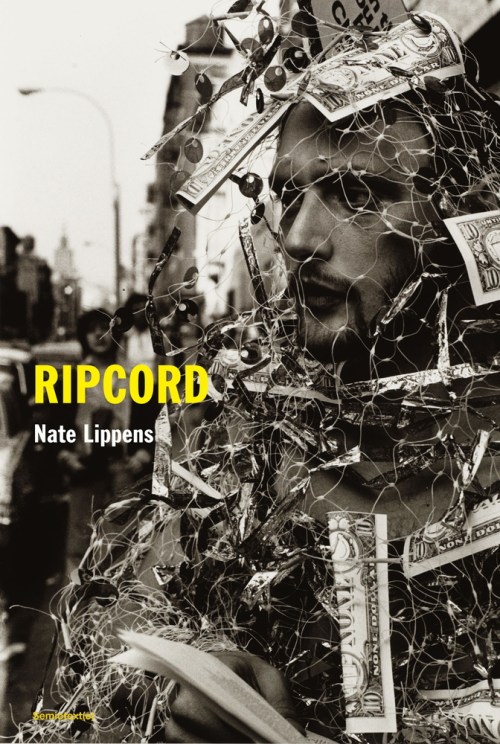
Both My Dead Book and Ripcord are haunted by dead friends, but also by the ghosts of artists, lost queer cultural figures, like Steve Varble, who is pictured on the cover of Ripcord. Can you talk about the choice to use that image for the cover? Did you have input when it came to the new cover for My Dead Book?
Nate Lippens
The Stephen Varble photo was taken by Peter Hujar. Varble fashioned garbage into costumes and performed protest actions. This costume was partially netting with fake money on it and I loved that it has a furious fucked-up camp aesthetic, and tied into the narrator and his friends struggling to get by. Varble looks almost caged. It’s very strange and you can’t immediately tell what’s going on. For the Pilot edition of My Dead Book, I was fortunate to get to use a Jimmy DeSana self-portrait that looks otherworldly. His trust, run by Laurie Simmons, his close friend who has kept his legacy alive since his death, let us use it. That was meaningful to me. Hedi suggested the Mark Morrisroe for the Semiotext(e) reissue and I love Morrisroe’s photos. He was part of the Boston School with Nan Goldin, Jack Pierson, and David Armstrong, all of whom fed into the creation of the character Rudy in that book. Varble, DeSana, Hujar, and Morrisroe all died of AIDS and there seemed to be a precarious time where that work wasn’t discussed. But over the years their work has been historically reassessed. Varble was a performance artist, so his work is ephemeral, and the photos and some videos are mostly what remain. It suited the vanishing aspect the narrator is considering in Ripcord.
FICTION
Ripcord
by Nate Lippens
Semiotext(e)
Published October 22, 2024


