


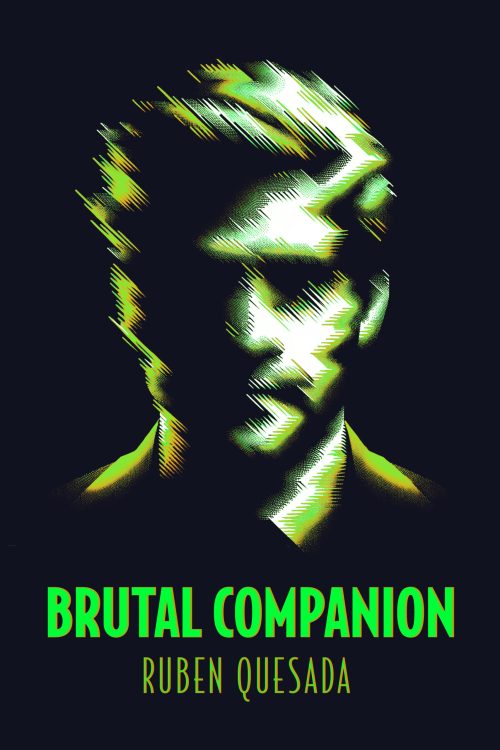
Chicago poet, critic, and editor Ruben Quesada is a writer I’ve long admired, not only for his poetry but for his commitment to making space for Latinx and queer poets. His poetry and editorial work is often in conversation with other artists and writers; he leaves the door open for new writers to find a place for critical engagement as well. When I heard about his latest full-length poetry collection Brutal Companion, winner of the Barrow Street Editors Prize, I knew I needed to get my hands on a copy.
Quesada weaves longing and grief, passion and pain to create the mosaic that is Brutal Companion. Quesada’s artful use of varying poetic forms emphasizes the urgency of trauma and desire throughout the speaker’s life, those that came before him, and those that will come after.
Named for one who believes certainty is impossible, the poem “Acataleptic” establishes the intimacy with the reader that threads through the whole collection:
“In time you, too, will find yourself–
in fleeting moments, in the next stanza, in the next
monosyllabic word: thin, its airy hum vibrating
in your nose. I am in these lines you are reading.
We are here with these words, like a moving object,
whose echoes fill our ears like a sonic boom.”
The title Brutal Companion is certainly apt as the reader is invited into each poem, following the poet from Lubbock, Texas, to Classic Rome, back to Chicago, Illinois, and everywhere in between. Death lurks either as an undercurrent or tangible presence in many of these poems.
Quesada recently edited the craft anthology Latinx Poetics, so it is no surprise to find his careful attention to poetics and literary lineage. Throughout Brutal Companion, Quesada’s range is impressive; sensual sonnets like “Moonlight” bring traditional forms to a present day readership while poems like “East Of Wyoming, I Remember Matthew Shepard” elegize through lines that mournfully dance around the page.
Regarding Quesada’s attention to poetics and craft, every word feels as deliberate as a painter’s brush stroke. This is further emphasized through many poems’ relationship to visual artwork. Take the poem “On Presence,” written for René Magritte, leading surrealist artist of the 20th century. The images in this poem conjure Magritte’s works: “apple-faced / angels,” “tobacco- / colored sunlight,” and “the fabric of space wrinkled / like the bridge above your nose.” There is a delightful juxtaposition in this imagery being used to describe presence, in blurring the lines between reality and the artistic rendering of it. The poem culminates in a heavy yet beautiful expression of desire:

“weight of dark matter heavy on your bottom lip the balm of
your body against my mouth.”
Of course, desire is a running thread throughout Brutal Companion, the longing usually accompanied by the grim aspects of the world around lovers and companions. Poems like “With A Line By Paul Monette” examine the duality of love and addiction with tenderness and brevity. “Liebestod” directly addresses the reader, or “listener” in this case, and the ending we expect for doomed lovers in tragic love stories. “You’d hoped it would end / another way,” Quesada writes, as death is inevitable still. But the poem ends on the flowery beauty of imagining a better ending, a better world for the lovers and for ourselves.
Above all, the poems in Brutal Companion make beauty out of the cruel world we were all born into. This is the kind of poetry collection that heals. In the poem “Connoisseurs,” Quesada confides, “Humans are wondrous. Poets are wondrous. / This I like best.” This is a sentiment I certainly come away with, too, time and again. Humans are wondrous, if we take the time to notice this in each other.
POETRY
Brutal Companion
by Ruben Quesada
Barrow Street
Published October 15, 2024


