


I used to draw maps in school. No matter the subject, I would sketch lakes and rivers, fantasy continents with arboreal paradises, and dots and stars for capitals. I really only got away with it in English class.
As a poet, I find that not much has changed since middle school. We still make lines all over the page. We cut, we break, we manipulate the space and nature that we feel, soul-bound, is our domain. These worlds are not as magical, but perhaps just as mythical, although they are part of a mythos inextricable from the actual world, with its uses and abuses of power. We are cartographers, mapping the myriad geographies of the world in our notebooks, on our bodies, for our audiences, and in our homes.
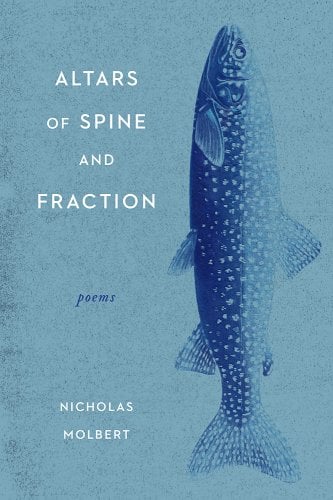
The American South is one such geography marked by power, where the sins of the past seep into skin so slowly you don’t notice the scars. In Nicholas Molbert’s debut poetry collection Altars of Spine and Fraction, each poem is a small map, demarcating where boyhood begins and ends. Ideas of masculinity, soft and hard, are formed in the speaker’s childhood: some brittle and prone to breakage, others weathered and gentle, and still more sharp and capable of causing great pain. In his poems, settings such as wharves, playgrounds, and linoleum kitchen floors serve as those titular altars, sacred spaces of peace, connection, and quiet. Molbert persuades us they are holy, not because they are separated from the weight of history, but because they hold the personal and the universal to account, asking the reader to judge if transformation between the two is possible, and at what cost.
In Molbert’s poetry, ideas of Southern manhood are responsible for separating fathers and sons, grandfathers and grandsons, from each other along some ineffable, mysterious line that cannot be acknowledged. Often, what splits men from men is violence, forced or implied, assumed by a young boy to be required. In “Parable of Baiting,” the speaker begins nervous that his “beginner’s luck/ might pluck a throat/ from the throng swarming/ the boat’s belly,” but by the end, he has wasted so many minnows by “punctur[ing]/ their throats/ with a click to the point” that the grandfather tells the speaker to be gentler. The speaker, perhaps frustrated and surprised that overwhelming violence was not needed, asks under their breath, “What else did I expect?” Soon after, in the poem “Parable of Cutting,” the grandfather demonstrates how to gut and scale a fish with an electric knife. He explains: “in the gills,/ lift the fin/ start here.” The unstated rules, difficult to learn, take a lifetime to master. It is not so much that the grandfather and speaker are irreconcilable, but that the terms of masculinity dictate that any lessons about life must be taught in parable form, where meaning and intention are slippery, and can easily wriggle out of one’s grasp. Later, after the grandfather dies, the boy cannot quite understand the funeral process: “I thought you were anywhere/ but in that body.”
But the loss of connection that comes with familial masculinity is not Molbert’s only terrain. As the collection progresses, the reader moves with his speakers through adolescence, from rivalries in sports and over girls’ attention, to romantic partnerships in young adulthood. And no exploration of southern boyhood would be complete without acknowledging football, the eternal proving ground. In two poems back to back, “Two for the Boy” and “Drill, 2001,” Molbert chronicles the lucky tackles, the ill-fitting pads, the brutal Oklahoma drills, and the experiences of those boys who play but don’t have the heart for it. Despite the speaker’s lack of talent for the game, his coach is “surprised at what he could do/ when given no other choice.” Football provides a rationale for masculine violence that the young speaker understands better than the more adult rules his grandfather provided.
While the intimate geographies are keenly mapped by Molbert’s language, what moves his work into broader landscapes are the voices he gives to the elements of southern nature. Hurricanes rhapsodize on aesthetic theory, gulls and canals snipe at one another, and the fish sing in poem after poem, dipping through the currents of the Louisiana coastline. Indeed, the hurricanes articulate the book’s first words: they long only to “dissolve, not disappear,” that despite their destruction, or perhaps because of that destruction’s necessity, they yearn to “touch down on shoulder to begin/ as tender apologies yes soft but never ceasing.” At times, it seems that the hurricanes possess the speaker as the collection continues. Throughout, the hurricanes whisper “a sound/ threatening/ to become [the speaker’s] name.” The speaker creates his own language, learned from his environment: his internal composition is “one-fourth man/ two-fourths boy, one-fourth throat.” The weather, the land, the sea, his family, his partner – they all teach the speaker how to draw the maps, shade the elevations, and how to write exactly what needs to be said and not a word more.
Molbert knows that good cartographers do not pretend to control the erosion of the sand dunes. They do not assume that the moon will pull the tide up high the next morning, or that the river will keep to the measurements of the depth charts. They make their maps as accurate as possible, and trace the world’s longing for constant transformation with precision, so that travelers do not get lost even when the stars are hidden by clouds. The book ends with one more loving acknowledgement of the speaker’s grandfather, but also of everything that shaped the man he is today: “Yes, we humans have been grandfathered into this time/ of a known master theory…/tell me the water still doesn’t try to take it away.” Throughout his collection, Molbert writes with confidence, and ultimately he tracks the minute changes of the human heart, knowing that tomorrow he will have to draw them in detail all over again.
POETRY

By Nicholas Molbert
Curbstone Press
September 15, 2024


