


Literary phenomenon Sally Rooney returns with her fourth and most accomplished novel yet. As a recent immigrant to Ireland, my reading of Intermezzo is attentive to the plentiful Irish idiosyncrasies at home in the novel: the cold Atlantic sea swims, sharp banter, a sense of embarrassment that comes with an awareness of the perceptions of others, Catholicism and sexual desire, an unique handling of alcoholism (it is often not acknowledged as an issue), the predominance of WhatsApp for texting (“two checkmarks”), the Irish housing crisis, and even callouts to Dublin city streets or popular spots such The Workman’s Club, Stephen’s Green, or South Leinster Street, near College Green. All of these details serve to remind readers that Rooney’s writing is deeply rooted in her country and its culture, and ultimately inextricable from her literary appeal.
Intermezzo focuses on Irish brothers Peter and Ivan as they grieve the recent death of their father, though they share little common ground beyond their familial ties. The siblings differ in both personalities and age, with a ten year gap. Struggling to connect to one another, they instead seek solace in romantic relationships.
Dublin lawyer and older brother Peter distracts himself with work, drugs, alcohol, and caring for two women. His first love, Sylvia, remains a close friend but their relationship is complicated by Sylvia’s incurable chronic pain from an undetailed traumatic accident that ruled out sex and led to the end of their partnership years ago. As he mourns his father, he also grieves for the life he and Sylvia could have had together, unable to give up their lost future. Sexual desire seemingly pushes Peter toward Naomi, a 23-year-old student who formerly earned income by selling her photos online. When she needs more money or legal support as she and her friends squat in a tenant building, Peter obliges. Their relationship is transactional yet emotionally-driven; their sex supplemented by power imbalance. The two women are aware of each other, and both accept their mutual relationship with Peter as is. With professor Sylvia, Peter walks around Dublin during the day surveying the world. He goes to his ex for reason and comfort. Often after a drink or a mental breakdown, he turns to Naomi to stave off feelings of personal inadequacy.
Meanwhile, 22-year-old chess genius Ivan fails to connect meaningfully with his peers until he meets and attracts 36-year-old divorcee Margaret after a local chess tournament. He fears his talent for chess peaked in his teens and prevented him from finding community, confessing as much as he takes her to bed. Nonetheless, Margaret savors Ivan’s desire and admiration after an isolating married life. It’s a meeting of mutual loneliness—in the other, they each feel seen. The pair begin to see each other in secret as Margaret fears how her family and friends will judge the age difference between her and her new lover.
The whole story unfolds in carefully crafted, close third person as the rhythm of the prose switches between chapters to differentiate the brothers. Incomplete, staccato sentences which scrapbook observations, conversation, and confessions in Peter’s sections then cut to well-structured, full syntax when we’re reading from Ivan’s considered perspective. On a construction level, it’s Sally Rooney at her finest and most controlled. As in her previous writing, the scant punctuation coupled with extensive dialogue propel scenes forward with ease.
Interestingly, Margaret’s fears and hopes for love and life eventually emerge as the third perspective in the book. It’s an interiority—written with long and contemplative paragraphs much like Ivan’s sections—we aren’t given for Naomi and Sylvia. Perhaps the similar prose styling helps solidify the genuine emotional and intellectual connection between Ivan and Margaret. Margaret’s story parallels Peter’s, too: she’s lost her father, is estranged from her mother and siblings, is tethered to a previous relationship (albeit, not with the same fondness as Peter and Sylvia), and falls in love with a much younger partner despite fear of retribution from her community. She must internally overcome her inhibitions to fall in love. In turn, Margaret’s love and care for Ivan enables him to move forward and grow as a person, while simultaneously deconstructing Peter’s understanding of his younger brother as a morally corrupt, sexist young boy whose social awkwardness and skewed worldview leaves him unable to connect to others. Naomi and Sylvia, on the other hand, must wait for Peter to accept a non-conforming lifestyle that reflects their three-way relationship. We understand their perspectives primarily through their individual actions and direct exchanges with Peter. Rooney does acknowledge the hypocrisy of Peter’s outrage over Ivan’s older girlfriend, but it doesn’t appear to be a central thesis to this book. Rather, differing ages are merely another device to make these relationships more complicated and intriguing. A mark of Rooney’s writing, after all, is to anchor down into extended conversations between different characters at turning points in their lives.
In several ways, Intermezzo is not new territory for Rooney. Fans of her work will recognize recurring themes, motifs, and ideas across her novels, from Marxist musings to representations of mental illness and women’s health issues; complex and self-sabotaging erotic desires; attractive yet socially outcast characters; heavy dialogue and interiority; miscommunication and intimacy; and of course, satisfying sex scenes. To discount the recurrence of certain themes and characterizations across her novels as unoriginal is to overlook the profundity of this novel. There’s a reason Rooney’s characters delve into political and theoretical conversations on the same page as descriptions of mundane tasks, which read almost like stage directions at times. Juxtapositions between complex ideas and the everyday not only deepen the quality of her characters’ lives, but also give value to all aspects of reality—not just romance or other commercially profitable literary conventions.
Although love does play a significant role in each of Rooney’s novels, it’s not quixotic and, in this case, not limited to romantic relationships. Intermezzo is the first of Rooney’s novels that centers complicated family relationships alongside romantic connections. We come to understand how Peter and Ivan’s actions and reactions to intimate moments in their romantic relationships are impacted by their turbulent relationship as siblings. I’ll admit that not extending an exploration of familial love to Peter and Ivan’s relationship with their parents, who are both peripheral and looming for most of the novel, feels like a missed opportunity (if only because parental figures tend to be the cause of tense sibling relationships). Yet the intrinsic impact of the family dynamic is well-shown between the brothers, and even manifested in a small comedy over the responsibility of the family pet.
A whippet named Alexei is left without a home following their father’s death. Ivan’s Dublin accommodation is unfortunately not suitable for dogs, Peter does not offer to mind Alexei, and their mother, Christine, shows no interest in having a canine dependent. Christine threatens to rehome the dog, while Peter promises he’ll take care of the ordeal, but neither threat nor promise are acted upon. Eventually, Ivan reclaims Alexei and shares the dog with an important new member of his immediate circle, Margaret. The runaround with the dog is a minor, farcical plot point, but it does introduce a different kind of love to juxtapose the central relationships in the novel—an unconditional care between human and dog unimpeded by the perceived feelings of friends and family.
Again and again, Rooney’s novels pose questions about what love is and how it shapes our lives. In Intermezzo, especially, this thesis is posed in a more heartfelt, direct way than her previous work: the guilt of grief comes against the feeling of falling in love. Ivan, at first, understands love to be conditional—after all, if his brother is condescending and disrespectful, then Peter’s presence doesn’t feel like love. In contrast, Ivan is able to tell Margaret, “I love you, with no pain.” Painful love is present, too, in the emotionally unpleasant conditions of grief he sets around his father’s memory. For the Koubek brothers, the guilt of grief clashes with impulses for love. New relationships form amidst the loss of another, and they’re left to figure out how to sustain their former, younger lives with the future simultaneously. Love becomes a “moving force … wanting to find a home for itself elsewhere.” When Rooney characters try to rationalize their feelings, they often find love doesn’t follow reason.
However, grief and love are not Rooney’s only conceptual endeavors. Intermezzo is also in deep conversation with other great thinkers and writers in history, broadening the scope of the novel’s project. Peter, Ivan, and Margaret’s concerns with beauty, truth, love, reality, goodness, and even God call back to ideas formed by Rooney’s literary predecessors, including Joyce, Doestevsky, Keats, Shakespeare, Sontag, and Wittgenstein, and more listed in the Notes section at the back of the book. Anyone familiar with the protagonists of Ulysses or A Portrait of the Artist as a Young Man will recognize similarities in Peter Koubek, in both the Joycean stream of consciousness Rooney employs as well as Peter’s contained wanderings throughout Dublin, identifying landmarks. Discussions about beauty and truth in the novel are likewise reminiscent of the closing lines of John Keats’s 1819 poem, “Ode to a Grecian Urn”: “‘Beauty is truth, truth beauty’—that is all ye know on earth, and all ye need to know.” Ivan explains this concept more colloquially: “Listening to certain music, or looking at art. Even playing chess, although that might sound weird. It’s like the order is so deep, and it’s so beautiful. I feel like there must be something underneath it all.” Naturally, periods of sadness also make the characters question God and order. It’s an opinion Intermezzo shares with Beautiful World, Where Are You, which I agree, as a whole, felt “reluctantly futile” in its characters’ attempts to look past the wrongs of the world to assign the true meaning of life. Yet Intermezzo exaggerates the pointlessness of life—in the wake of death, there’s an “onwardly flowing blur of all experience”—and comes to the same conclusion: “doesn’t the feeling between people have a truth of its own?” However, this time, the characters’ conclusions are less futile and more buoyant. Loss and pain don’t cancel out goodness. Conceiving the coexistence of hate and love, sadness and happiness, bad and good, is not utterly impossible. The book concludes, “Even to think about it is to live.” Perhaps this means we improve upon life simply by considering alternatives. It’s an interesting angle on Rooney’s part, considering her outspoken criticism on many world issues.
Part of Rooney books’ undeniable charm is their firm positioning in the present moment. In Intermezzo, her characters consider hot topics like climate change, while sick days are postmarked with questions about Covid, and briefly explored is a certain type of xenophobia against other Europeans within some European countries. The brothers’ Slovakian last name, for instance, establishes them as eastern European outsiders, though both Peter and Ivan grow up in Ireland. For Ivan, this alienation manifests as the “impenetrable systems” of community and society. For Peter, the more assimilated and successful brother who dons a South Dublin accent, class privilege compounds such division: “What they were born to, he has to work for […] Not to inherent but to earn […] What they could never understand. Mere privilege he thinks can’t touch what he has so richly acquired. Beauty, culture, yes. Can’t be bought.” It’s a Marxist aside, sure, but it’s relevant to the character. The emotional interiority or intellectual expression of Rooney’s characters may feel overwrought for some, but so too are Fyodor Dostoevsky’s psychologically-driven characters, for instance. Ippolit proclaims to Mishkin “Beauty will save the world” in The Idiot. Doestevsky’s characters endeavor to find hope and God within themselves. Intellectualizing is not just a means for Peter, Ivan, and Margaret to find purpose in their lives, but also a way to cope with moments of melancholy as well as joy in the modern world.

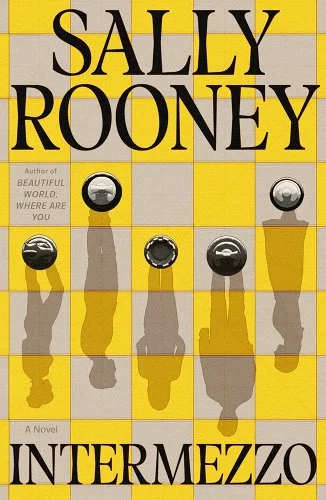
Of course, music, art, books, and even chess are capable of doing the same. Each forms a mirror of our world. The novel’s title suggests as much: an “intermezzo” in chess is an “in-between move,” which forces its players to respond. It’s symbolic of the way death repositions a life and grief shocks love. Similarly, we understand the influential power of writing: look no further than Rooney’s impact on the publishing industry. The musical definition of “intermezzo”—a connecting instrumental piece between plays or musical works—seems to apply as well: Rooney is capturing a brief period in her character’s lives, and then their thoughts and feelings get to keep living, in some way, beyond the last page.
Rooney’s ability to seamlessly present age-old questions and ideas within the reality of our current world—which, at times, can feel hopeless—seems to be, in part, what makes her a significant writer today. If Intermezzo is any indication, the author’s literary finesse grows with each new novel. I understand there may be valid counterpoints to the presentation of cultural and political opinions in this book, but to my mind, each of her successive books is an expansive exploration rather than an outright manifesto. All of the characters in her novels so far feature young adults figuring out the desires, dreams, and people that compose their respective lives (much like Rooney’s main readership). Peter, Ivan, and Margaret have been dropped into specific and unique scenarios, yet their feelings will resonate with many readers, as did the feelings of characters in her previous novels. Callbacks to topics explored in her preceding books additionally showcase the ways in which Rooney is in conversation with herself and her past writing, suggesting her maturation alongside her characters. Perhaps her ongoing success hinges on continuing to capture with compassion the ways in which we all respond, grieve, and grow with each new day. As if to say, we’re all new to this life and “life itself is the netting, holding people in place, making sense of things.”
The throughline of Rooney’s writing is, above all, an interest in community and connection, forged through displays of love and understanding. Her books aren’t guidance or solutions, they’re patterns, structures, frameworks. There’s no definite end to Rooney’s stories, and she is careful to remind us the problems her characters and novels confront are still there: “Nothing is fixed.” Instead, there’s a suggestion Rooney still has more to say: a pause between scenes, punctuated with ellipses.
FICTION
FICTION
Intermezzo
by Sally Rooney
Farrar, Straus and Giroux
Published on September 24, 2024


