It started with a photograph. Ruthvika Rao has always had a habit of combing through old newspapers, and one day, she came across a striking image in an edition of the New York Times from the 1970s. “At first, I didn’t even know what I was looking at,” she shared, but slowly, the scene took shape: a severed head in a field in rural India. What had led to this brutal act? What had come after? The photograph stayed with her, and eventually, it would serve as inspiration for the opening image for her stunning debut novel, The Fertile Earth.
The Fertile Earth spans the second half of the twentieth century, following the intertwined lives of Vijaya, the daughter of the wealthy Deshmukhs, and Krishna, the son of a widowed servant in the Deshmukh household. It is a powerful portrait of love across lines of difference, but it’s also a complex political novel about a tumultuous moment in India’s history.
Rao herself grew up in Hyderabad, moving to the US more than a decade ago to study computer programming. We talked about how she came to write her first book, the stigma of writing a romance, and the importance of place in fiction.
The interview has been edited and condensed for length and clarity.

Rowan Beaird
Your education and the start of your career were focused on computer programming. How did you end up writing this book?
Ruthvika Rao
I always wanted to be a writer of some sort, but I didn’t think I could do it as a full-time occupation. I have a bachelor and master’s in computer science, and I thought you could have a job and then you have your passion; I didn’t think they could be one and the same. But I was publishing shorter pieces, and then I thought that, okay, what is the most ambitious thing you can do as a writer? It’s to write a novel. That’s supposedly the hardest thing to do. So when I turned twenty-nine, I made this really sudden decision to quit my job I’d had for six years. I said, I’m just going to take the summer and write this novel. I don’t care what happens.
From June to August, I wrote a whole draft, 500 pages, and then I didn’t have a plan what to do next, so I took creative writing classes at night at Wayne State University. It was the first time another human being was really reviewing my work, and it was shocking that they thought it was any good. And then everyone was applying to MFA programs, and I applied and then I got in to Iowa, and my only objective while there was to finish this novel. I put all the eggs in this one basket. I didn’t want to work on a backup project. I didn’t want to work on anything else. This was it.
Rowan Beaird
This is such a complicated time in India’s history to write about. What did your research process look like? Did you speak to your parents, given they lived through these decades?
Ruthvika Rao
Oh, I never told them what I was working on. It was a secret project. To my friends, I would just say I’m writing a love story, but to my parents, I wouldn’t even say that at first.
My research process was the opposite of methodical. I never had to write a research paper in my entire life, because in India, you choose which major you’re going to have before you go to college, and so the last two years of high school, I just did math, physics, and chemistry. So I was just doing as much research as I needed to get to the next chapter, but at some point I got stuck. I felt like I knew most of my characters, I felt like I knew this world that they lived in, the house that they lived in, but I couldn’t figure out what these particular characters would be doing during this time.
So I took a whole summer off to figure that out. The good thing was, at this point I wasn’t doing exploratory research; I knew what I was looking for. I tried a number of different methods, and I found that books of oral history and poetry were the right fit for me. Poetry is the emotion of the moment and not the analysis of emotions. My mom was also living with me then, and I used to ask her to help read these oral histories or poetry, and then I would translate. A lot of the characters are speaking in a different language, and so much of the book felt like translation.
Rowan Beaird
That makes me think about how being in the US, you were writing about India from a distance. And obviously there’s also the distance of that time period. What was that experience like?
Ruthvika Rao
You know, when I moved to the US, I thought it would feel like a different country, but America is such a cultural force that everywhere is America now. It didn’t feel like being transplanted into a completely foreign place. And I’ve always made it a point to spend part of my year in India because my entire family is in India. So I have not yet reached a place where I feel like my home has changed or been transplanted in any way. It’s just that my home is larger. So I don’t feel the distance, is what I’m trying to say. The only distance was the time period.
Rowan Beaird
The novel doesn’t start with a character, it starts with a place, the fictional village of Irumi. Why begin this way?
Ruthvika Rao
For me as a writer, place always comes before people. I don’t know why that is, maybe it’s just how I observe life. I memorize the geography of wherever I live. I remember every house I’ve ever lived in with an extreme amount of detail, and I find it hard to imagine people without imagining the place where they are. Whenever I meet someone new, I’m curious where they are from, and I think without having that information, it’s hard for me to understand a person. It’s the same with characters as well. And, I didn’t know this in the beginning, obviously, but there is a big cast of characters in the novel, and for me to be able to handle so many people, I needed one place where they belonged. A place where I could be familiar with all of them at once before they go their separate ways. It wasn’t a technical choice, it was more like an instinctive choice.
Rowan Beaird
I feel like that’s true of so many decisions when writing. Afterwards, people assume it was all intentional, but it’s mostly instinct.
Ruthvika Rao
I think if you think too technically, it doesn’t come to life.
Rowan Beaird
Well, even though you started with place, the characters you then developed are so rich. One of the novel’s incredible strengths is that although you could paint certain characters in broad strokes—the wealthy landowners versus the heroic revolutionaries—they contain so many shades of gray. How did you achieve this?
Ruthvika Rao

I think it reflects your reading history to a great extent. How things are never simple. And maybe it’s a factor of how old you are when you’re writing, and then the older you get alongside the book, you add a bit more about what you’ve learned of life. You go back in, and you rewrite some of these characters and keep adding in all these different shades and then slowly they shift and they change. I think the biggest influence on me are the Indian epics that I grew up around, like the Mahabharata. And I think a lot of the gray-shaded characters are in some way or other inspired by the characters from the epics. No one’s ever one thing.
Rowan Beaird
You mentioned that, when pressed about the book, you told your friends you were writing a love story. Why did you want to write a love story?
Ruthvika Rao
When I decided that I would write a novel, I thought of the books that I loved. A Suitable Boy was the first real, adult novel that I ever read in my life. I couldn’t put it down, and I wanted to replicate my experience of reading that book. Books like that, and like Doctor Zhivago, they’re love stories, but they’re also much bigger than love stories. They’re books that you want to return to again and again. A difficulty of writing a love story is feeling judged for it, as maybe they will think less of you because it’s considered to be such a trivial thing, but I had to get to the point where I didn’t care what people thought.
Rowan Beaird
I would love to know about the kaleidoscope, an item that Vijaya and Krishna create and share. It feels like a really powerful symbol, as so much of the book is about perception and misperceptions.
Ruthvika Rao
I discovered it along the way. I needed to figure out something that would bring these two main characters together, how to put them side by side, because up until that point they were existing in my head as separate people. Making a kaleidoscope is a project that most children in India do at some point, and that’s the reason I thought of it in the first place. I don’t think I understood its importance until toward the end of working on this book, like almost as I was working with my editor at Flatiron. It became this touchstone object, so I gave it a bit more light.
Rowan Beaird
Are you working on a new project? Or are you giving yourself some time to breathe?
Ruthvika Rao
I don’t know, I don’t really like to give myself too much time to breathe. If I have time, I will just overthink, and I’m not happy when I’m overthinking. But I am trying to figure out if I still remember how to write a short story. It’s a muscle that you need to exercise now and then, and I want to figure out if I still have it in me to write one. Novel writing is a painful thing, but writing short fiction is not painful at all. I just love it, so I want to see if I can be happy again, if I can love writing again. <laughing>
FICTION
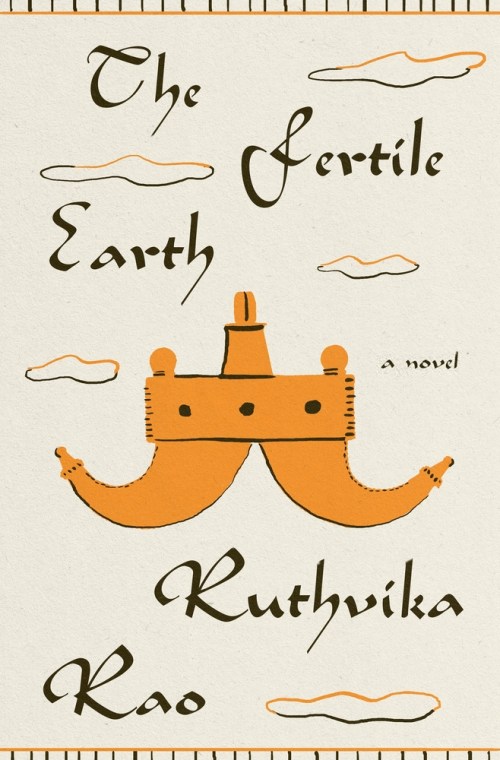
The Fertile Earth
Ruthvika Rao
Flatiron Books
Published August 13, 2024