


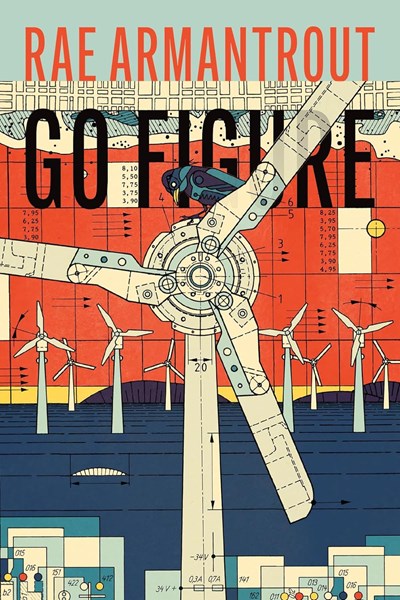
Some spent the pandemic learning how to bake bread, others adopted dogs, and the rest of us figured out how to look formal from the waist up and couch potato from the waist down. Rae Armantrout, one of our most celebrated poets, published Conjure in 2020. Since then, she has published the double collection Finalists in 2022, the chapbook Notice in early 2024, and now the full-length Go Figure. If her record holds, she’ll be halfway done with a new collection in the time it takes me to finish editing this review.
“In the midst of the evident collapse, / I’m bored. What is there left / to say, I say” writes Armantrout in “Flame.” Go Figure proves otherwise.
Armantrout’s sharp-eyed approach to language and meaning has always been especially attuned to our times, when fragmentary images and sayings brush up against each other in our overstimulated lives. Yet, the craft of her poetry—what makes it work when you read it once, and several times later—is the verbal precision that roots these images and words. It’s also what makes her poetry consistently timely. Money Shot, taking on issues of greed and the price—and cost—of being human, was published during the 2008 financial crisis — an era obsessed with consumerism—and it is still relevant. That’s because whether her lens is science, finance, the pandemic, climate change or AI, her poems use the quotidian as a primary palette to engage with what it is to be human: our flaws, fears, loves, and desires.
“It could have started like this.
My mother took me to fabric shops when I was a kid.
I would wander through the tall bolts dazed, reading
fortunes in the colors.”
This excerpt from “Fortune” brings to mind “The Way,” from Veil, where “As a child, / I was abandoned // in a story / made of trees.” There’s the contrast of “could” and “would,” the friction of the conditionals that underscores the indefiniteness of our origin stories, as well as the poet’s ability to “read fortunes,” to see more than what is visible with the eye.
Armantrout’s use of nursery rhymes and fairy tales is sonically inviting, but also an echo of the darker stories they represent, where children are often in danger, girls most of all. Armantrout’s twin granddaughters have been wandering through her poems since they were born, and readers have been able to see the world through their eyes as they mastered language, discovered object permanence, and developed individual consciousness. Yet in Go Figure—and in our fast-eroding social and political environment—the stakes are higher for them and for us, and how we allow soulless infrastructures to model narratives must be questioned: As she writes in “Preconditions”: “Things happen / to motherless girls / whose fathers are complacent / kings, / whose brothers are scattered / wild creatures. // The story tells girls / they can change things / if they make shirts / from nettles / and say / nothing.”
Armantrout is deservedly well known for her linguistic epées, often in service of our foibles, yet in Go Figure she slices deeper into our societal and individual hypocrisies, our inexplicable tendencies to become accustomed to, and scroll through, horror, especially memorable in “Picture This”:
“Particles, whether long- or short-lived,
arise from “a permanent
traveling disturbance
in a quantum field.”
But we all know that
when a disturbance
is permanent,
it no longer disturbs.
Picture a tent city.”
That last line demands a re-reading of the poem, one that doesn’t complacently scroll through others’ turmoils. This is one of Armantrout’s poetic strengths, a Dickinsonian telling the truth slantly—often with humor, or in this case, a gasp—that needles existing power structures, and our own self-deceptions.
Armantrout keenly describes the stakes of our time and the state of our humanity in “Seeing Reason,” which wonders about our acceptance of the status quo, the society that so easily flicks through all manners of apocalyptic signs and asks: “What was the point of warnings / when desiccation, inundation, / plague, extinction, and / the murder of children / were on constant display?”
She then shifts the perspective, questioning our fixed narratives of right and wrong in a similarly titled “Reasons,” slyly declaring: “The snake was a fall guy. / That tree / was temptation enough. Staged apples, drop-dead gorgeous.”

As much as I enjoy the expansive landscape of long poems, this Armantroutian mastery of short form poetry invites readers to deeply engage in rewarding excavations. I’ve often used the term playfulness when describing her poems, but that is always matched by the rigor of her craft, and focused intent. “In Time” plays with the form of the haiku, handily delivering in spirit and imagery, if not the conventional 5/7/5 structure: “First thing this morning, / two dead bees curled up / to form a parenthesis. // That’s not quite / haiku, but / who’s counting?” Go figure—this collection is full of the delights of Armantrout’s inquisitive mind, sleight of language, and distinctive telescopic and microscopic juxtapositions.
“There’s no way to explain
how faultlessly I want to write
about how pointless all this is.
Nothing I can point to, but
the gesture itself,
the way it comes to seem
anachronistic, spectral—
like this ongoing attempt
to catalog the world
by latching each thing
to the last
memory it calls up.
from “Here I Go”
I can’t explain how faultlessly I want to write about this collection, and of course, I shan’t be able to do so. Throughout her career, Armantrout has both questioned poetry and proven its value. She excels at what we’ve been losing: the art of paying attention. It’s that attention—to words, to minutiae and magnitude, in our world and lives—that makes her work so fresh and delightful, and this, a collection to savor.
POETRY
Go Figure
By Rae Armantrout
Wesleyan University Press
Published August 6, 2024


