


There’s so much to savor in Carl Phillips’s new collection, Scattered Snows, To the North—his much-admired lyricism, his exacting use of language, his stunning juxtapositions—all rendered with candor and intimacy. In the poem “Back Soon, Driving—” the speaker talks of “The way the present cuts into history, / or how the future can look at first / like the past sweeping through,” and these poems embrace such multi-temporality, rooting the human condition within a far greater landscape: of memory, of nature, of time itself. His brevity, in specific poems, and with the collection itself—it is a headily-distilled 54 pages—is equally satisfying. “This is the deep light you’ve waited for, unfiltered…” he writes in “This is the Light.” The same can be said for this striking collection, and exceptional poet.

This interview has been lightly edited for clarity.
Mandana Chaffa
After publishing the expansive, Pulitzer Prize-winning Then the War: And Selected Poems in 2022, I’m fascinated with Scattered Snows, To the North as its poetic follow up. The former could be considered a career retrospective, across a variety of literary forms, and this collection is architecturally sparer, with a quietude that allows more echoes and intimate resonances. How did these two collections, so different, yet singularly you, come into existence barely two years apart? What do they express, or answer, for you?
Carl Phillips
I’ll start with the last part first, and say that each of my books, since the first one in 1992, has been a space for me to wrestle for temporary answers to ongoing questions about what it means—for me, at least—to have a human body that often finds itself at odds with society’s expectations of how we should conduct our bodies. So, everything I’ve ever written is part of an ongoing meditation on that subject, which of course includes many things: love, desire, betrayal, loss, memory, mortality… I used to worry that I only wrote about the same things all the time, until I realized 1) that these are pretty rich subjects, ones that can be explored for a lifetime, and 2) each time I explore these ideas, I’m doing so from a different vantage point, being older, having accumulated more experiences in my life. In that sense, the poetry keeps evolving, I hope…The big difference with these two books may just be size. “Then the War” was originally just that part of the book with that title—it didn’t include the selected poems. Then Carcanet in England wanted to publish a book of mine, and they were interested in a selected, as a way to introduce me to a UK audience. I had the idea to add the selected poems to the book that was already scheduled to be published on its own. But most of my books have been very slender volumes, across my career, so Scattered Snows just seems especially slender because it has followed a compilation. It is true, though, that it’s my shortest book ever, I’m pretty sure.
It’s as if
from “Mechanics”
the mind somewhere
means to shut down memory,
that way preventing us from
understanding too clearly
our own unhappiness, and
in place of memory, offers up
belief. We believe we’re happy.”
Mandana Chaffa
Memory—or perhaps memoria, with its more expansive Latin context leading to a form of improvisational rhetoric—is a consistent thematic line in your work, both prose and poetry.
There’s a kind of destabilizing freedom that comes from divorcing memory from “fact,” a greater sense of possibility about what may have been, and what may yet be. Or as you wrote in “Fall Colors” “Believing in, versus believing.” What happens to identity—and poetry—when one chooses the former rather than the latter?
Carl Phillips
I’m going to assume, by the question, that you equate “believing in” with memory and “believing” with fact. So, what happens when one chooses memory over fact, when it comes to identity and poetry? I think you may have answered it in the question: there’s a kind of destabilizing freedom. Facts stabilize us, give us solid guideposts. But when we can’t recover the facts, and have only our memories for proof that something happened, it means that we are only remembering ‘facts’ as we are capable and willing to remember them. A classic example: two people fall out of love and break up. Each of those people is likely to come up with an explanation of what happened, and it usually means, for the sake of self-survival, that we come up with a narrative in which we behaved more nobly than the other person. No one wants to imagine themselves as a bad person who did bad things to someone else. So yes, there’s a freedom to it, we get to create our own narrative of the past. But the danger is that we can start to believe that that narrative is fact, and what seemed a wild freedom is more a potentially dangerous detachment from reality. And on the other hand, sometimes we need to be detached from reality—I guess I’m echoing here what Eliot spoke of, about humankind not being able to bear too much reality.
I used to worry
about the impression I left on others; and then I really
don’t remember which came first: I grew up?
I grew tired?
from “The Closing Hour”
Mandana Chaffa
Do you write with an audience in mind?
Carl Phillips
I don’t write with an audience in mind, ever. Unless it’s the audience of the self. I’m always trying to work out something, often something I can’t put a real name to—I write in resistance to inner conundrum, as a way of temporarily holding at bay what threatens to overwhelm me. I know how dramatic that sounds…I know that I first wrote as a way of working out what turned out to be my queerness, something I hadn’t had a way to process until I found poetry, which seemed an extremely private—and therefore safe—place to talk about what I was afraid to speak of openly. But beyond sexual identity, there are so many other parts to being a human being, so many conundrums that can’t be worked out but which we have to figure out a way to include in our lives—loss, for example, the fact that people die and that we ourselves will die. I feel lucky that poetry has provided me a space within which to consider these things.
And as usual, early summer seems already to hold, inside it,
the split fruit of late fall, those afternoons whose
diminished music we’ll soon enough lie down in–surprised, a little, to feel at all surprised…
Meanwhile, how the wind sometimes makes the slenderest trees, still young, bend over
From “Before All of This”
Mandana Chaffa
Nature—our immortal elder and progenitor—stands in many of these poems for time far greater than our ephemeral existence (let alone our inadequate memories). You’ve lived in a variety of locations, from the middle of the country to its shores. How much does where you live impact what or how you write?
Carl Phillips
Place plays a very large role in what I write, in a very basic way, namely, at the level of imagery. I didn’t have a lot of fields and prairies in my poems until I lived in the midwest, for example, where I also discovered a different quality to the light, compared to the light here on the east coast. I think the reason for so much marine imagery in the poems has everything to do with my having spent my high school, college, and early adult years here in Massachusetts in a seaside town where just driving to the grocery store means encountering a view of the sea, or at least the smell of it. But there are also all the places of memory—I grew up moving from one air force base to the next, from Oregon to Minnesota to Germany and many places in between. Those are places I carry with me at some level all the time.
That answers the part about how place affects what I write. I don’t think I’m able to speak to its effects on how I write—I know there must be an effect, but I’m not sure what it is.
Mandana Chaffa
Might we talk about collection structure? The three sections—”Somewhere It’s Still Summer,” “Rehearsal,” and “When We Get There”—each have title poems, but the title poems aren’t in the sections named after them. I love the playfulness of this act, this gesture against traditional forms of collection creation. Would you talk about this decision, and whether it is a kind of signaling about your current poetic perspective?
Carl Phillips
In some ways, I see each of the three sections of this book being a version of the others—there are deliberately recurring motifs, but in what I hope are subtle ways. For example, light reflecting off a basin of water in one section returns in another as someone viewing an eclipse safely by looking at it as reflected in a basin of water (as opposed to looking straight at the eclipse itself). Each of the three section title poems involves two people traveling (or having traveled) across an unnamed landscape. Are they the same people in these poems, or different ones? And what are they traveling toward? I think I had the idea, once I realized I had these three poems—which stand out from the others in being more traditionally narrative—that they could represent any life journey (getting older, moving from one relationship to another one, moving from one chapter of a life to the next one). I think of them as anchor poems, because the other poems in the book are more lyric, more like insets from a larger narrative, they’re in this sense more free-floating than the narrative poems.
I stumbled late upon the idea of moving the title poems to sections that didn’t match the title. To me, it seemed a way to reinforce how these three sections are stitched together and interrelated. But also, I think it reinforces—very subtly, I guess—that our lives aren’t as easily pinned down, there’s a desire for structure, but things don’t match up as precisely as we might wish for. Having each title poem appear in the section with that particular title would have been too finished, too predictable. Life isn’t predictable. That’s not meant as a signal about my current poetic perspective—it’s simply how I’ve always understood life, from the moment that I was told in sixth grade health class that my future was meant to be that, as a man, I would marry a woman and have children. Even then, though I had no understanding of my sexuality, I didn’t believe that it could be that straightforward, that inflexible.

how the river, running always away
the way rivers tend to, stands as proof that reliability
doesn’t have to mean steadfast, how the
river itself would say so, if a river could say…
from “Sunlight in Fog”
Mandana Chaffa
I love river poems, such as Langston Hughes’s, “The Negro Speaks of Rivers” or John Ashbery’s “Into the Dusk-Charged Air,” so I reveled in the variety of rivers, and other bodies of water, streamed through this collection; living water that isn’t at a distance or a gesture, but an act of intimacy and emotion, a “river-love.”
What are the rivers of your life that still wind through your memories, and into your poetry? How is a river like love?
Carl Phillips
I suppose the main ones have been the Mississippi and Missouri Rivers, since I’ve lived near them for thirty years. Until this summer, I lived very near Forest Park in St. Louis, where there’s at least one creek that runs through the park—that’s been like a river for me, or it was, one that I walked my dog beside often. But I don’t think of rivers playing a large role in my work, compared with the ocean, which I fear I return to too often in my poems, but it’s what I’ve known best, and continues to be where I feel most at home. I’ve just moved permanently back to Massachusetts, to Cape Cod, where I get to visit the ocean every day. It feels like returning to a best friend.
Life itself being a ramble of mystery, pattern, accident,
and surprise, we took heart in knowing whatever road we were on
must be the right one—or anyway, we believed it was and belief
still counts.”
from “Troubadours”
Mandana Chaffa
Your lyricism—both in service to the self and nature—is another ever-present theme in both your prose and poetry. I especially appreciated your meditations on language and the creative self in My Trade Is Mystery: Seven Meditations from a Life in Writing, which you somehow published between Then the War and this new collection. Might you speak to both your prolificness—which I appreciate as a reader, and envy as a writer—as well as your embrace of mystery, and how it figures into your personal interest and professorial pedagogy?
Carl Phillips
Aha, two very different questions… To start with prolificness, I guess it looks like I’m prolific if we count the number of books within 32 years. But one thing that no one ever considers is how short my books have always been and how spare most of my poems are – if we went by word count, for example, I think I would seem to have written about 8 books in my career, which seems an ordinary enough number. Most books of poems, these days, are over 100 pages, whereas mine are rarely more than 55.
I’ve also always wanted to be as pared down as possible within each poem—no word wasted, nothing except what’s absolutely essential. The trend in U.S. poetry, from what I can tell, has long been a more conversational, demotic use of language, colloquial, I suppose, in keeping with an informality that I associate more with an ‘American’ tradition of poetry than with the traditions that I’ve always been more interested in—archaic Greek lyric tradition, for example, as well as the precise poems of the Chinese T’ang Dynasty. I’ve always preferred Team Dickinson over Team Whitman, but I think most poets in this country lean toward the latter, for various reasons. In poetry, as in conversation, I’m not interested in loquaciousness—that feels like a waste of words to me. I want something more chiseled, the language chiseled to exactly what the thinking requires.
Which leads us to the second question, because what comes with that spareness can be mystery—mystery can’t exist if everything has been revealed and/or said. Of course, the risk of mystery is that it can also be so mysterious that it provides no access to anyone outside the mystery. As I used to tell my students, mystery is one thing, obfuscation another. But the benefit of mystery is that it can provide resonance, i.e., it can leave us with questions that can be productive. If a poem simply declares everything clearly, I have no room to start pondering further. As a reader and as an artist, I want that room for pondering—it’s what gives a poem continued life, because we keep returning to the poem in a desire to answer the questions which the poem itself refuses to entirely answer. As a teacher, I want to draw that out in my students, a desire for more. Which is why I’ve never been prescriptive as a teacher—I don’t want to tell a student how to ‘fix’ a poem. I want to provoke questions in them—and in their efforts to answer those questions for themselves, I’m hoping they might find what their poem wants and needs to do—which is different from fixing a poem. I like to think I’d have been the kind of parent who wouldn’t dream of telling my child how they should live their life. Instead, I’d want to encourage them to explore the infinite possibilities for how to live, and to choose the possibilities that feel right at any given time. The possibilities are always shifting—why be limited to any one of them in particular?
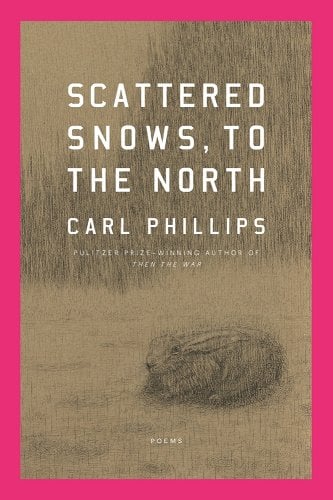
POETRY
Scattered Snows, to the North
By Carl Phillips
Farrar, Straus and Giroux
Published August 6, 2024


