


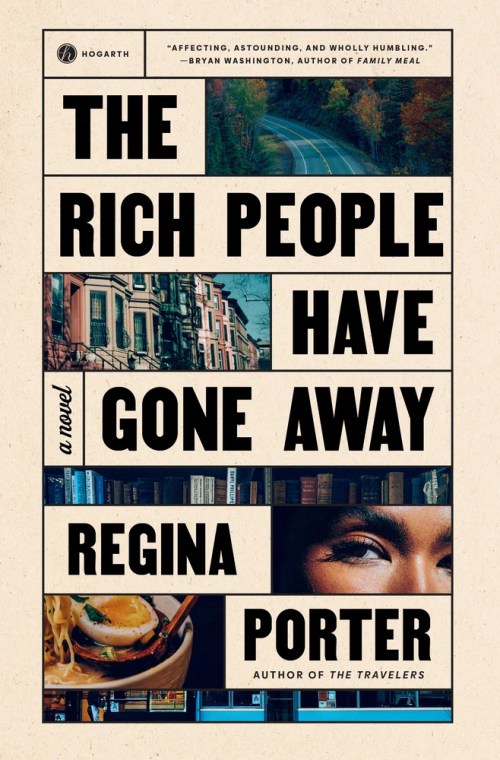
Regina Porter’s new novel, The Rich People Have Gone Away, joins a cadre of terrific Covid-19-pandemic focused novels published this summer. Like Porochista Khakpour’s Tehrangeles, Teddy Wayne’s The Winner, and Hari Kunzru’s Blue Ruin, Porter’s novel delves specifically into how the early days of the pandemic lockdown affected people of different privilege in vastly different ways. There are many definitions of privilege, but we all learned a new one then: privilege is the opportunity to improve your chances of surviving a deadly virus.
Porter leaves little doubt about how we should frame the discussion in our minds before we open the novel: it’s right there in the title! When you’re rich (and in many cases, white), you have the luxury of simply running away from problems, as many New Yorkers did in March and April 2020.
“People weren’t simply running from the coronavirus,” Porter writes. “They were running from what a city becomes when most of the people who live there are nonwhite and the economy goes crazy. And they can no longer flit around and pretend those people don’t exist.”
Yes, inherent in any discussion of privilege must also be a discussion of race, and Porter examines these inseparable ideas with expert nuance in this novel. The two stars of this show, the married couple Theo and Darla, leave their cozy Brooklyn home and abscond northward to a cozy cabin upstate to ride out the pandemic. But after an argument during a hike (and the subject of this argument is crucial to Porter’s themes of race, privilege, and escape), the beautiful, blond-haired, two-months-pregnant Darla disappears.
Porter employs a neat trick here: We know Darla, though injured, is still alive—Porter gives us periodic point of view shifts from Darla’s perspective allowing us to follow her as she convalesces and then decides to stay disappeared. This allows Porter to further build on the theme of the privilege of being able to escape. Would folks be as willing to help Darla if she weren’t pretty and white? And more so, if she weren’t pretty and white, would the media and online frenzy be as fierce as it soon becomes? Of course, we know the answers to these questions already. The media also latches onto the human-interest angle that Darla’s father died during 9/11, making the family twice the victim of New York’s two greatest tragedies of the 20th century.
Theo is the main suspect—the last person to see her alive. But even though we know he didn’t kill her, no one else does, including the cast of secondary characters we’ve also been following throughout the novel.
There’s Darla’s best friend Ruby. Black and from a wealthy family (more nuance!), Ruby is married to a Japanese chef named Katsumi and together they own a Michelin-starred restaurant in New York City. A third family round out the supporting roles: Darla and Theo’s across-the-street neighbors, a Black family of mother Nadine, father Irvin, and teenage son Xavier.
These supporting characters are all basically vehicles to drive forward Porter’s themes of escape and privilege. They’re not nearly as fully drawn as Theo and Darla. But that’s okay. They have their place and do their jobs in the narrative. Ruby is given an extensive backstory, which furthers the theme of escape, for instance. Nadine gets Covid and is hospitalized, allowing Porter to offer some commentary on how at the time we didn’t know, but now do, that Covid affected minorities—both in terms of Covid health outcomes and economically—much more emphatically.
Still, the missing person drama is the meat of this story. Though not exactly a thriller, there’s more than enough plot, and quite a few twists, to keep readers quickly turning the pages. Just don’t turn them so quickly you miss the central messages Porter is delivering. The rich people may get to go away, but we should really work towards a more equitable society so that they don’t feel like they have to.
FICTION

The Rich People Have Gone Away
by Regina Porter
Hogarth Press
Published on August 6, 2024


