


In his latest collection The Murmuring Grief of the Americas, poet and translator Daniel Borzutzky continues his searing investigation into mechanisms of control, systemic dehumanization past and present, and the limits and power of language. Exploring both real and imagined landscapes, these poems express the collective and individual pain wrought by the Western capitalist project, where profit comes at the expense of humanity.
Like much of his earlier work, including Written After a Massacre in the Year 2018 (2021) and the National Book Award-winning The Performance of Becoming Human (2016), Borzutzky’s energetic poems not only hold the mirror up to nature, but speak back to us—sometimes in murmurs, other times through megaphones. The tapestry of voices in this collection demands that we not only see the inner workings of oppressive systems, but listen deeply as well.
We discussed some of the thematic work underpinning Borzutzky’s collection and, as he puts it, “what books can do” amidst suffering and grief.
Devyn Andrews:
I was struck by a sense of urgency throughout The Murmuring Grief of the Americas, particularly as the voices in these poems interrogate the nature of power. The act of questioning itself seems central to this work—as you were writing, what kinds of questions were you considering or exploring on the page?
Daniel Borzutzky:
Funny that you should ask this. The book actually began with a question that I posed in my last collection. At the end of Written After a Massacre in the Year 2018, one of the final poems poses the question: How do we quantify the murmuring grief of the Americas? Perhaps this is a question that I’ve been asking in different ways throughout many books: The section headings of the Murmuring Grief also help to answer your question: When will I/you/they/we be human again? What is it to be human? How is our human-ness or humanity a performance? These are continued obsessions, along with: how does financialization function, especially in relation to natural disaster? What is debt and how does it determine who we are? How do migration, language discrimination, xenophobia and hatred sink into the smallest corners of our language? What can poems do? What makes us laugh? How do we survive? Why do I love the word “murmur,” with its repetitions and the many sounds and words contained it? But also: what is a book? What does it do? Who is it for? Help?
Devyn Andrews:
Some of the poems in The Murmuring Grief of the Americas share their titles with your previous collections The Performance of Becoming Human (2016) and Lake Michigan (2019). How do you view this collection in the context of your work as a whole?
Daniel Borzutzky:
I’d like to say that while they are separate books: they are only separate books in time and materiality… and that, really, it’s all just one book… the book of life or the book of my life or the book of how I move through life or how I understand life. The poet-character in Murmuring’s “How I Wrote Certain of My Books” “would give advice like fuck doing new things you’re a writer not an iPhone”—maybe I agree?
Devyn Andrews:
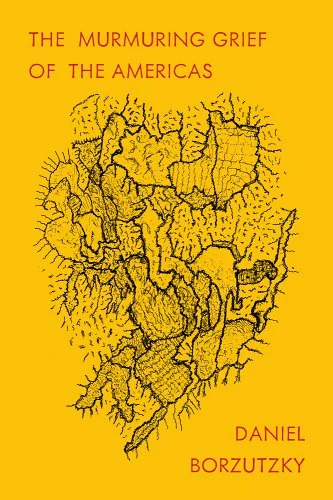
I was really compelled by the cover artwork for the book, and was interested to see that it’s an illustration you made called “New Map of The Americas #502.” Is visual art often part of your creative process, and how do you see it functioning here?
Daniel Borzutzky:
Thank you for asking! This is new for me. Until this year, no one had seen anything I’d ever drawn. But as I wrote this book I was making drawings obsessively and in some cases the poems and the drawings came out together. I guess I do do new things after all :). The cover drawing was a way of obsessively and minutely—with tiny movements of the hand—thinking about the colonial, imperial and visual qualities of map-making and re-mapping. I like drawing in part because I know nothing about it. It was a relief to be immersed in an artform whose discourse I am unfamiliar with and not involved in. It was an opportunity for innocence and experimentation.
Devyn Andrews:
This concept of map-making and re-mapping fits beautifully into my next question. There is a lot of movement in the landscapes these poems explore between the natural, manmade, and even dream-like or imagined spaces. For example, in “Lake Michigan, Scene #1130”: “Chicago emerges from the disappeared waves and / in the distance we see the borders of the dead states rising from the sand that is not there.” How do you conceive of place within your work?
Daniel Borzutzky:
Chicago, the beach, the sand, the lake, are all living characters in my books, just as they are concepts. The landscape, be it the lake or the desert, is never empty. And it always contains so many layers of time and temporal survival. The lake is a continuous site of both beauty as well as political and ecological violence. That the lake looks and sounds different from every angle, that its usage and subsistence signals the economic, structural, and racial components of the city—continues to intrigue me.
Devyn Andrews:
Intertextuality plays a significant role in this project, which makes references to the works of Clarice Lispector, Emily Dickinson, Pedro Pietri, César Vallejo, Roque Raquel Salas Rivera, among others. How do you see your work in conversation with these other texts and writers?
Daniel Borzutzky:

I think all my work is written in conversation with other work. I could talk about each of these writers individually, though that would take too long. I would say, however, that together in these writers is a poetry of the Americas that has helped me write through problems of grief and unquantifiable pain (Lispector, Dickinson, Vallejo); of debt and money (Pietri, Salas Rivera); of violence, of performativity, humanity, barbarism, and the very possibilities of what language can do, poems can do, books can do.
Devyn Andrews:
In a similar vein—one particularly strong connection seems to be with Franz Kafka’s short story “In the Penal Colony,” in which a visitor to an unspecified labor camp learns about a machine used to torture and execute prisoners by literally inscribing their sentences on their bodies. This is such a visceral and haunting image, which seems central to some of the themes you’re exploring here. Could you talk a bit about the relationships between power and corruption, writing, and the body as you see them?
Daniel Borzutzky:
As I was writing this book I had a dream about a “writing colony,” where people who were not allowed to speak were forced to give up their bodies so that “apprentice” writers could learn how to write about them. One writer stared into the body that was written upon and understood that the only place for literature was in the space between debt and death, language and languageness, composition and decomposition, what we are and what we owe. Raúl Zurita, in an interview, once told me that in 1985 under the Pinochet dictatorship he wanted to write a poetry that was as powerful as the pain being delivered by the state. Vallejo wrote about the blows in life that are so powerful that “I don’t know.” Dickinson wrote that “Pain has an element of blank.” I try to write in, through, with, against, and because of these impossibilities and blanknesses. And always there is the question of how the body survives amid the humanity of humans performing their humanness, which is power, weakness, horror, all at the same time.
Devyn Andrews:
It seems that many of these poems seek to express that which is perhaps beyond language itself, resulting in a compelling navigation between the unsayable object and the inherently language-bound medium of expression. What is the role of the artist, particularly the poet, in moving beyond language to write about the unwritable, or speak about the unsayable?
Daniel Borzutzky:
Thank you—that’s a beautiful thing to say. In the end we have words and we have silence…those are the writer’s tools. The writing I have cared about most has been about the unwritable. I don’t know that it’s a role or responsibility. I think it’s a drive or a desire that can’t be fulfilled. And that’s why I keep writing. Not so much to move beyond language—but at least to push it as far as I can—to make word-art that speaks to the impossibilities of being alive by pushing against the murmuring grief of life itself.
POETRY
The Murmuring Grief of the Americas
By Daniel Borzutzky
Coffee House Press
Published August 6, 2024


