


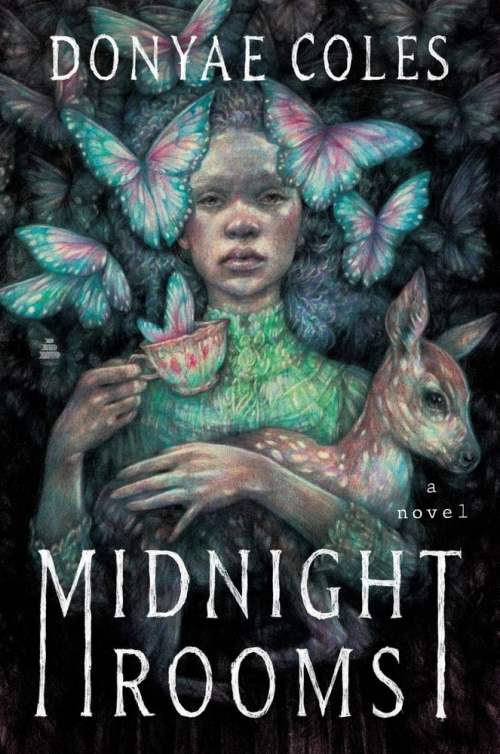
Midnight Rooms, the debut novel from Donyae Coles, is a gothic tale set in 1840s England. Orabella, a young, biracial woman who lost her parents in early childhood is subsequently raised and sold into marriage by her aunt and uncle to cover a gambling debt. Her husband-to-be is a man with a respected family name who pledges to treat her far better than her relatives ever have. On the strength of this promise and her mysterious attraction to him, Orabella allows herself to be whisked away from all she knows to Korringhill Manor, a decrepit, labyrinthine mansion that seems everyday to crumble further.
Coles sets the stage well for this story, immediately conveying Orabella’s curiosity and courage as she spies on her uncle’s meeting with the man who will become her husband. Her cousin has already left to marry and settle into her own home elsewhere, leaving Orabella the sole burden of the household. Hoping at first to scare the suitor away by revealing her Blackness, she is soon drawn in by his bold manner and professed desire for her. She accepts his proposal, conceding that if she does not, another potentially worse option will surely take his place. During their very brief wedding and en route to their new home, Elias Blakersby does seem genuinely keen to lavish his new wife with affection, his mood only flickering into darkness at the mention of his family, of whom he refuses to speak. They do not remain completely unknown for long though as, upon her arrival at Korringhill, Orabella meets them for herself. So begins the story’s plunge into a surreality that often strays to the edge of nightmare.
Those familiar with the gothic subgenre will immediately recognize many of its conventions in Midnight Rooms: the generations-old family home in disrepair; uncomfortable class juxtaposition; terrible family secrets; a possible supernatural undercurrent; secret passageways; the interplay of the natural world with that of man, etc. Nature is especially pervasive, with Elias’s family often being likened to both foxes and fae, and with Korringhill itself being steadily overtaken by vines and other flora in a creeping act of reclamation. The story’s atmosphere is intriguingly unsettling, with new mysteries cropping up at every turn. The patriarch of the family, Hastings, looks like the walking dead, and his daughter, Claresta is like a perfect statue: unblemished, silent, and often unmoving. Orabella sends several letters to a friend, none of which are returned. The hallways in the home seem to shift, always leading someplace new and containing a near endless number of doors Orabella is discouraged from opening. Not to mention the tea and wine that propel her into hallucinogenic drowsiness, and her husband’s insistence on keeping Orabella locked in her bedroom at night.
Each cryptic element is tantalizingly written and increases the anticipation for a payoff that never quite comes. There are mysteries that work in great service to this story, like whether or not Elias and the other Blakersbys are actually human. The dreamy scenes filled with meat, spilled wine, blood, and the strange family’s raucous laughter are evocative of struggling to wake from a hellish dream, which fits perfectly with the environment Coles welcomes us into. But other mysteries, left unsolved, have the overall effect of weakening the narrative.
None more so than what the Blakersbys actually want and exactly how they hope to achieve it. It isn’t the accrual of great wealth—the Blakersbys are known to accept goods and services from their tenants in lieu of money, and Orabella is given brand new clothes, books, and other knick knacks without concern over the expense. It isn’t a widening net of control—they only socialize with one another and are loath to interact with outsiders. What exactly are they trying to hide and protect? These questions are never answered. It’s possible to come up with plausible explanations, but none are confirmed in the text, allowing the question of why the story unfolds as it does to persist. Without a trail of small truths that gradually build to a grand unveiling, the eventual climax of the story does not pack the punch it sets out to.
Orabella herself is a somewhat paradoxical character. She is slow to pick up on certain things that will likely be clear to the reader from the start while simultaneously knowing particulars of her new environment that we don’t witness her learning. Orabella often comes across troubling realities that she dismisses as dreams or stories she’s made up despite having seen them with her own eyes. Her insistence on performing the role of good, obedient wife—while justified at the start as a byproduct of her upbringing and status as an outsider, even among her own family—makes less sense as the story continues. Each time Orabella seems ready to get serious about figuring out the truth, she falls right back into the same cycle of resignation despite new occurrences and information. Even extreme violence and tragedy aren’t enough to influence an attempt at escape.
Her interactions with her husband are mostly sexual—the two don’t spend much time together, and when they do, there is not a lot of conversation, which makes her continued desire for and loyalty to him in the face of clear violations feel unwarranted. Though it makes sense that being treated as burdensome for much of her life might make Orabella hesitant to trust herself, it would have been nice to see her sense of self strengthen over the course of the novel rather than repeatedly dissolve in a way that leaves her back at square one. It would also have been satisfying for what appeared to be clues to indeed lead to definitive knowledge about what the Blakersbys are up to.
Midnight Rooms is an ethereal debut that wields its eeriness to compelling effect. But like the halls of Korringhill Manor, this story’s paths snake back on themselves to no discernible end except to trap you in the dream a little longer.
FICTION

by Donyae Coles
Amistad Press
Published on July 2, 2024


