


The first time I encountered Lisa Low’s poetry was at a literary reading tucked away in the corner of the RoscoeBooks bookstore. She read her poem, “Nine Apologies,” a sarcastic and unconventional criticism of shallow celebrity apologies. When she finished reading, I was instantly reminded why I love poetry so dearly, and in awe of her work’s ability to hold magnitudes within just a few lines.
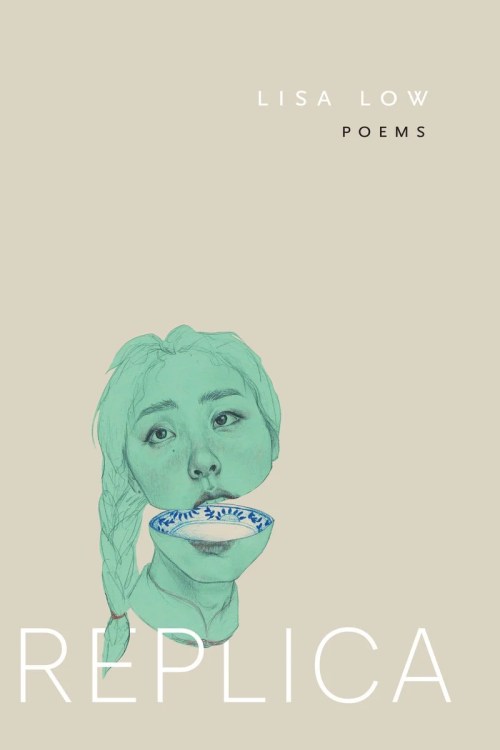
If I appreciated “Nine Apologies,” that was just the beginning. Low’s newest poetry collection, Replica, knocks the breath out of your lungs at every turn of the page. Vulnerable, sharp-witted, and poignant, each poem is a carefully laid, singular experience that even after rereading, presents a new and unique narrative.
I had the pleasure of sitting down with Lisa Low to discuss her electric new collection.

Angie Raney
I’m a sucker for structure, especially when it’s about poetry. I love that you had a palinode, as it’s not the most flashy poetic form. How do you determine what form best encapsulates the intention of the actual poem?
Lisa Low
I like the idea of expanding and contracting. I wouldn’t say I’m experimental per se, but I like trying unique forms, especially in the last section of the collection, which is more formally different with the erasure and the footnotes poem. I really love poems like the ode and ars poetica that aren’t strict forms but are still containers of some kind. I think with the palinode specifically, it also just came from an obsession with couplets (laughs).
But all in all, I wanted each poem to feel distinct, so looking at the poems next to each other was really helpful.
Angie Raney
One of my favorite poems was “Party Anxiety.” I don’t know if I’ve ever read a poem that cites research in the text and as footnotes. I like it though—it exacerbates that obsession with self-assessment. What prompted you to explicitly cite your research as opposed to more nebulously referencing the sources you mention in the poem?
Lisa Low
I’m definitely not the first or only poet to use footnotes. But an editor actually asked me if I should add them at the end of the book instead of at the end of the poem, and I said no. I like the idea of what we think of as a poem or poetic space interacting with the world.
Angie Raney
Totally. I think a lot of people hear “contemporary poetry,” and they really only think of stanza-ed freeverse. But there’s something so cool about mixing genres, formats, etc.
Lisa Low
Exactly! I love it when something teeters on the line between essay and poem. I also like the idea that this research isn’t totally applicable, but it is applicable. You can’t do that in regular, academic writing, but I love that you can do that in a poem.
Angie Raney
You can throw stuff at the wall and see what sticks! (laughs)
That’s a good segue to my next question. I love “Nine Apologies.” I heard it read live, but seeing it on the page was a completely unique experience, which is oftentimes hard to translate with poetry. I’m also thinking about your formatting choices in “The Other Asian Girl.” What is your process when determining spacing and those minute formatting choices in a poem?
Lisa Low
My friend Anni Liu’s poem “Remains” has amazing indentations, and I totally followed the beginning of it to get me started! I like how her form was able to get me into this space where I could show a slight back and forth that the poem needs you to do—when you’re thinking about yourself and balancing that with how other people are looking and thinking of you. And more generally, I think white space in this book is really important.
Angie Raney
Speaking of, you explore placement—in primarily white spaces, in relationships, and even in your own body. You also don’t shy away from topics like self-assessment, blame, and emotional labor, but the collection has this beautiful through line of unconditional love. I’m curious, what is your biggest thematic inspiration for poetry? Is there something you’d like to write more about?
Lisa Low
This is a great question! I just mentioned, but I think this book is a lot about looking and watching—watching yourself and watching other people, and how that plays out in different spaces. At home, in public places like the dentist’s office, classrooms—that kind of stuff.
I also write about questioning stereotyping in general and what we consider “cliché.” I’m just really interested in complicated, sometimes shameful, or uncomfortable emotions.
Angie Raney
The three “Ars Poetica” poems explore perception based on perspective and framing. “Palinode” becomes a portal or physical space rather than just a poem on a piece of paper. Could you speak about how the frame of perspective through which we look at ourselves and our art influences you?
Lisa Low
I feel like there are arguments in poetry and writing in general about not being defined by experiences of racism, but I ended up wanting to write about it because it’s something that happened to me. These forms allow you to speak back to the reader and get another angle on writing what can feel like clichés or common experiences. And my question became: why can’t I write about this? I’m also writing about writing about it too, while still thinking about my audience. Every writer is thinking about their audience when they’re writing poetry to some extent, but I really love “Ars Poetica” because it’s very explicitly talking about what that relationship [between writer and reader] looks like and teaching people how to read you.
Angie Raney
“People Who Look Like You” is so singular because it mixes essay and poetry, and it’s evident that you have a keen ability to invite readers into a moment, as well as into your own head. We can really see the interpersonal and personal conflicts, but also that unconditional love you have for your partner. It’s both an analysis and a reckoning of sorts—a criticism and a show of grace.
I’m curious, how do you balance that feeling of responsibility to write someone you know and love accurately while also staying true to your own experiences?
Lisa Low
I think it’s a constant negotiation. First of all, it’s so much easier for me to write about significant others than family members. I want to present them in the best light, but it’s not always going to be beautiful or a showing of their best side. That’s what makes them a real person though. It’s something that I will always continue balancing, I think.
Angie Raney

In the same vein, how do you tackle memory and wanting to write something from your past that may not be 100% clear in your head?
Lisa Low
I struggle with this in creative nonfiction sometimes, but with poetry, there’s so much more room to be lenient with it, or to add in details that could have happened. There are nuances, you know? Speculation doesn’t need to be clear in poetry.
I actually love poems that point to the gaps or acknowledge where you miss something, too. I find that really cool because it creates a different kind of relationship with the audience, I think. Admissions of any sort allow you to do more interesting and daring things.
Angie Raney
How did you go about ordering the poems? Was there a moment where you knew that the collection was pulled together just right?
Lisa Low
It went through a lot of revisions, honestly. A lot of poems were cut and reordered. I really wanted to have the earlier poems that I’ve written in the first section to mirror an earlier perspective of my life. Then, by opening the second section with a long prose piece, I could contract it back with the sonnet crown in the third section. With the last section, I cut a lot of poems to make it go faster and make it formally different from the sections before.
Angie Raney
Each poem really does have a life of itself. They all feel so different.
Lisa Low
I’m glad [to hear] you say that! I didn’t want to explicitly repeat myself, but I am writing about the same topic in a lot of ways. Especially when I’m writing about race and whiteness, I feel like I’m repeating the actual word “white” a lot, and since the word is kind of loaded and it’s readily talked about, it can feel like, “Am I saying too much?” But that’s part of the book– to keep repeating it and keep saying it even though it makes me (and hopefully white readers) uncomfortable.
Angie Raney
What’s your favorite poem of the collection? I’m partial to “Nine Apologies” as you know (laughs).
Lisa Low
That was fun to write! It’s not my all-time favorite, but “Mail Order Groom” is so fun to read. I also love reading the dumpling making section of “People Who Look Like You” because watching peoples’ reactions is so fun, and I just love the thought of putting all of my friends past and present in one room. So yeah, I think that one is my favorite!
POETRY
Replica
by Lisa Low
University of Wisconsin Press
Published March 24, 2026


