


If you live in Chicago and love independent literature, you know Tortoise Books. The press is known and loved beyond Chicago, of course, but it’s part of this city’s literary lifeblood. Rick Kogan of the Chicago Tribune and WGN Radio called the press “one of the best, most provocative, and rewarding publishing houses in the entire country.”
Tortoise Books began as a one-person, one-book operation, but has grown in the past fourteen years. I had the opportunity to hear about the press from its founder, Gerald Brennan.
Brennan loves the slow, deliberate nature of the tortoise—and the notion that steady, patient progress will get you a lot farther than any other method. That’s why the press’s motto is “reinventing publishing…one step at a time.” It’s a reminder to Brennan to be patient and not take too many steps at once. “I had the sense when we started,” he says, “that we at least had some structural advantages over traditional publishers. (Although I do have much more empathy for traditional publishers now that we’ve been in business for a while!) In particular I think the quality of POD [print on demand] books is great enough that they’re usually comparable to mass-market paperbacks, so as long as you do a good job on layout, cover design, etc., nobody will know you’re using POD. And in fact the traditional industry’s had to embrace that technology in recent years—it’s too much of a gamble to do print runs when something’s been out for a while. (A book club I’m in was reading a book that won the National Book Award—Trust Exercise, by Susan Choi—and I saw the last-page markings that indicated it was POD…that definitely felt like a vindication!)”
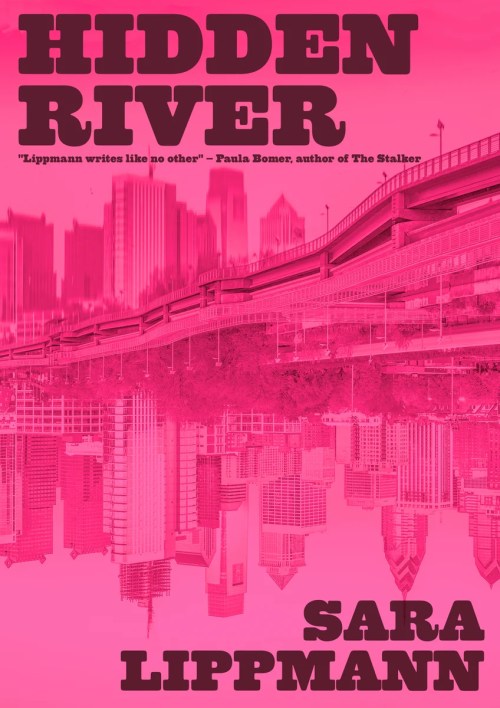
“Hidden River by Sara Lippmann is pretty amazing; it’s a harrowing and timely book about a woman named Cass whose former best friend invites her to her wedding, not knowing that her father had groomed Cass at a young age. Sara’s an incredible prose stylist, and we’re grateful to be working with her.”
Brennan explains that “Tortoise Books has brought on other editors here and there—some have worked on particular projects in exchange for a portion of their proceeds. Other times, someone like Christine Sneed will bring us an amazing project like Love in the Time of Time’s Up and will do all of the editorial work on it.” But currently he is the only one working in-house. He adds, “Editors are a tricky proposition—we’ve had some that’ve done amazing work, but you always want to read what they want to acquire, and sometimes you aren’t equally thrilled about something. As one of our authors said recently, ‘You can’t outsource taste.’”
Tortoise has a distributor, Publishers Group West, and Brennan says that’s a huge help—they do the heavy lifting to get Tortoise books in stores, and they also have a backlist marketing program that does a lot to jiggle various online algorithms and give Tortoise books another shot at finding readers. “As much as we all love the bookstore experience, online discoverability is huge,” Brennan says. “And I’m glad we don’t have to do that ourselves.” When it comes to publicity, Brennan does trade submissions and some media, and authors will sometimes hire publicists as well. He always feels a little guilty when that happens, but also grateful for the help: “Publishing has taught me how false the myth of ‘individual accomplishment’ really is; even if you’re the only person in a company, you have to deal with printers, stores, etc. Plus if you want to really enjoy the work, you want every author relationship to feel like a valued partnership, inasmuch as possible—it’s always a ‘we.’” Brennan works very collaboratively with his authors and wants it to be a fun experience for everyone, emphasizing that “there’s no point doing this work if everyone doesn’t enjoy it. We’ve had a few author relationships that have been tougher than others, but I can look everyone in the eye and know I’ve given them hard work and an honest accounting of the finances.”
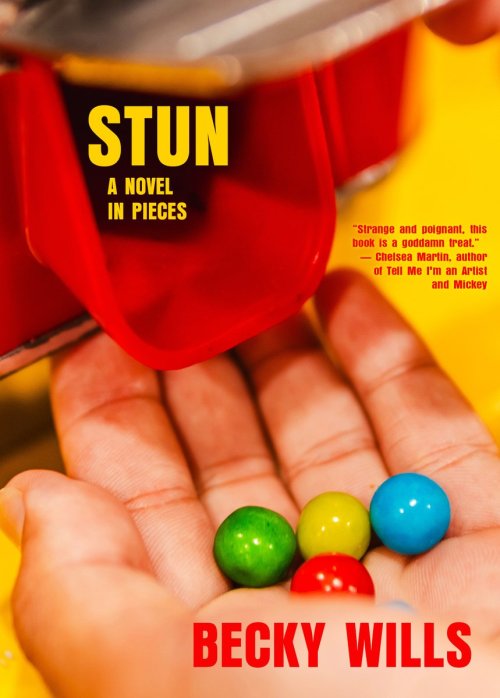
“Stun by Becky Wills is amazing as well; it’s a prose/poem hybrid about a young woman named Ember growing up with a workaholic father and a mother who’s addicted to a prescription drug called Stun—and then Ember, too, finds she has a taste for Stun.”
I was curious about Brennan’s day-to-day work at Tortoise. He gets up at 5:00 a.m. every weekday morning. “I have a little pre-Tortoise routine—coffee, spiritual stuff, a few moves on chess.com, placing various dental appliances in the cleaning device, a quick look at personal finances—that’s basically my equivalent of a computer’s boot-up sequence. Then I’m working on Tortoise stuff for the next few hours. (I still have a day job; if I’m going downtown I can work on Tortoise until 7:40; if not, 8:40.) I try to set healthy boundaries and not work on it at night, or on too many Saturdays. (And I never work Sunday unless there’s a festival or something that requires it.) Weeks like this, there are a few things that come to a head at once—we had to draft a few covers for our Fall ’26 titles to show our PGW rep during a check-in call on Wednesday, and we had to send some copies to blurbists, and we had to finalize one of our Spring ’26 titles, and do financials—and Printers Row Lit Fest just opened for submissions, so I had to notify the other presses we’re planning to share a tent with, and start collecting payments. (Plus I try to get a little of my own writing in, which I did early on Monday and Tuesday.) It can be relentless, but I try to focus on the essentials and cut myself some slack when I don’t get to the extras. We’re planting seeds that should bear fruit in coming months, and planting is hard work.”
So what makes a book a good fit for Tortoise Books? “It’s really such a weird range of unquantifiable factors!” Brennan says. “Sometimes it’s something that resonates with my personal experience—we’re doing a military recruiter memoir in the fall, for instance, and I’ve had just enough experience in the military to be really fascinated by that—and sometimes it’s something dramatically different from my life. But I always have to be at least a little jealous of the author for writing the book—sort of a ‘Wow, I wish I could have pulled that off!’”

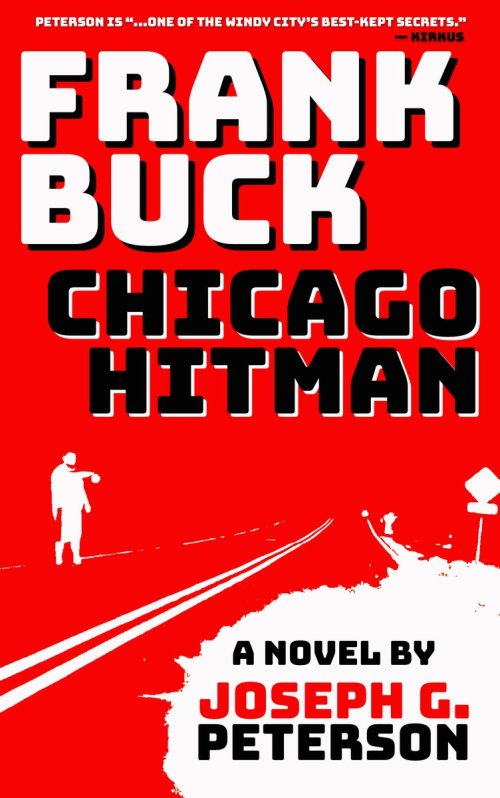
“We’re really thrilled to be publishing Frank Buck: Chicago Hitman by Joe Peterson. It’s a fantastic send-up of gun and hunting culture, a look at the pathetic loneliness behind so much of that; it’s an absurd and cartoonish book, but also strangely moving.“
“I used to hate the traditional industry for being so hard to crack,” Brennan says when I ask about submissions. “I had an open form for submissions on the Tortoise site, and I left it up all the time. And that served us well, for a while! Many of our early authors came to us that way, and some are great friends now. But we got to the point where we were getting more submissions in a week than we could publish in a year, and that’s when I started to have empathy for the industry. Still I wanted to be a little different. I decided to treat the submission process as a product and manage it with the inventory controls on the Tortoise website. And I realized there was a market for a paid submission process, sort of like a Disney fun pass that would give people a chance to jump to the front of the line.” [This full-service submission option costs $300 for a manuscript decision within four weeks plus an extensive Zoom critique session between Brennan and the author.] “And that’s been amazing—challenging, intense, and often very rewarding. Authors can already get feedback from writing instructors, and plenty of them really grow their craft that way. But I figure it’s also worthwhile for people to get feedback from someone who doesn’t have an incentive to keep them coming back. And that’s been a fascinating process—to talk honestly with authors who maybe have been working too hard on something, and need to set it down for a bit and work on something else. Or to give an acceptance face-to-face! We keep the inventory on our paid submissions very limited—I make it a point to only sell one or two a month—and out of the twenty-six we’ve sold, we’ve refunded five because we’d rather publish the book than keep the $300. (Obviously not everyone has the appetite or budget for that, and I get that—I put up batches of free submissions periodically as well. I’d love to take an honest look at everything that comes our way, but it’s every bit as impossible as reading every book that looks interesting in the bookstore.)”
So many books, so little time: it’s the endless problem for us bibliophiles. But as Rick Kogan says, when you pick up a Tortoise Books title, “you know you’re going to get something good, interesting, or provocative to read.” Or all three. In an era dominated by short-form videos, rapidly declining attention spans, and instant gratification, Brennan’s slow, steady approach to publishing is a welcome anomaly. A beautiful reminder that art takes time.


