


In honor of the 10th anniversary of the Chicago Review of Books, The New Chicago Renaissance series revisits exemplary works of literature about Chicago from the last 10 years and explores their continued relevance. Join us all year long as 12 leading writers and artists explore books that they love and why they’re meaningful to our understanding of modern Chicago.

I first read Last Summer on State Street just about as far away from its setting as one could be—which is to say, only 20 miles north, on Northwestern’s Evanston campus, a protected and privileged world of carefully maintained buildings and lawns.
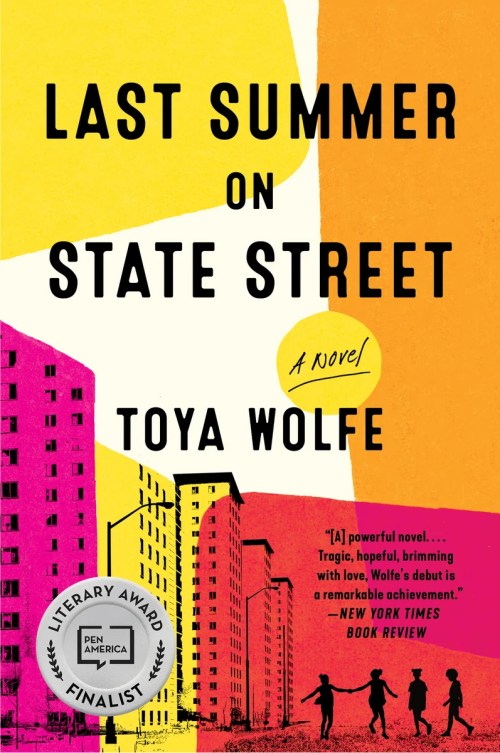
And 22 years separated me from the novel’s subject, as well; I was holding an early copy of the book in late 2021, but reading about the summer of 1999, when destruction of the Robert Taylor homes on South State Street had just begun. Yet Toya Wolfe’s 2022 debut is utterly transportive, as only the most immersive novels can be. And the book’s ultimate magic is that despite the brutality of its setting—this is, after all, a novel about danger, desperation, and absolute tragedy, in addition to hope—we want to be taken there, again and again.
In the second summer of the Chicago Housing Authority’s project of demolishing the landmark public housing high rises one by one—and the last days before 4950 South State Street’s planned demise—Fe Fe Stevens stands at the tipping point of adolescence, the raw moment when the childhood self, and any childhood innocence, must finally be bulldozed in order for adulthood to begin. Fe Fe’s friends Precious (a sweet, religious girl), Stacia (Gangster Disciple royalty), and Tonya (a new building resident with a particularly bleak home life) all face their own similar, if not equivalent, coming of age—sometimes with devastation waiting in the wings. So too does Meechie, Fe Fe’s adored older brother, whose very soul seems to be at stake.
Coming-of-age stories about young men tend to find audiences of adults who take them as serious and universal literature. Coming-of-age stories about young women are largely written for a YA audience, or else are about a first love—not about the formation of the self. But here, it’s Double Dutch that gets the romantic treatment often reserved for baseball, and Fe Fe’s religious and educational awakenings are treated with all the solemnity they deserve. In particular, the story of coming up in hard times, in a hard place, almost always belongs to the boys. Meechie’s story is crucial to the book, but this is ultimately the story of how Fe Fe herself is shaped by her surroundings, and what it means for her to carry the projects with her as an adult. Both Fe Fe and Meechie recognize by the end of the book that they themselves, in place of the Robert Taylor Homes that once dominated South State Street, can claim the status of Chicago landmarks.
The story is not pedantic, but it is an education—on the South Side in the late ‘90s, on the very particular sociology of one building and its youths, on the red tape and bureaucratic nightmares that compounded the violence, poverty, and drug problems of the projects. “Maybe the worst part about growing up in public housing,” an older Fe Fe reflects, “is that people think your body is public too.” On display is a deadly closed system of cause and effect, in which bad policing turns young men like Meechee into the criminals it always assumed them to be.
Yet Wolfe never neglects the place’s joy or profound sense of community. Perhaps narrative is the ideal vehicle for us to witness the way proximity, interdependence, and long, shared history bring these families, so often matriarchal, into something far closer than an average neighborly relationship. There are adults (teachers, parents, neighbors) who offer beams of light and ladders out; there are lifelong friendships; there’s the joy of music and Double Dutch and young children playing in the breezeway.
Through Mama Pearl, an elderly family friend, we get the deep history of the Robert Taylor Homes themselves, as well—the promise and stability they represented to their first inhabitants, many of them riding the Great Migration’s second wave from the south. Coming of age in Chicago in the ‘80s and ‘90s, I shamefully had never before contemplated, or seen represented, this aspect of the CHA projects and their past: the original, shining promise whose jagged shards remained standing for so many years.
Wolfe herself grew up in the Robert Taylor Homes, the 28 high-density buildings that dominated the State Street skyline in Bronzeville from 1959 until the destruction of the final building in 2007. That she intimately knows her setting is evident; the book is an elegy not just for childhood but for the place itself, and—in the grand tradition of the Chicago neighborhood novel—the people who bring the place to life. To no one’s surprise, it won the Newberry Library’s 2023 Pattis Family Foundation Chicago Book Award, an award that “celebrates works that transform public understanding of Chicago, its history, and its people.” The award, founded just in 2022, is itself a notable addition to the Chicago literary scene—an incentive, and a support, for those writing about our city and its thousands of microcultures.

In Last Summer on State Street’s DNA are surely Chicago bildungsromans like Sandra Cisneros’s The House on Mango Street and Richard Wright’s Native Son, but it seems to be just as much in conversation with Elena Ferrante’s Neapolitan Quartet, with its intricate filigree of friendships, betrayals, crushes, and loss. And it’s a cousin to all the great apartment building novels—from The Westing Game to The Women of Brewster Place to The Elegance of the Hedgehog, books in which the small town that might have served literature for so long in books like Winesburg, Ohio is turned vertical, its denizens stacked in a proximity sometimes claustrophobic, sometimes perilous, sometimes lifesaving.
Will this book retain a well-earned place in the Chicago canon? It’s been less than four years since publication, so it’s hard to say. But here’s what it already is: It’s a serious novel casting light on a place so often reduced to stereotype or news headline. It’s an invitation for other writers to tell their private and idiosyncratic (but thereby miraculously universal) stories about neighborhoods, streets, buildings, schools, childhoods that will never be on the cover of any coffee-table book about our city. And the book is, like its characters and the now-ghostly outlines of the place they called home, a Chicago landmark.
FICTION
Last Summer on State Street
By Toya Wolfe
William Morrow
Published May 2, 2023


